A story left untold slowly becomes something else — fragmented, distant, and eventually forgotten.
This story belongs to my wife Beth and her family. Much of it has been lost to time. Those who once carried the memories are gone, and those who remain often remember only pieces — faded fragments, half-heard stories, or nothing at all. Some details may never be known with certainty. But even incomplete stories matter, because they are all that remain of lives once lived.
While planning our trip to the Benelux countries, my wife had a vague memory that her grandfather’s brother, Herb Rubenstein, had been killed in action somewhere in Belgium, during the Battle of the Bulge. That was all she knew.
Then something remarkable happened. When she typed Herb’s name into a Google search, a detailed report about his death — researched and published by the Delaware Jewish Historical Society — had appeared online just five days earlier (delawarewwiifallen.com/2025/12/19/private-herbert-rubenstein). After eighty some years in which Herb’s story had largely faded, an extraordinary amount of information had suddenly surfaced almost by chance, just as we were preparing to planning travel to the very region where he had died more than eighty years earlier.
St. Vith
With our trusty driver Salah at the wheel, we met up with Bob Konings near St. Vith. Bob — the husband of Eveline, our guide the previous day — is an energetic and deeply knowledgeable World War II military historian, who leads tours focused on the Battle of the Bulge. After just a few minutes, it was obvious that Bob was the right person to help us trace Herb’s path through the Ardennes and better understand the circumstances surrounding his final days.
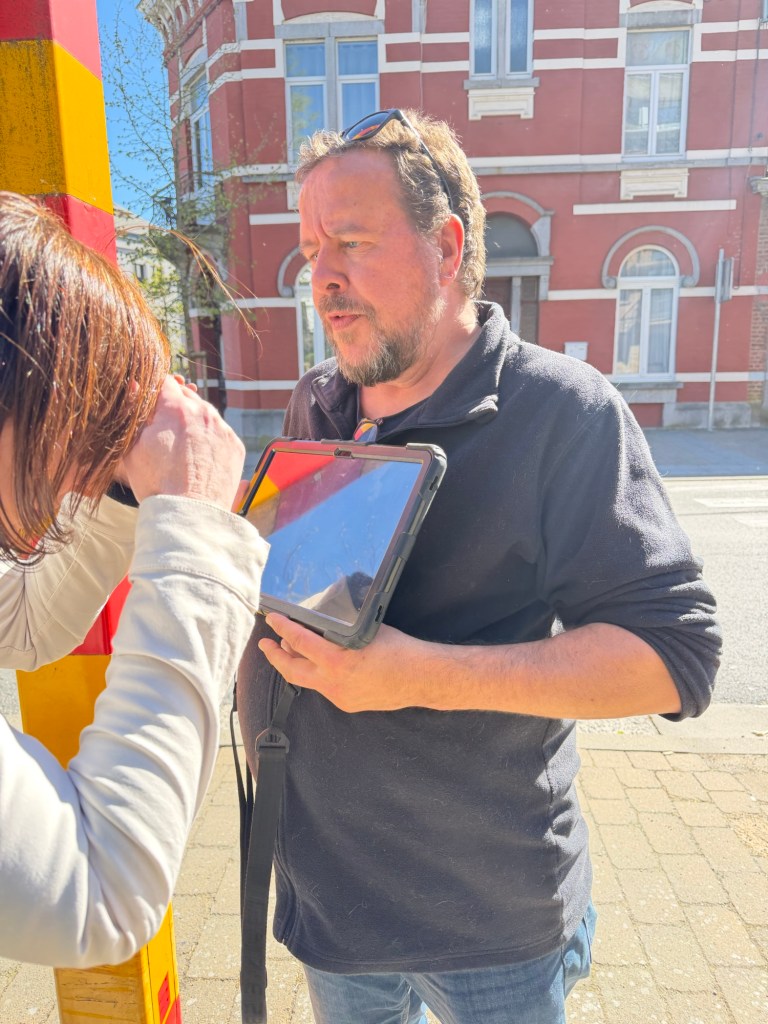
St. Vith — a small Ardennes town whose quiet appearance today gives little indication of the immense strategic importance it once held. Before the war, St. Vith was one of the most important railway junctions in eastern Belgium, linking lines running toward Germany, Luxembourg, and deeper into Belgium. The old station building still stands today as a museum, but in December 1944 it sat at the center of one of the last great offensives of the war.
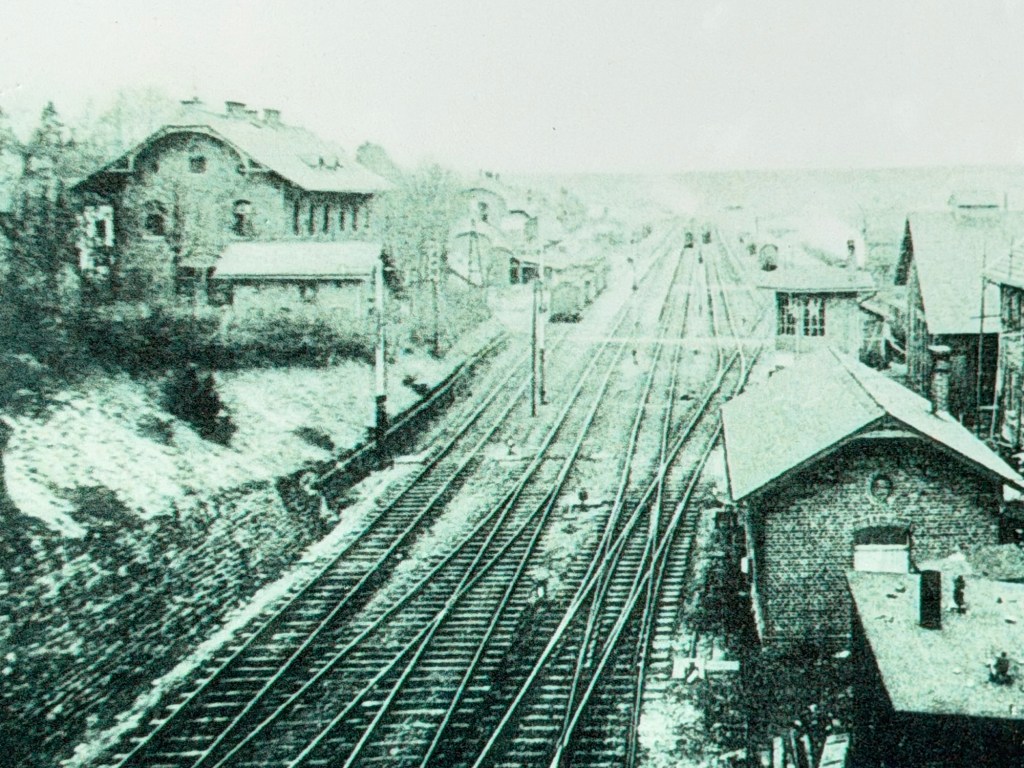
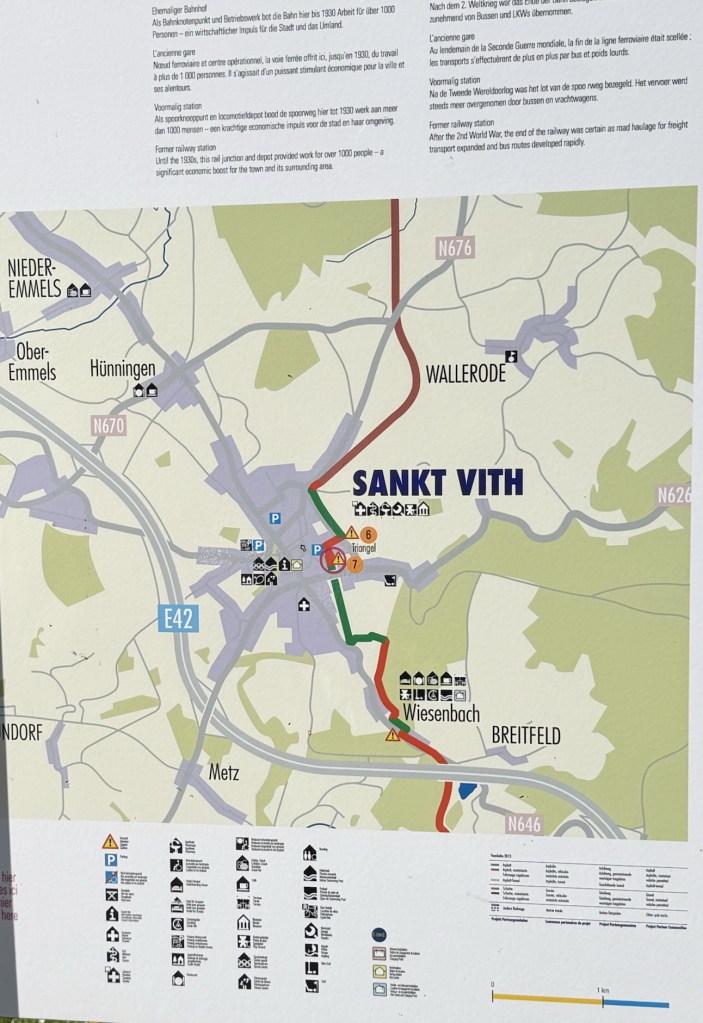
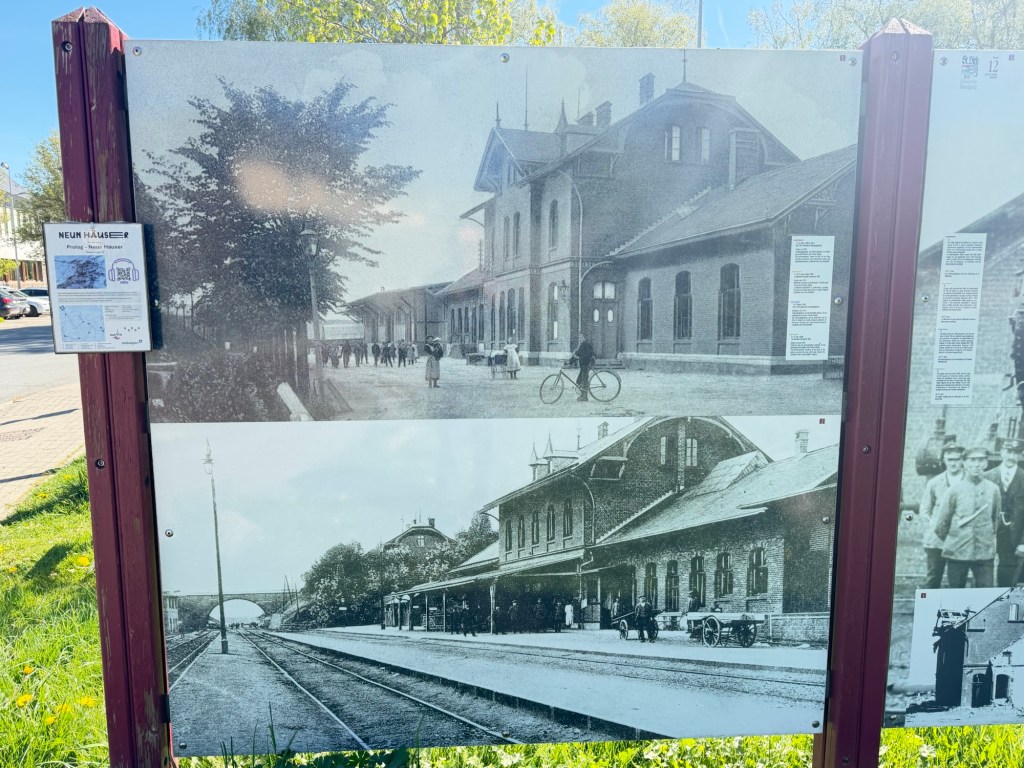
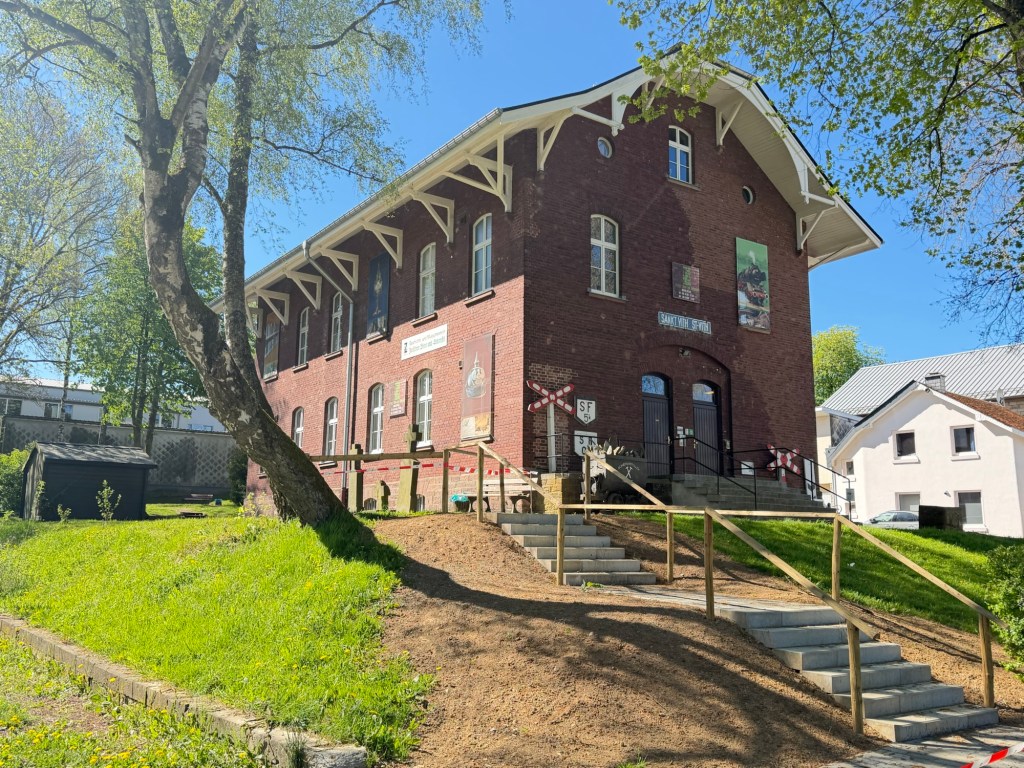
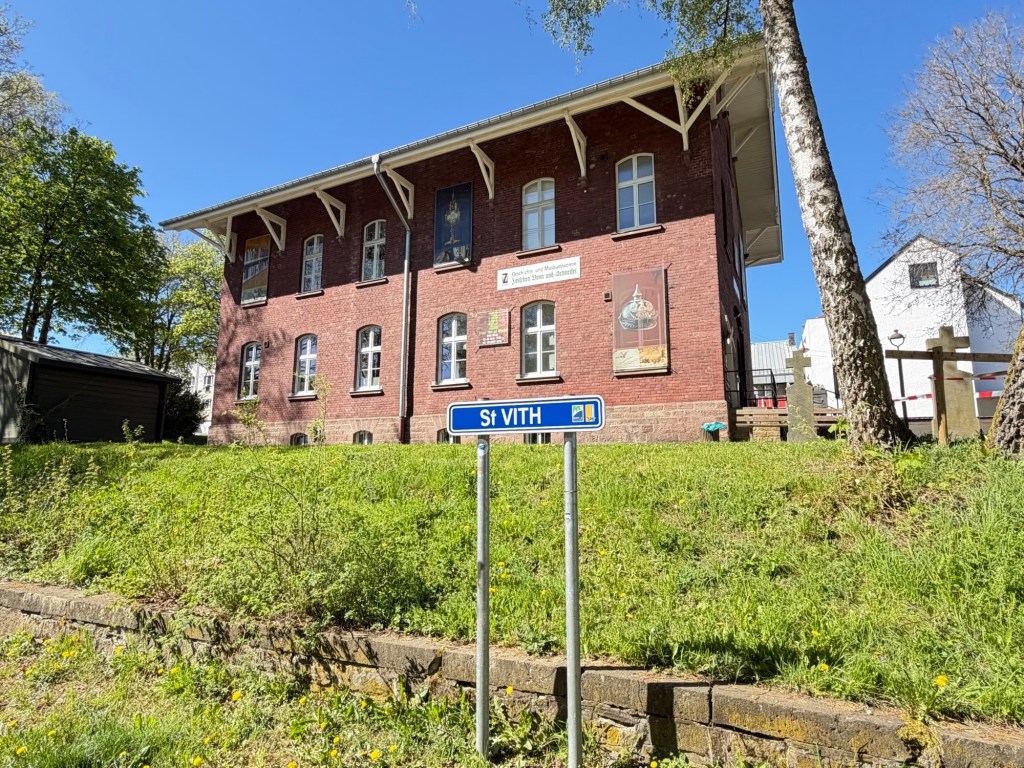
Standing beside the old station, Bob began introducing us to the intricate details of the Battle of the Bulge, Hitler’s desperate gamble in the winter of 1944 and the vast brutal machinery of the Nazi war effort that still consumed Europe even as Germany was already losing the war. Hitler believed that one massive surprise offensive through the Ardennes could split the Allied armies, seize Antwerp and Brussels and force the western Allies into a negotiated peace. After all, he’d already used this route in 1940.
It was a plan built on fanaticism, exhaustion, and denial — demanding impossible speed and sacrifice from an army already running short of fuel, equipment, trained men, and time.
St. Vith became critical because the roads and rail lines converging there. Whoever controlled this junction controlled movement through a large section of the Ardennes. German armored columns needed these routes to maintain momentum westward, and they anticipated taking St. Vith in one day. The Americans understood that too, and the stubborn resistance here — including from elements of the 106th Infantry Division of which Herb was a part— disrupted German timetables at precisely the moment speed mattered most. The Germans did not take St. Vith in one day. The 106th held out while the town and its surrounds were completely obliterated.
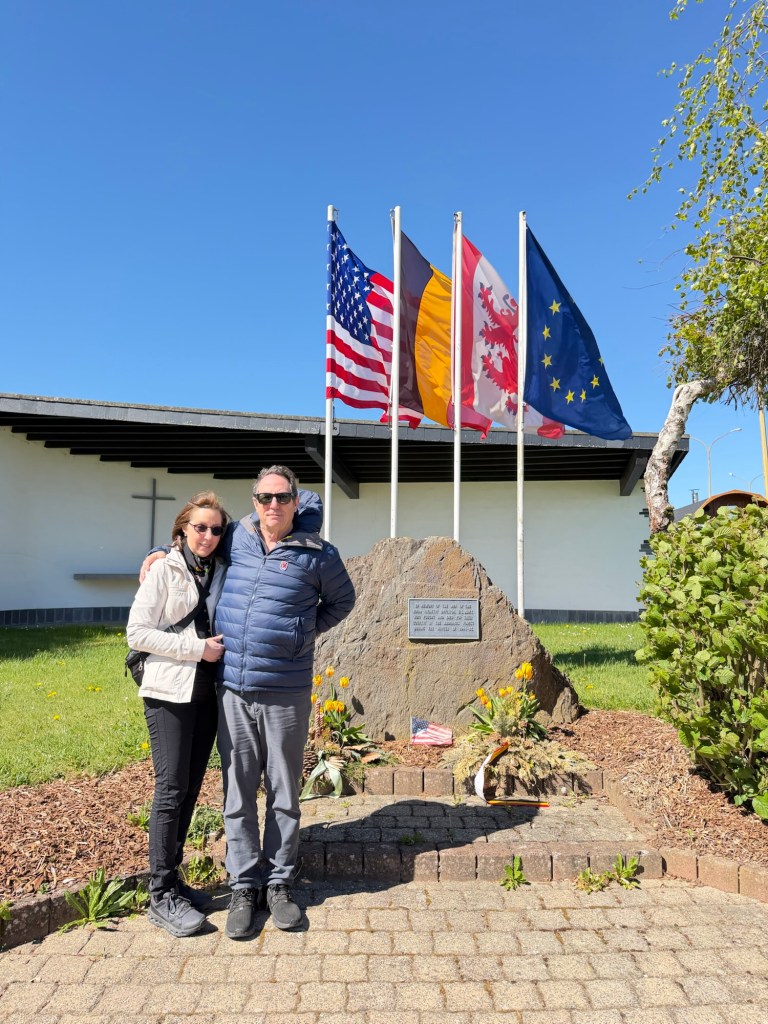
As Bob spoke, the town itself became part of the lesson. The preserved station, wartime photographs, memorials, and surviving rail corridor transformed abstract history into something tangible. Standing before a memorial honoring the American dead and the liberation of the region, it became impossible not to think about the fact that Herb himself had passed through this landscape with the 106th Infantry during those terrible days in December 1944. The roads, rail lines, and hills around St. Vith were no longer distant history to us. They were part of his final journey.
What struck us most was the contrast. On this beautiful spring day, St. Vith felt calm, orderly, and almost gentle. Yet eighty years earlier in the dead of a punishing winter, this same place had been consumed by artillery, fire, retreating troops, refugees, and fear. The silence of the town today somehow made the scale of what happened there even harder to comprehend.
Hill 504
Before our trip, my wife Beth had shared the information she uncovered about Herb with Tom from Brilliant Ideas, the company that arranged our trip to Belgium. That information eventually made its way to Bob, and he and Beth soon found themselves speaking in a kind of shorthand about Hill 504 and surrounding areas in the Ardennes — the place where we were headed.
Bob told us he had taken the information Beth had shared and combined it with his own research, including battlefield maps, unit positions, and wartime accounts, and that he was pretty sure he had found the “spot.” By then, we understood exactly what he meant: the place where Herb had been killed, during the chaotic opening days of the battle in December 1944. After a short drive down some lonely roads we arrived at the “spot”. The German border was just a short distance away, perhaps as close as several hundred yards.
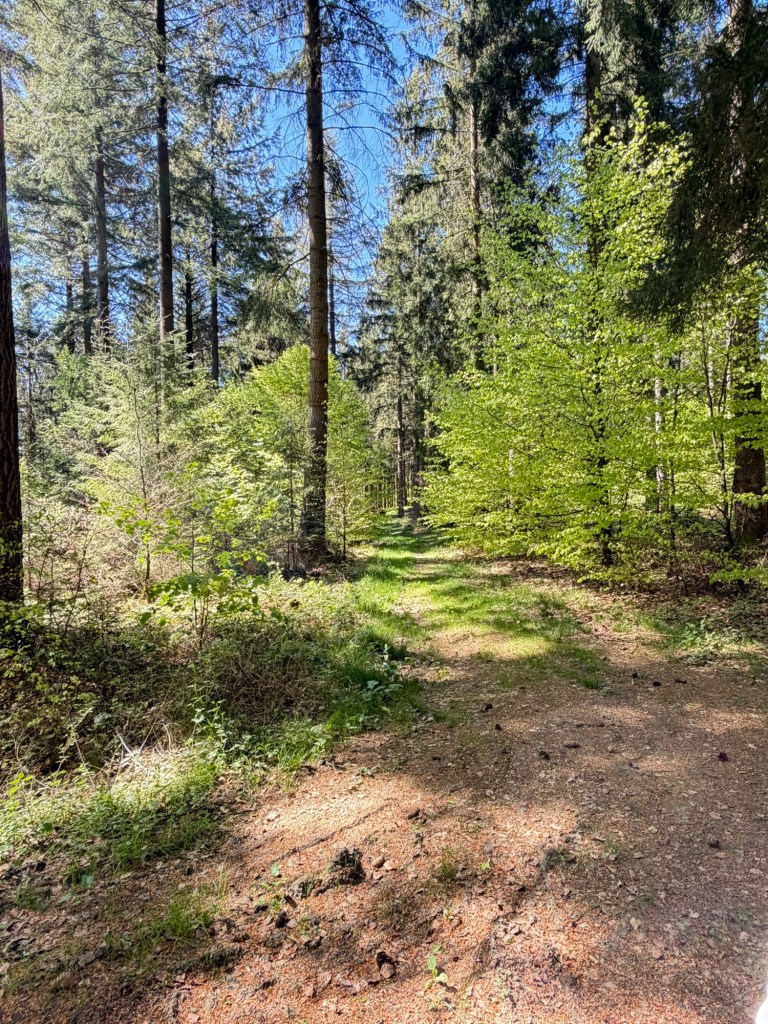
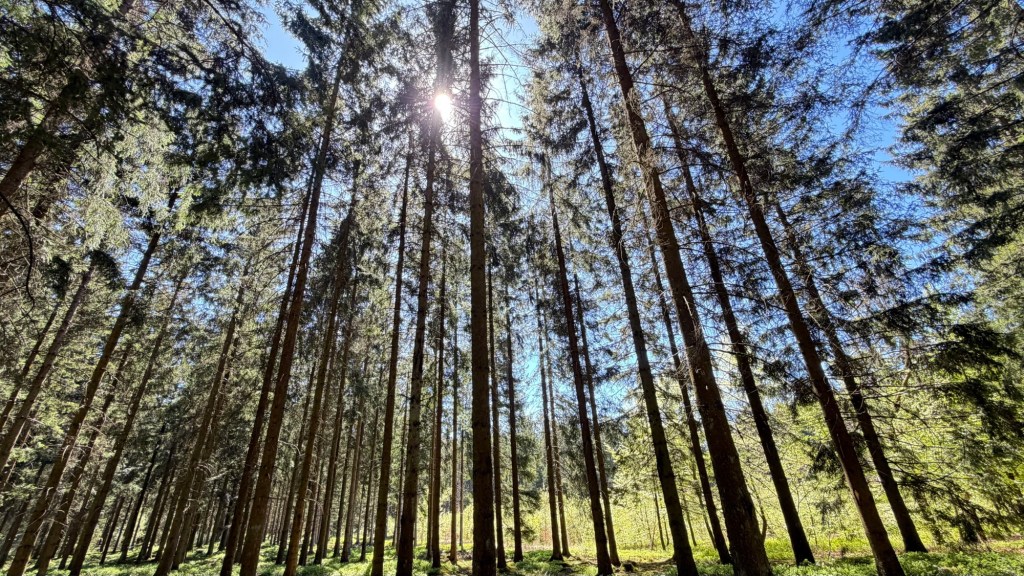
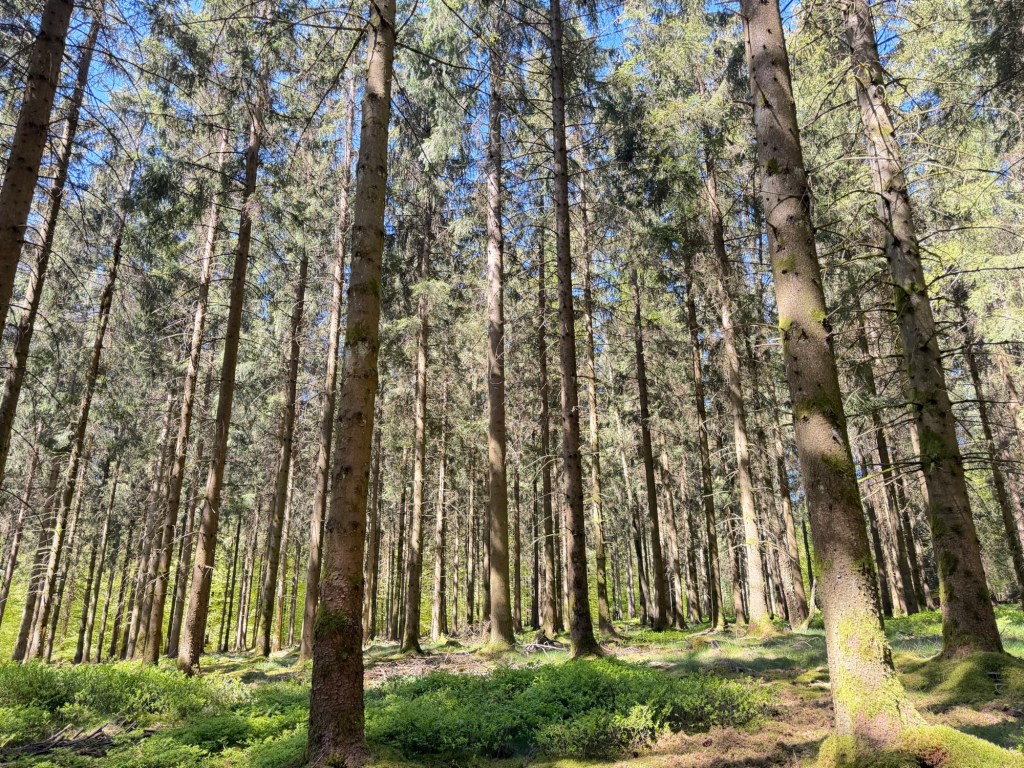
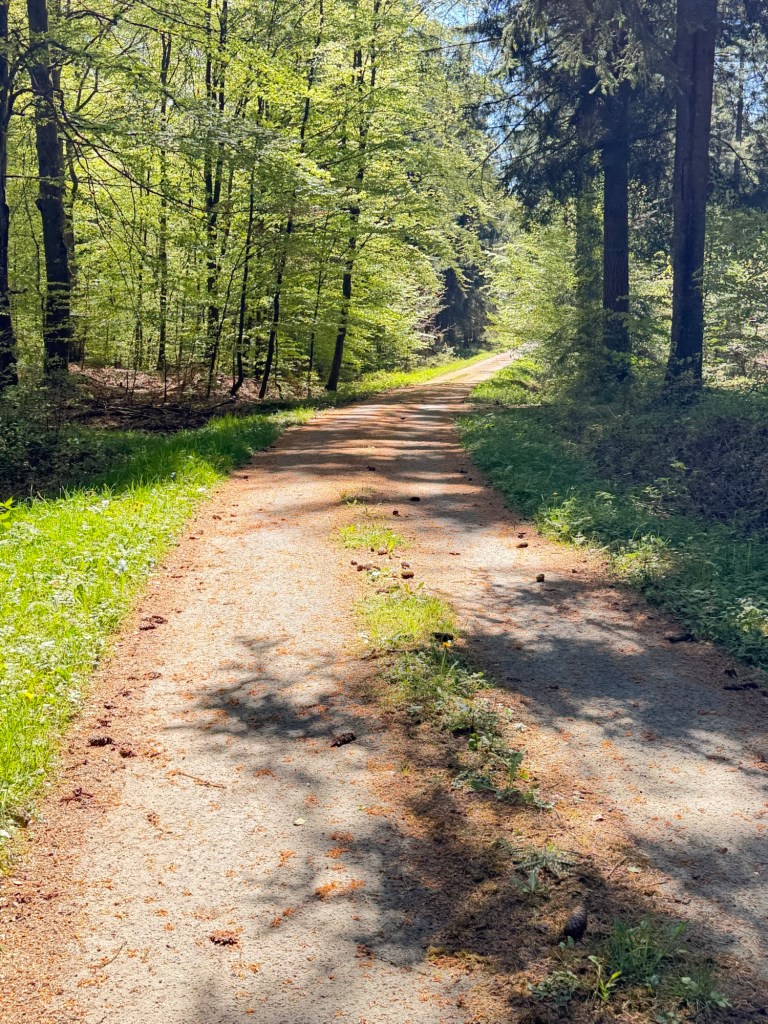
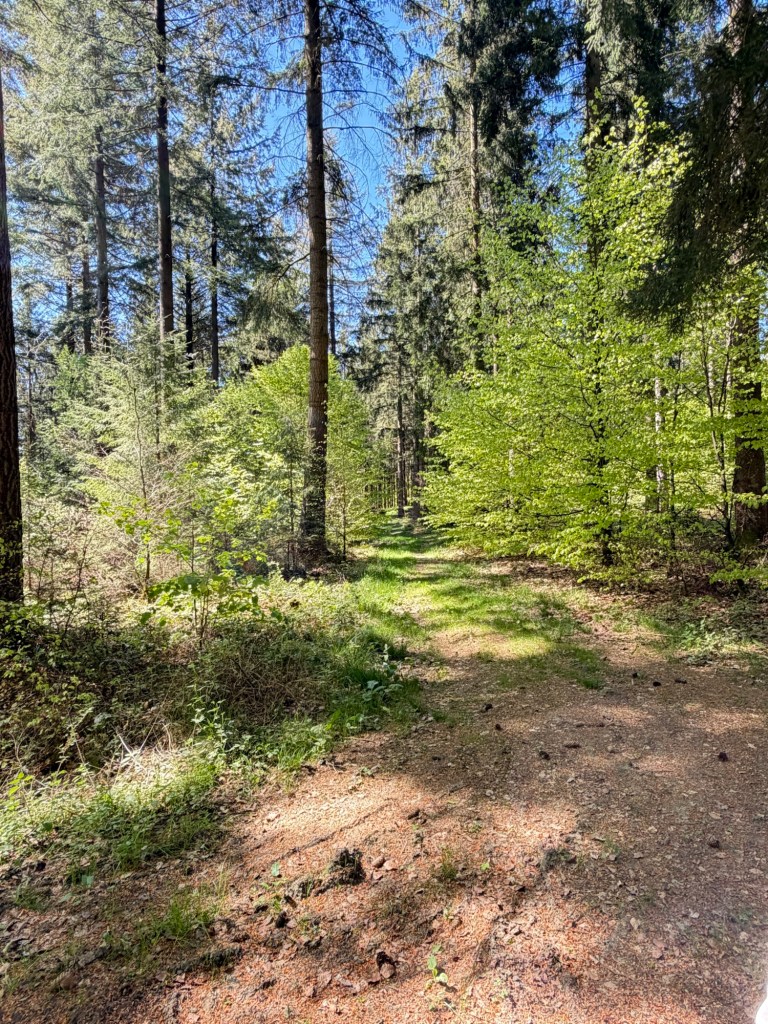
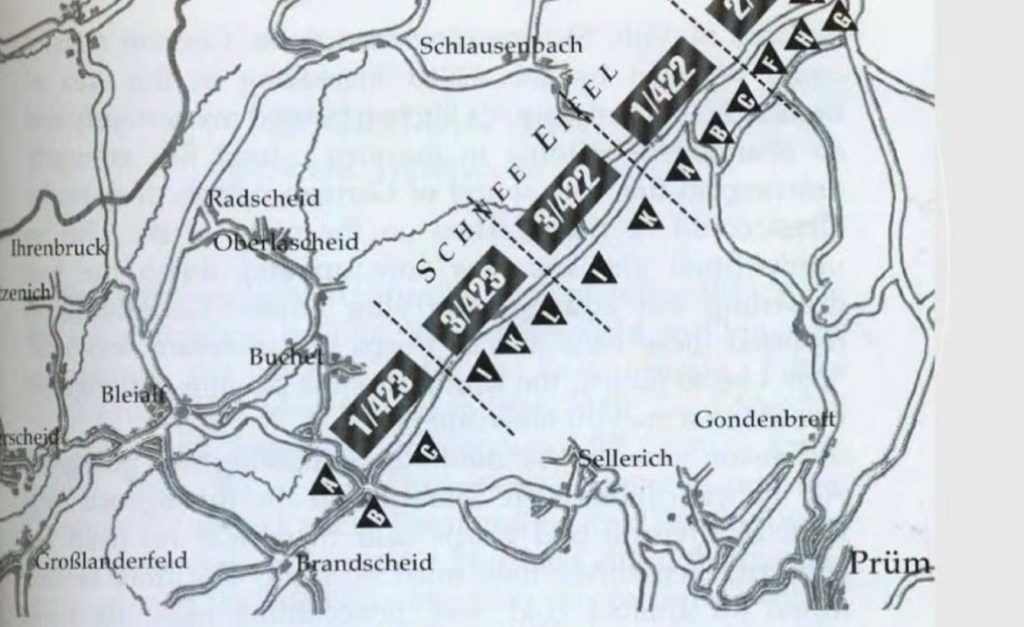
It is difficult to reconcile how such a calm and peaceful place could once have been the end point of Herb’s 21 year life, possibly at the exact location we were standing.
Today the hills are quiet, the forests serene, and the villages almost impossibly tranquil. Yet beneath that stillness lies the memory of one of the bloodiest battles fought by American forces in World War II — and the realization that, for Herb and thousands of others, these peaceful fields were once a landscape of fear, confusion, exhaustion, and death. Even now, the land still bears witness: foxholes remain in the woods, and the artifacts of war continue to surface from the soil.
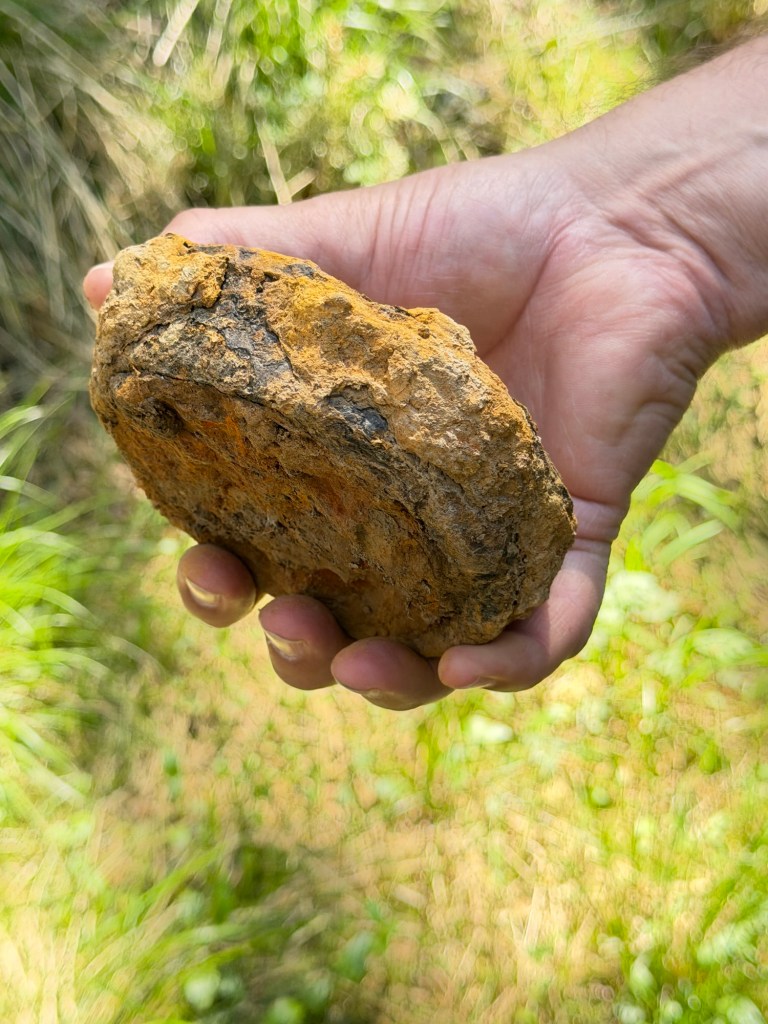
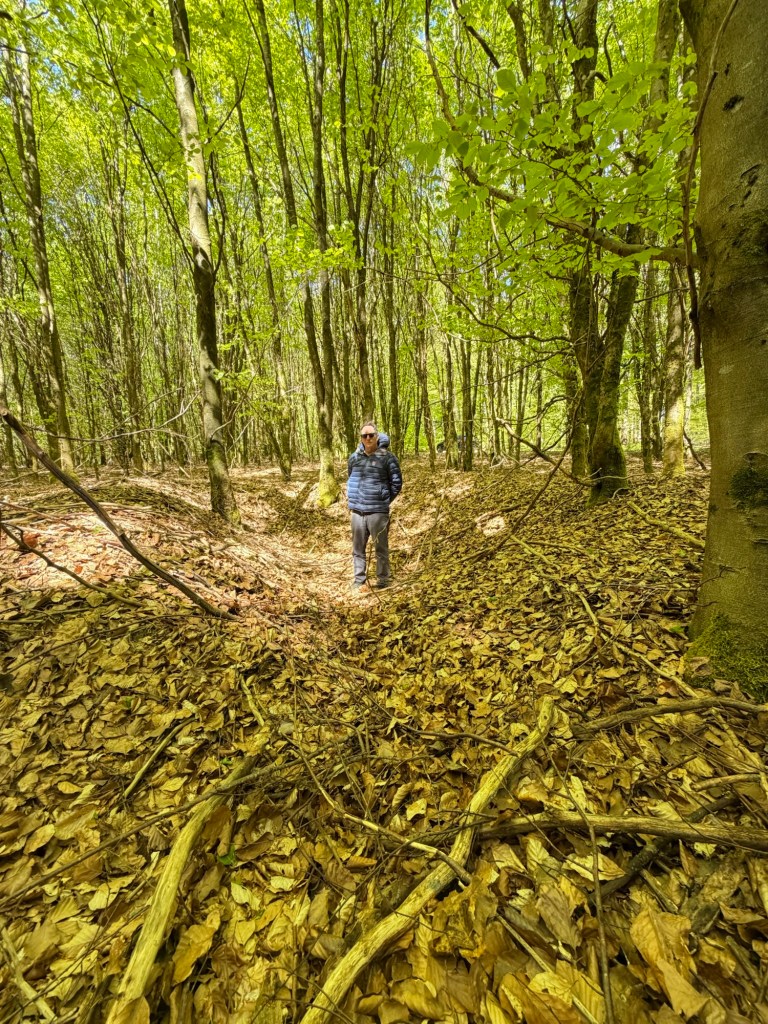
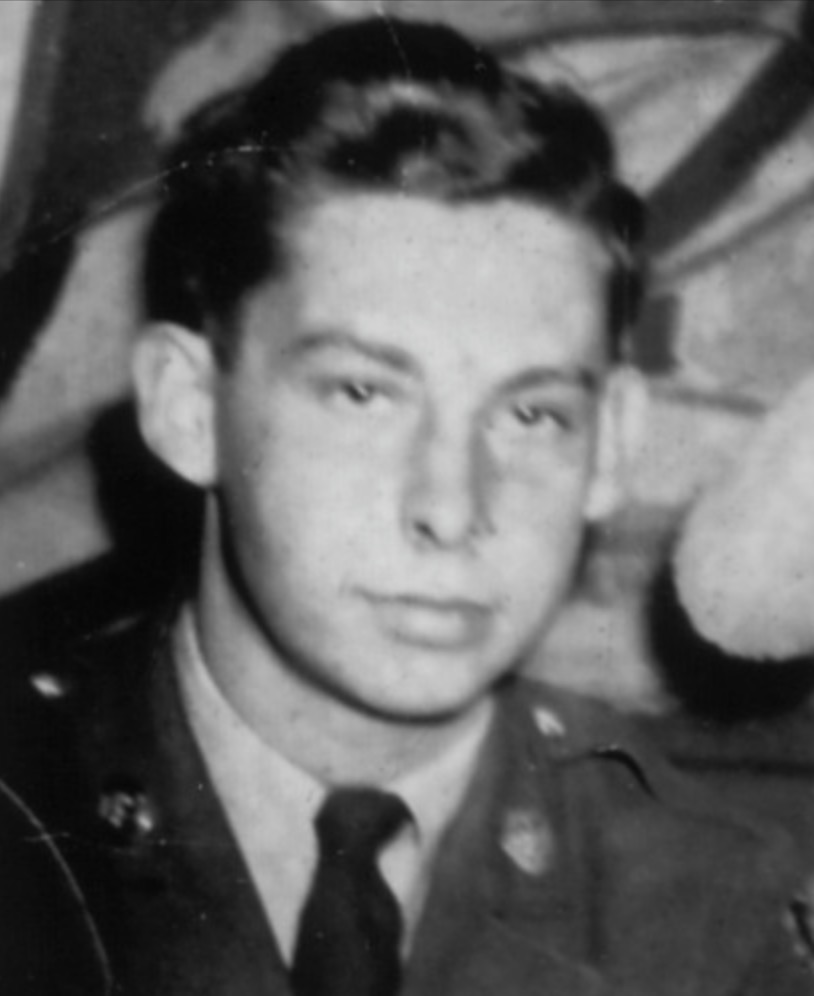
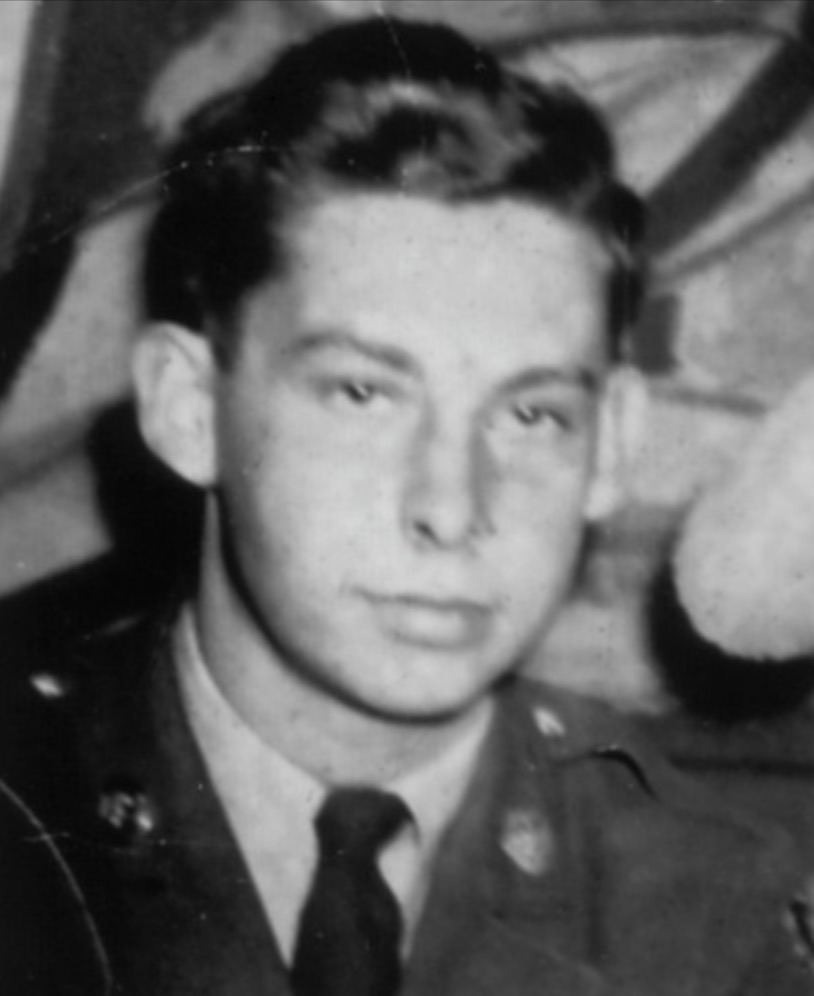
Herb Rubenstein was born in Wilmington, Delaware, on September 22, 1923 to Morris and Mary Rubenstein. He was the youngest of five children, including my wife’s grandfather, Harry.
Few details of Herb’s life prior to 1944 are known or publicly available. He graduated from Pierre S. duPont High School in Wilmington and later enrolled at the University of Delaware as a member of the Class of 1945. While there, Herb worked on the Blue Hen yearbook as an associate editor, and appeared in a 1942 student production of A Midsummer Night’s Dream with the E-52 theater group. He was also a member of the Sigma Tau Phi fraternity. Herb temporarily worked at the Bethlehem Steel plant in Wilmington while continuing his studies.
Herb enlisted in the Army on December 12, 1942, volunteering for the Enlisted Reserve Corps, while still attending the University of Delaware. He was called to active duty and headed off to boot camp on June 8, 1943, when he was sent south for infantry basic training at Camp Wolters, Texas. After training stops in South Carolina, Tennasee, Kentucky, Indiana and Massachusetts, Herb became a medic attached to the 106th Infantry, 423 Regiment, L Company.
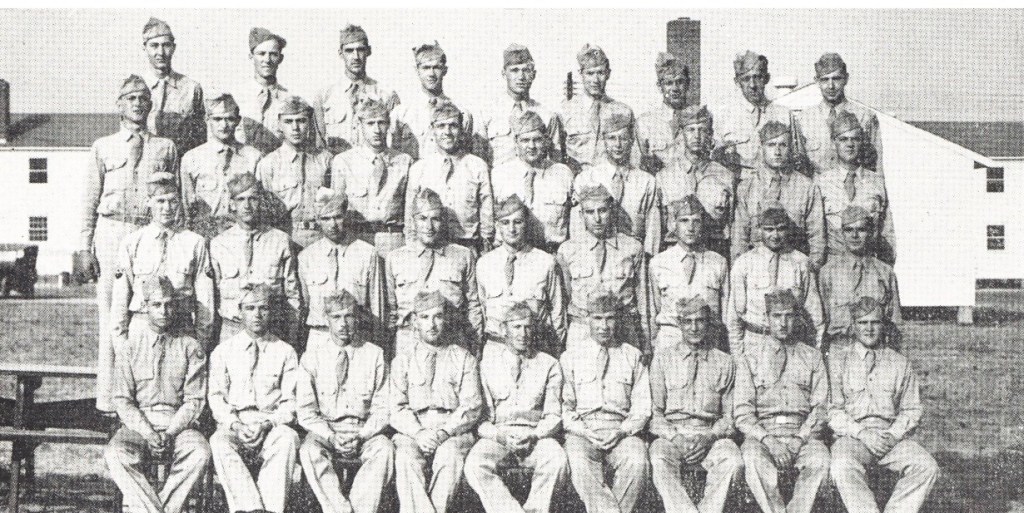
Herb then deployed overseas with the 106th Infantry Division. Like thousands of American troops heading to the European Theater, he crossed the Atlantic aboard the famed RMS Queen Elizabeth, which had been converted into a massive troopship during the war. The ship carried American soldiers to England at high speed and without escort, relying on its size and speed to avoid German U-boats.
The 106th — nicknamed the “Golden Lions” — was one of the last American infantry divisions to arrive in Europe. The division had trained in the United States and had never before seen combat. Compounding matters, many of its most experienced officers and enlisted men had been “plucked” away before deployment and reassigned as replacements to veteran units already fighting in Europe after the heavy losses suffered following the Normandy invasion. As a result, the division that eventually entered Belgium in late 1944 was, in many respects, a weakened and partially rebuilt force made up largely of young and inexperienced soldiers, many facing combat for the first time.
Once in England, Herb and the 423rd Infantry Regiment of the 106th continued final preparations before crossing into continental Europe. Between December 9 and December 11, 1944, the division moved into the Ardennes region of Belgium, officially relieving battle-worn veteran units along what Allied commanders believed was a relatively “quiet” sector of the front on December 11 and 12.
Herb was positioned with the 423rd, Company L, near the village of Schonberg, along the Schnee Eifel (snow mountain) sector of the Ardennes front.
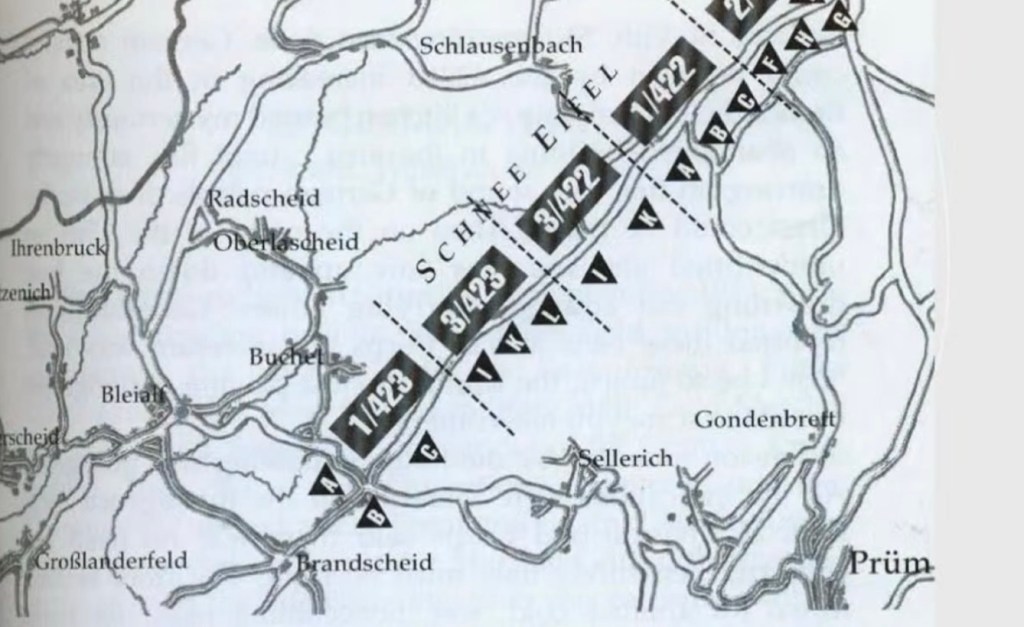
Only four days later, on December 16, the Germans launched the massive surprise offensive that became known as the Battle of the Bulge. What had been expected to be a quiet sector suddenly became one of the most heavily attacked areas during the opening days of the battle.
One of the most haunting moments of the Battle of the Bulge may have come down to a broken phone connection on the night of December 16, 1944.
As the German offensive erupted across the Ardennes, that night Major General Alan W. Jones of the 106th Infantry Division grew increasingly concerned about the exposed position of the 422nd and 423rd Infantry Regiments in the Schnee Eifel east of St. Vith.
German forces were already beginning to push around both flanks toward Schoenberg, threatening to trap thousands of American soldiers.
On December 17th, Jones called his superior, Major General Troy Middleton of VIII Corps, and asked whether he should “call them out” — withdraw the regiments before the roads west were cut.
But the battlefield was collapsing into chaos. Telephone lines and communications were unreliable. According to later accounts, portions of the conversation may not have been heard clearly. Middleton reportedly believed he had approved withdrawal. Jones came away believing he was still expected to hold the line.
That misunderstanding may have changed the fate of thousands of men.
By the next day, German armor had already cut key escape routes through Schoenberg. A noose was tightening around the 422nd and 423rd.
Weather in the Ardennes was also cold, wet, and unforgiving. Snow and freezing fog blanketed the forests around St. Vith and Hill 504. The skies were dark and overcast, roads turned to mud and ice, and visibility was often reduced to only a few yards. Foxholes filled with freezing water. Men fought exhaustion, frostbite, hunger, and terror alongside the enemy itself.
Earlier that morning on the 19th, Herb encountered another soldier, Technician 3rd Grade Gayle Wingate. Years later, Wingate recalled that Herb asked him if he knew where Company L was, as he had become separated from it. Wingate told him he did not — “things were very confused at that time.”
The German offensive had shattered the front. Units were scattered, communications had collapsed, and small groups of exhausted American soldiers were trying to find one another while surrounded by enemy forces.
A few hours later, Herb was seen again moving cautiously near the edge of an open field with another medic, Technician 5th Grade Ritchie. Ritchie later recalled that Herb was waving a white cloth and shouting for the Americans ahead not to fire because “all hell has broken loose up ahead.” The men believed they were still among friendly forces, but visibility was poor because of the trees, brush, and knee-high grass.
What they did not know was that a German soldier was concealed in the grass ahead.
According to later recollections, Herb unknowingly stumbled upon or “kicked up” the hidden German position. The German soldier suddenly rose and opened fire with an automatic weapon, shooting Herb.
Lieutenant Dr. Herbert Blackburn rushed from cover to help him, reportedly shouting that a soldier “couldn’t shoot a medic.” (Under the laws of war, soldiers were prohibited from intentionally targeting enemy medical personnel.) The German solidier then turned his weapon on Blackburn, mortally wounding him as well.
Another American soldier immediately killed the German.
Wingate rushed to Herb’s side and later wrote about what he found. Herb was still alive but barely conscious. His right hand had been badly mangled, and he had suffered a devastating gunshot wound to his back near the kidney. Wingate administered morphine, tried desperately to stop the bleeding, and stayed with him as he died.
“Within ten minutes Herb was dead,” Wingate later wrote. “He didn’t struggle or show signs of pain… He just passed away very quietly.”
Only hours later, with ammunition exhausted and completely surrounded, most of the men of the 423rd Infantry Regiment surrendered. It became one of the largest mass surrenders of American troops in the European Theater during World War II (or anywhere). Nearly 7,000 American soldiers went into captivity as prisoners of war.
Yet their resistance around St. Vith had delayed Hitler’s timetable during the Battle of the Bulge, buying precious time for Allied reinforcements to arrive.
Many of the captured Americans from the 422nd and 423rd Infantry Regiments endured months of brutal captivity in German prisoner-of-war camps. Exhausted, hungry, and already weakened by the freezing conditions of the Ardennes, they were marched eastward in bitter winter weather with little food, inadequate clothing, and almost no medical care. Some died during the marches or shortly after arriving at the camps from exposure, disease, malnutrition, or wounds.
Standing in those same peaceful woods in Belgium with historian Bob Konings, it was almost impossible to comprehend that this quiet landscape had once been the scene of such violence, fear, confusion, and sacrifice — and the final moments of a 21-year-old medic from Wilmington, Delaware.
The American pragmatist philosopher William James once wrote that for every instance of “monumental” history, there are a series of events surrounding it that gets swept under the rug, but have the same bearing as the bigger occurrence.
The story of the 106th Infantry Division is far less remembered than other chapters of the Battle of the Bulge — perhaps because it is a story marked by confusion, isolation, defeat, and surrender rather than dramatic triumph. Public memory tends to gravitate toward places like Siege of Bastogne, with the famous stand of the 101st Airborne, George S. Patton racing north through the snow, and Brigadier General Anthony McAuliffe answering the German surrender demand with a single word: “Nuts!”
But the men of the 106th fought under catastrophic circumstances. Many were inexperienced, spread thin across difficult terrain in the Schnee Eifel, and struck by the full force of Hitler’s surprise offensive. Their story lacks the simplicity of a heroic last stand, yet their resistance delayed German forces at a critical moment and came at an enormous human cost.
For the young men caught in it — including Herb — it was no less courageous, and no less tragic.
Herb was initially buried here, at the Foy American Temporary Cemetery, among thousands of other Americans killed during the Battle of the Bulge.
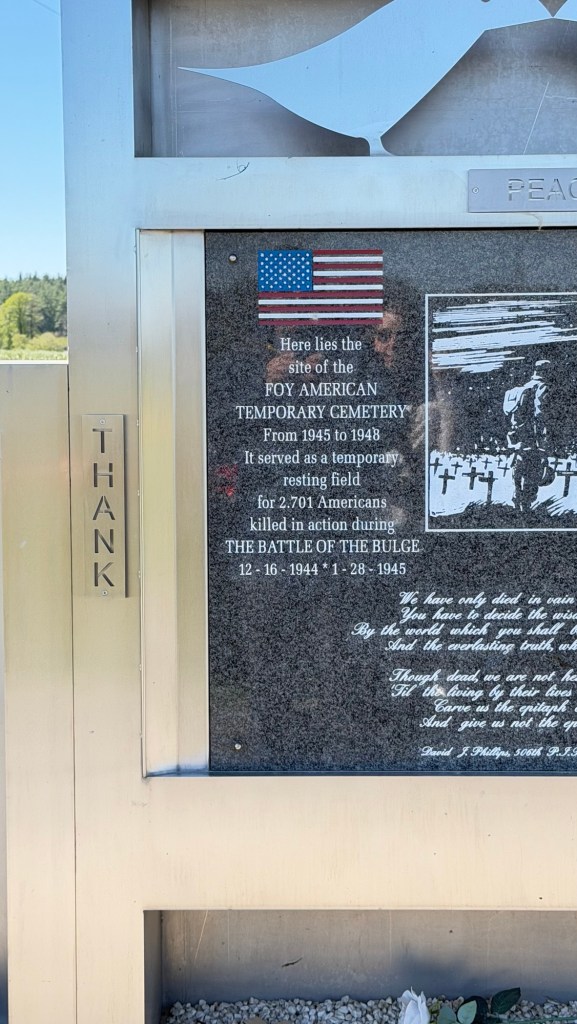
For a time, this quiet Belgian field became Herb’s resting place — far from home, far from family, and far from the city where he had grown up.
After the war, at his family’s request, Herb’s remains were repatriated to Wilmington, Delaware. Herb now rests peacefully in the family cemetery 3860
Miles from Belgium alongside a number of other young soldiers whose lives were cut short by the war.
The history of sacrifice here should never be forgotten.
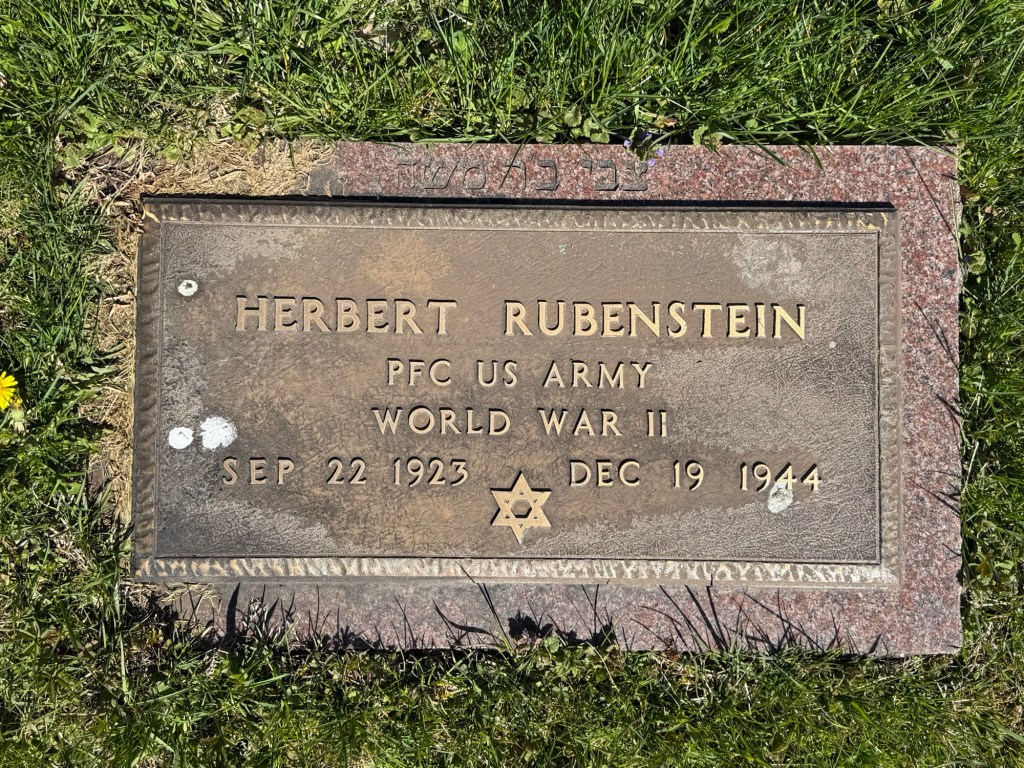
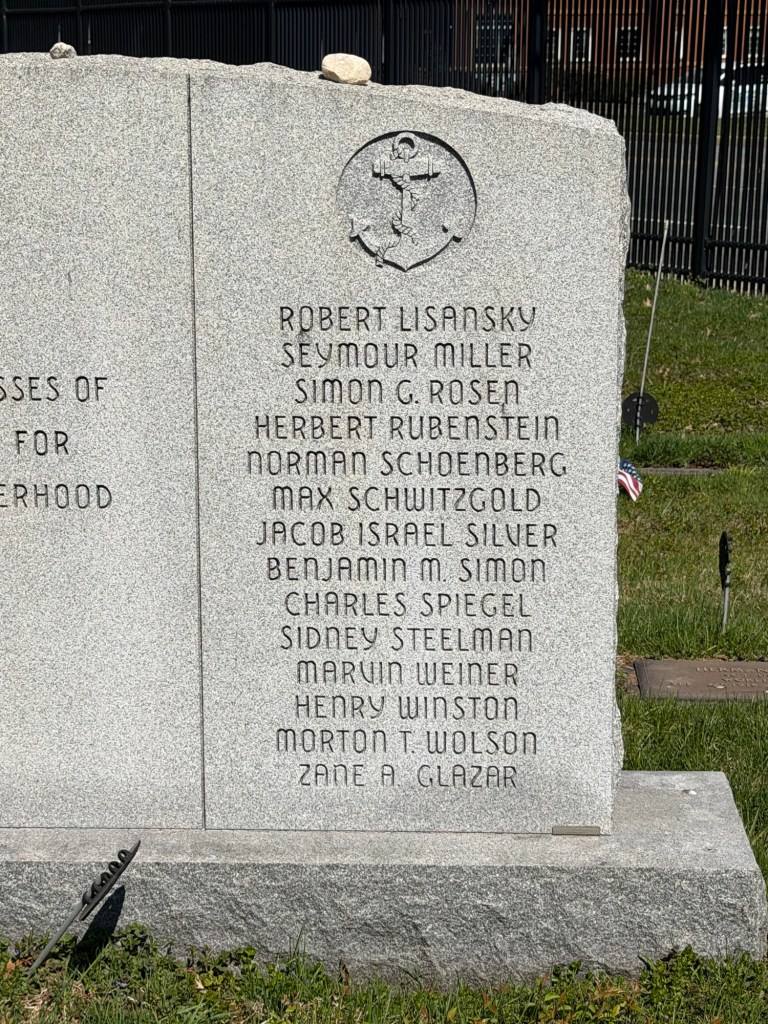
Like so many families, Herb’s endured not only the shock of his loss, but also the long and painful process of waiting through the war’s aftermath before their loved one could be returned to them.
Both of Herb’s parents had come to America in the early 1900s seeking something millions before them had also searched for — a safer, freer, and more hopeful life. They left behind a world where Jews too often lived under the shadow of religious intolerance, entrenched bigotry, and periodic violence that had haunted their families and communities for generations. America represented possibility, stability, and the chance to build a future their children might never have known otherwise.
It is impossible not to think of the cruel irony that their son would later return to Europe in uniform, fighting and ultimately dying on the very continent from which his parents had once fled in search of refuge and peace.
Mardasson War Memorial
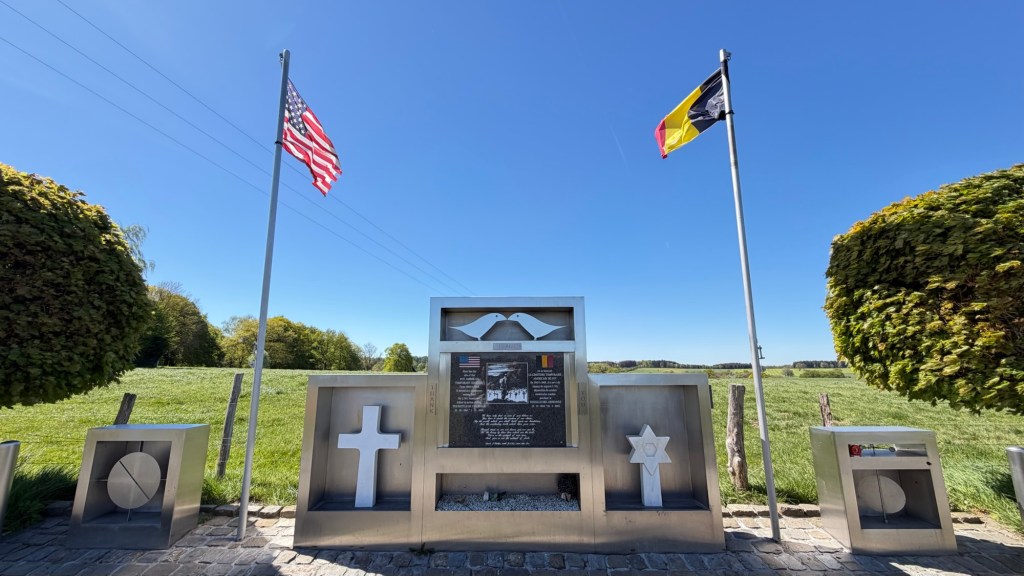
We stopped at the Bastogne War Museum for lunch before continuing on to the nearby Mardasson Memorial, one of the most important memorials to American soldiers in the Battle of the Bulge.
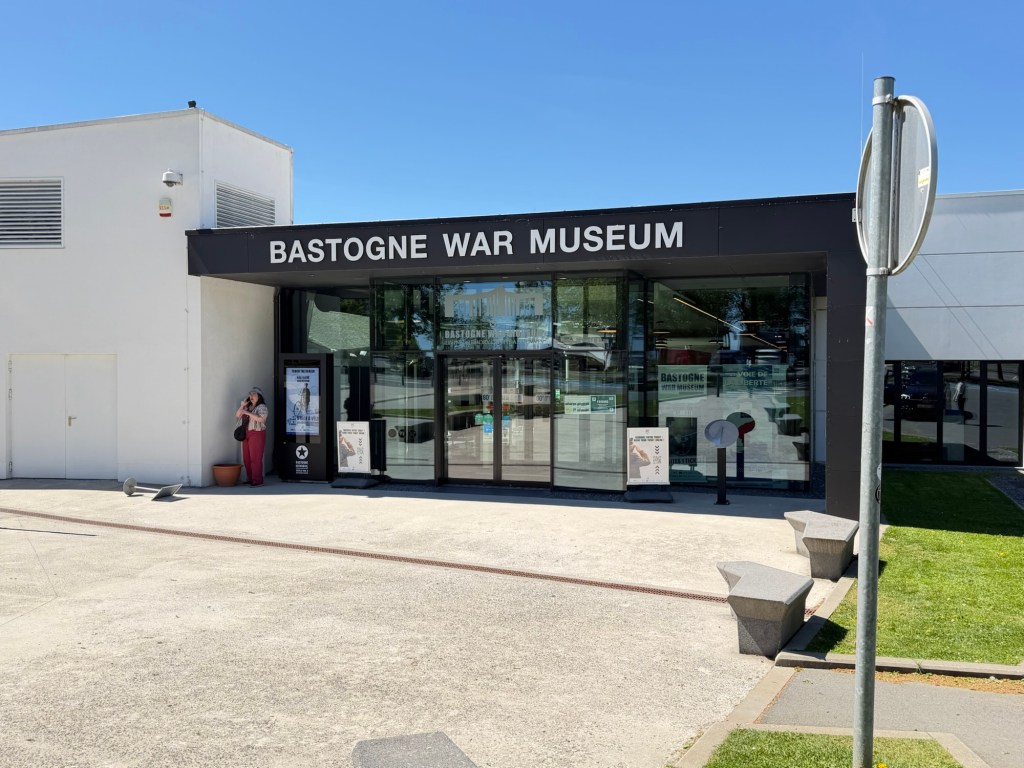
The memorial honors the Americans who fought and died during Hitler’s last major offensive in the West. Carved into the stone are the names of the American states, standing as a reminder that young men from every corner of the United States were drawn into the forests and villages surrounding Bastogne.
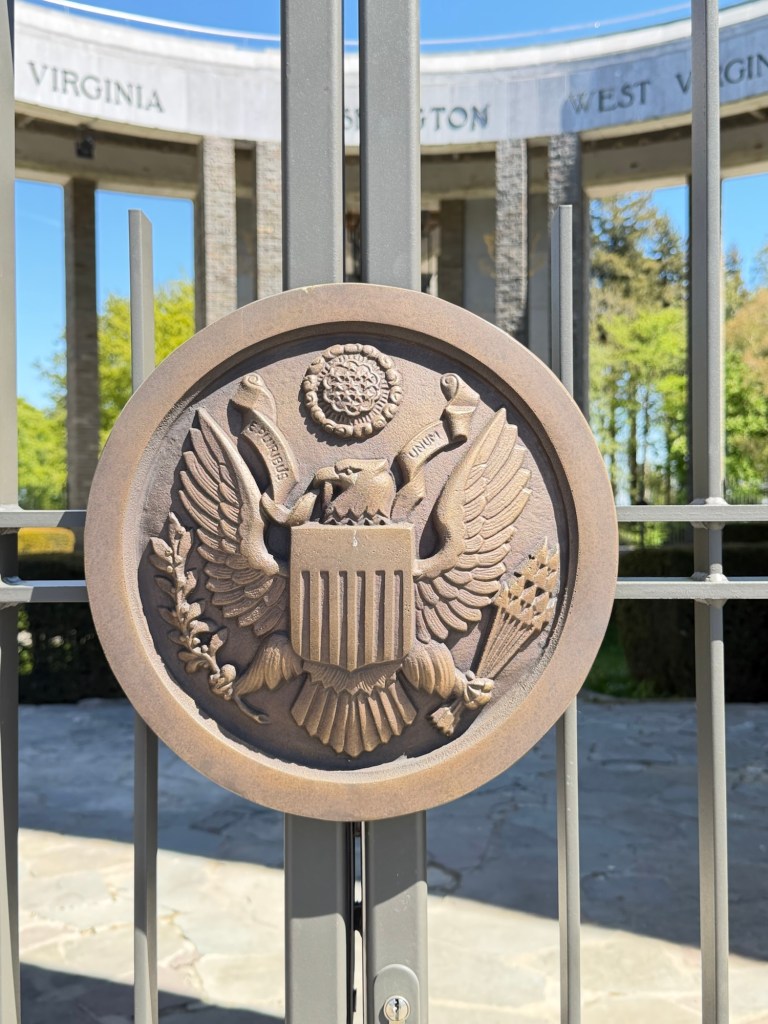
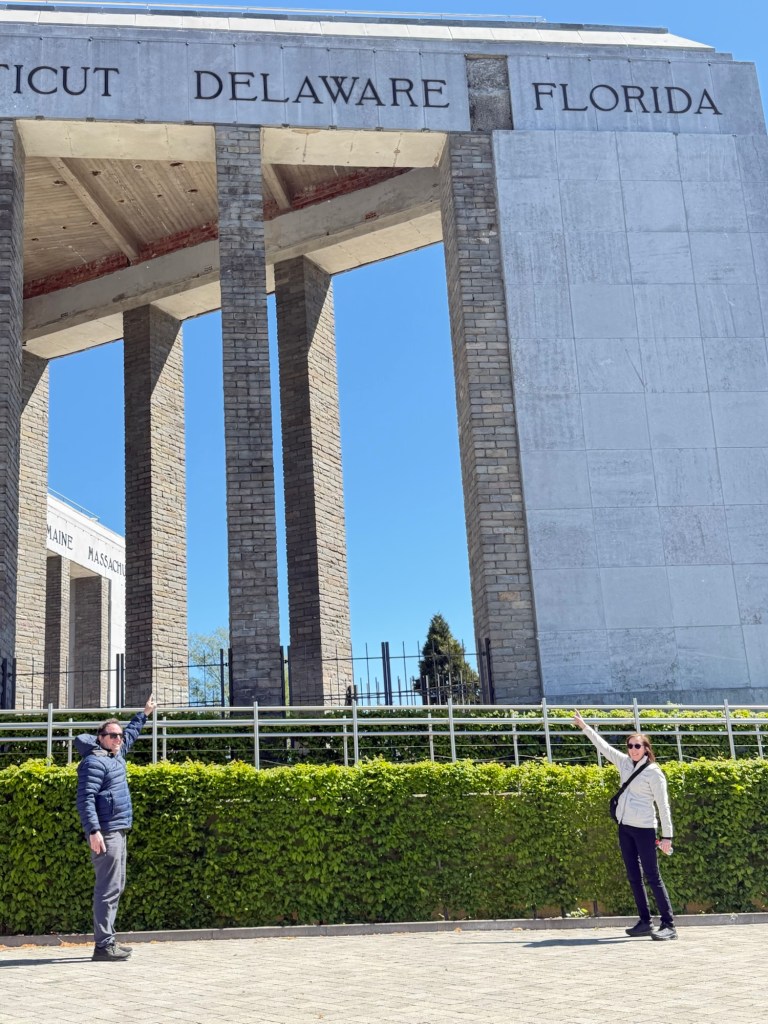
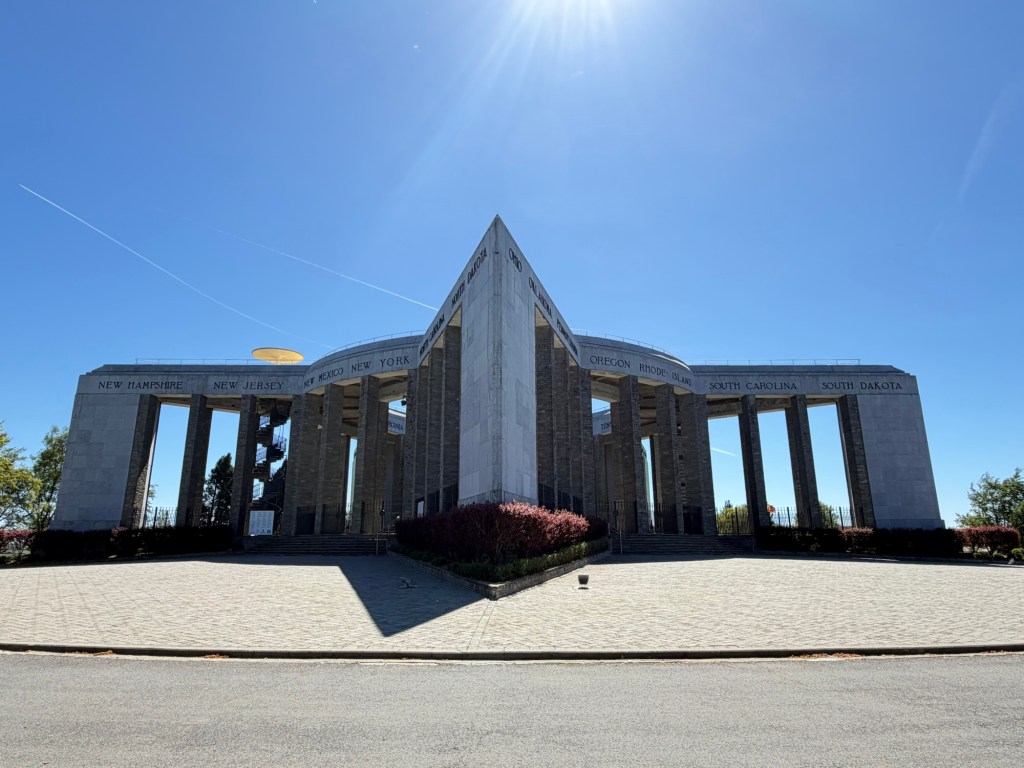
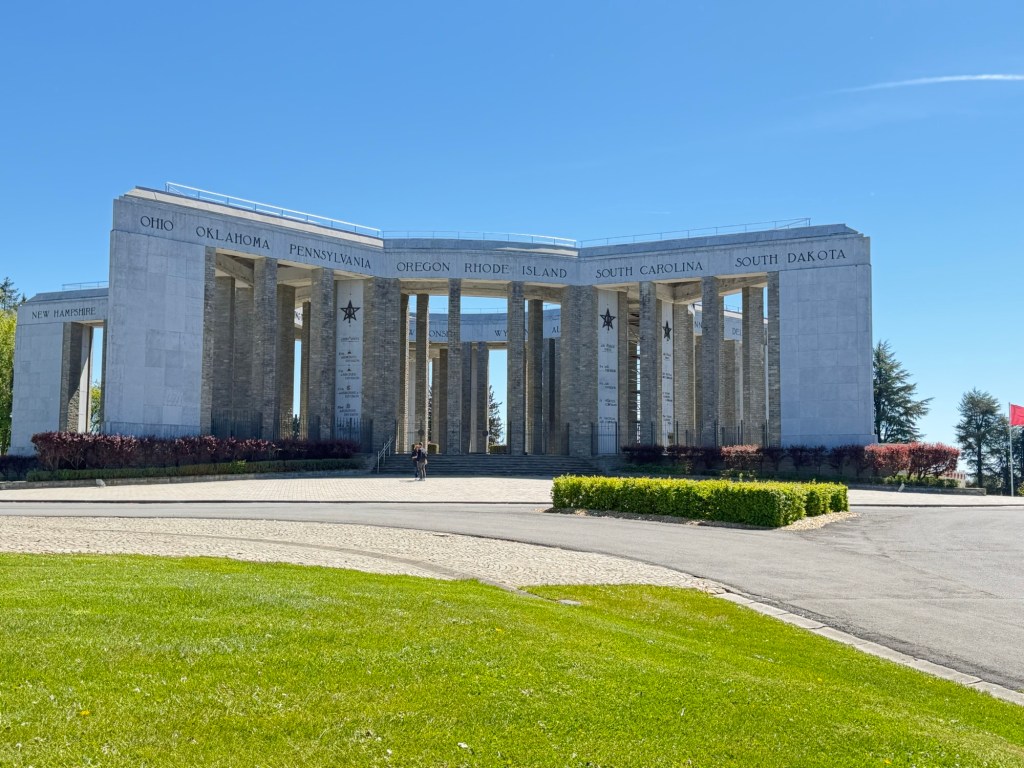
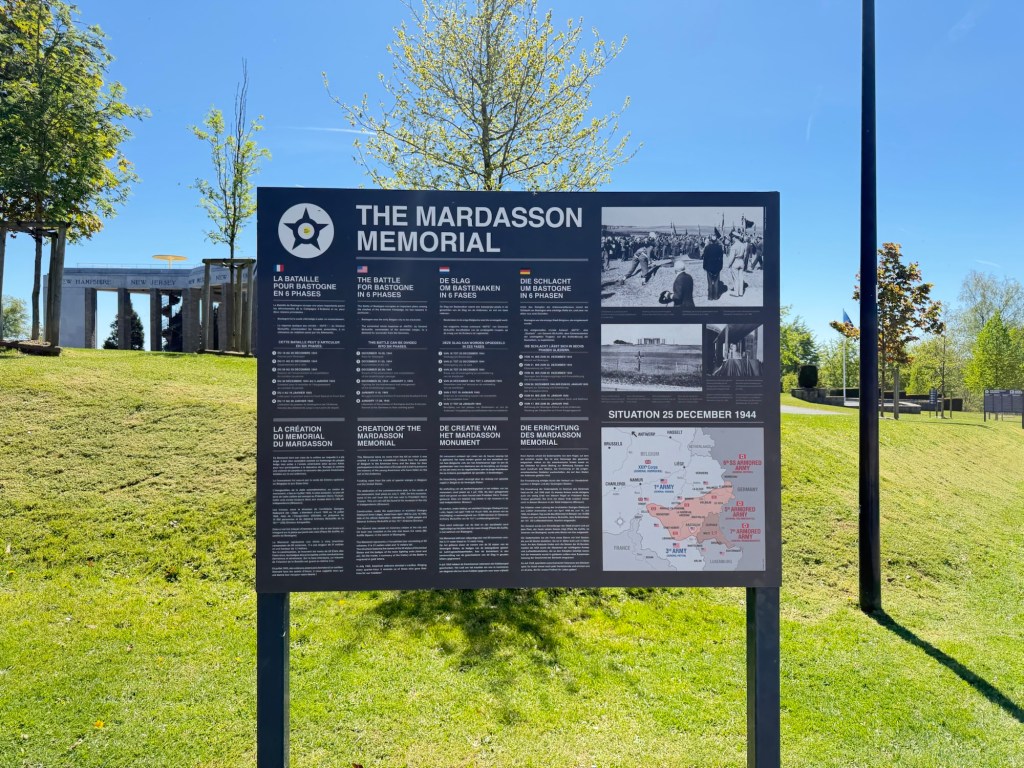
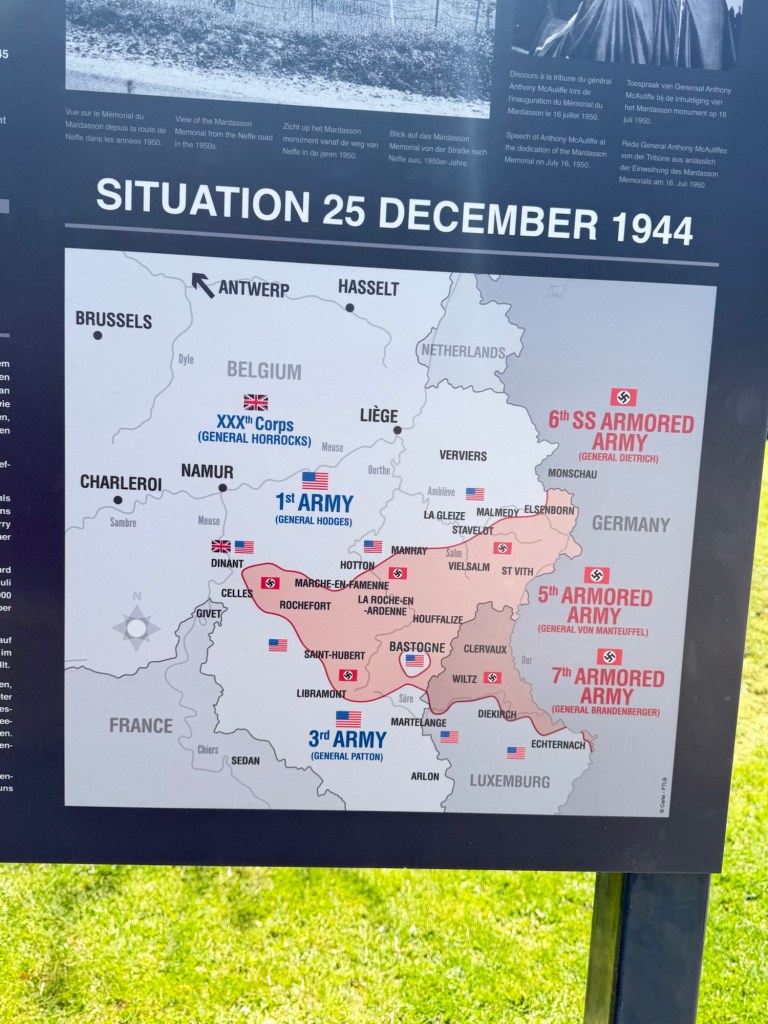
One inscription especially stood out to us: the 106th Infantry Division — the “Golden Lions.” This was Herb’s Regiment.
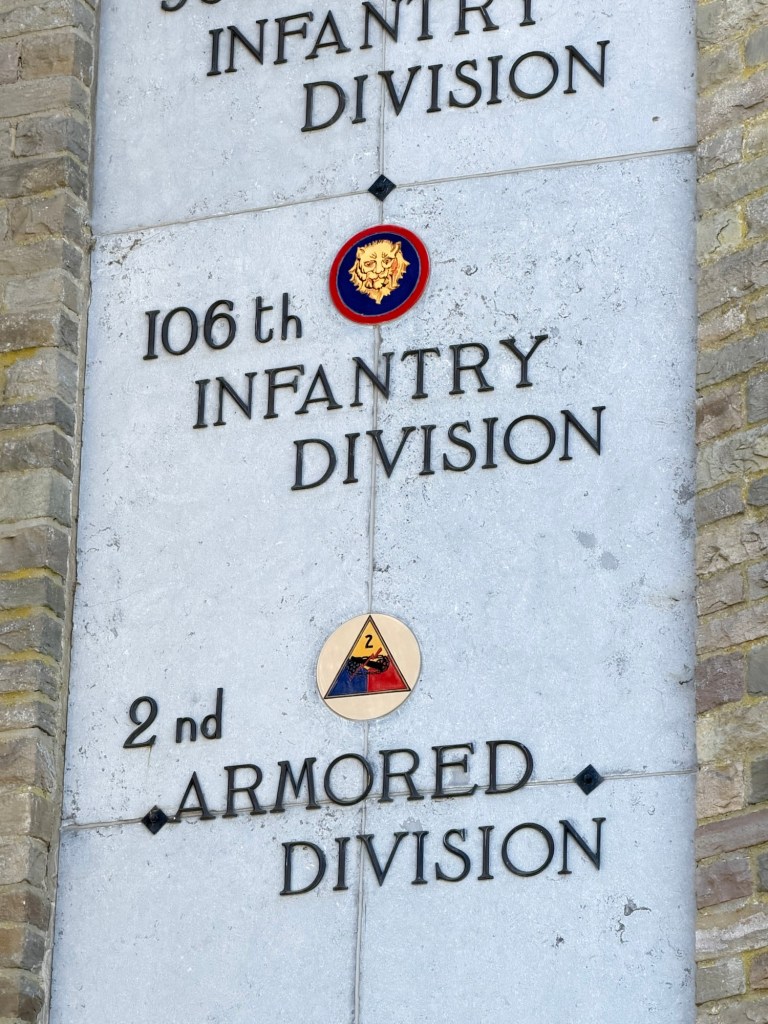
Standing there today, it was difficult not to think about how quickly ordinary lives became part of history.
101st Airtborne
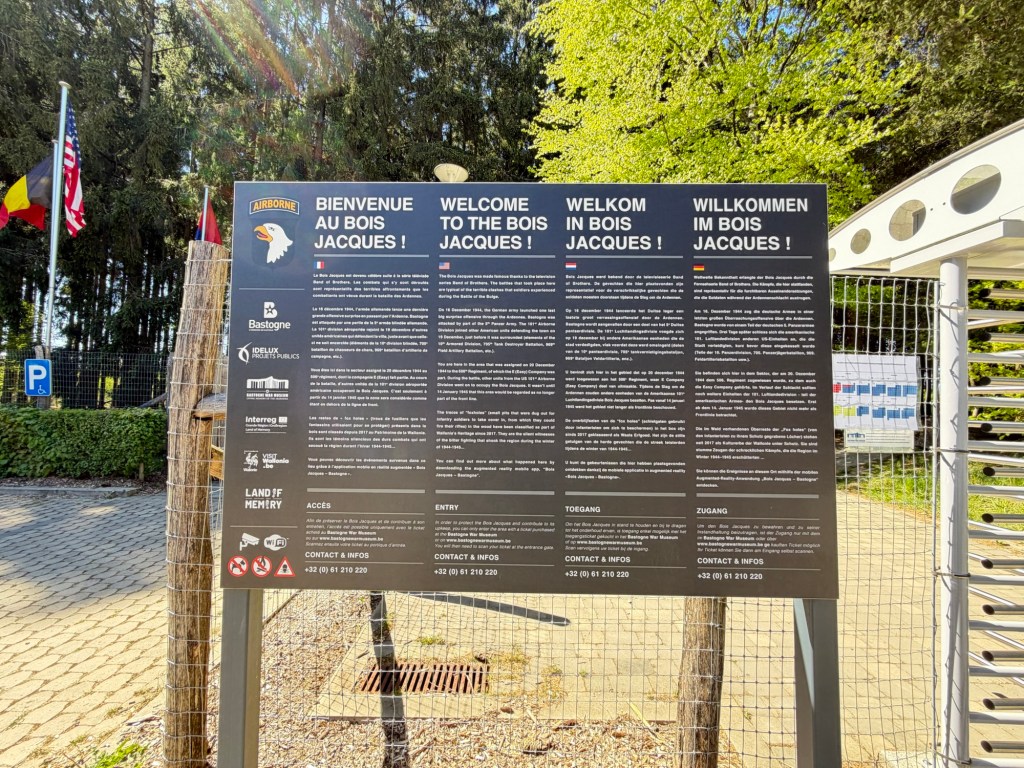
One of the most moving stops of our journey through the Ardennes was a quiet forest memorial dedicated to the men of Company E, 506th Parachute Infantry Regiment, 101st Airborne Division — the unit made famous decades later by Band of Brothers.
It is difficult to imagine today, standing among the tall trees and silence of the Bois Jacques woods, that this peaceful forest was once the scene of brutal winter combat during the Battle of the Bulge. In December 1944, the men of the 101st Airborne Division were rushed into the region to stop the German advance toward Bastogne and the Meuse River.
The fighting here was savage. American paratroopers, many already exhausted from months of combat, dug foxholes into frozen ground and defended the forests and crossroads against repeated German attacks. Snow, fog, bitter cold, artillery fire, and constant uncertainty defined daily life. Supplies often ran short. Medical evacuation was difficult or impossible. Many soldiers fought while half-frozen and sleep-deprived.
The forests themselves became deadly battlefields. Visibility was limited, units became separated, and artillery shells exploded through the trees in terrifying “tree bursts,” sending shrapnel raining down on soldiers below. Every patch of woods concealed danger.
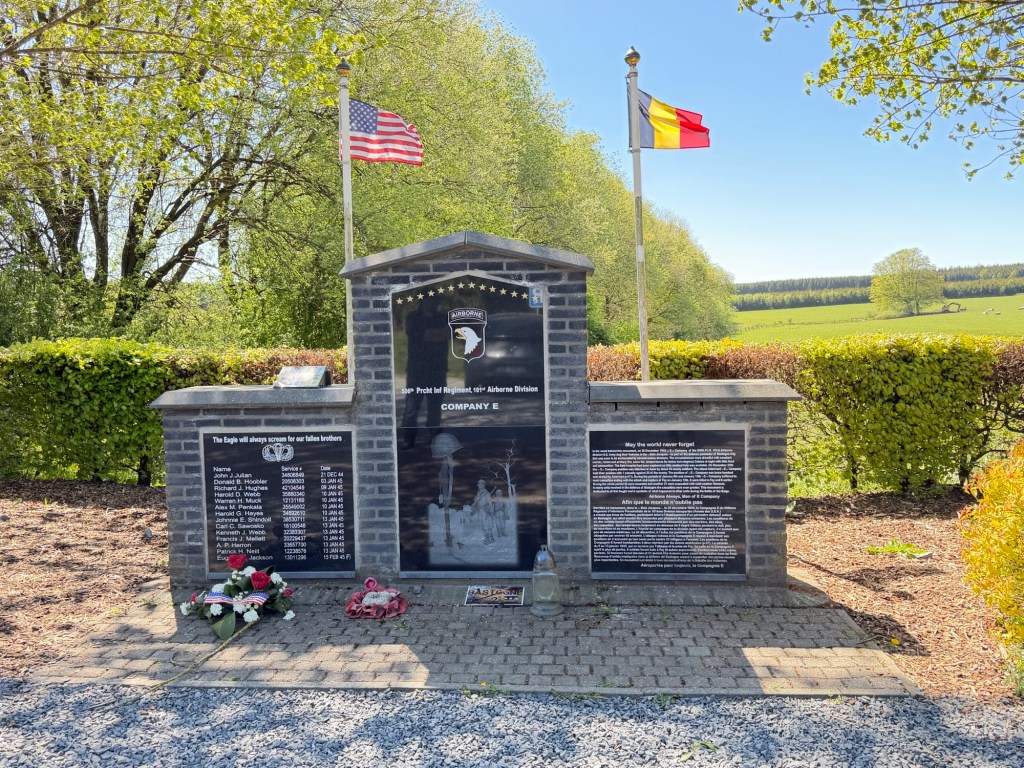
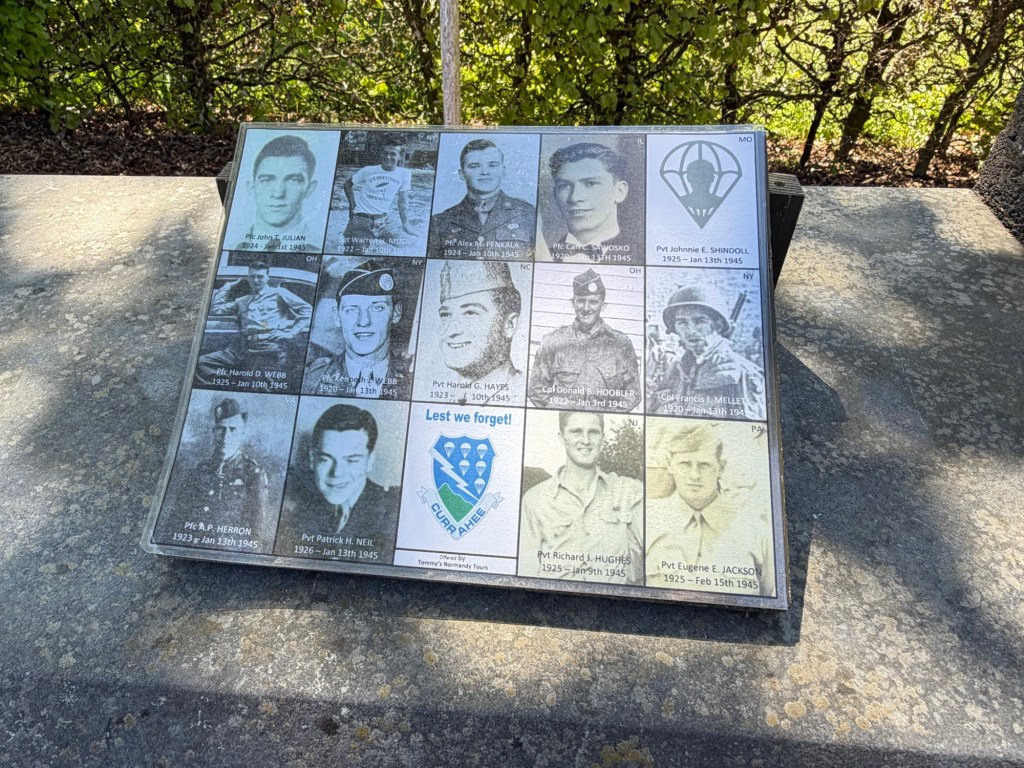
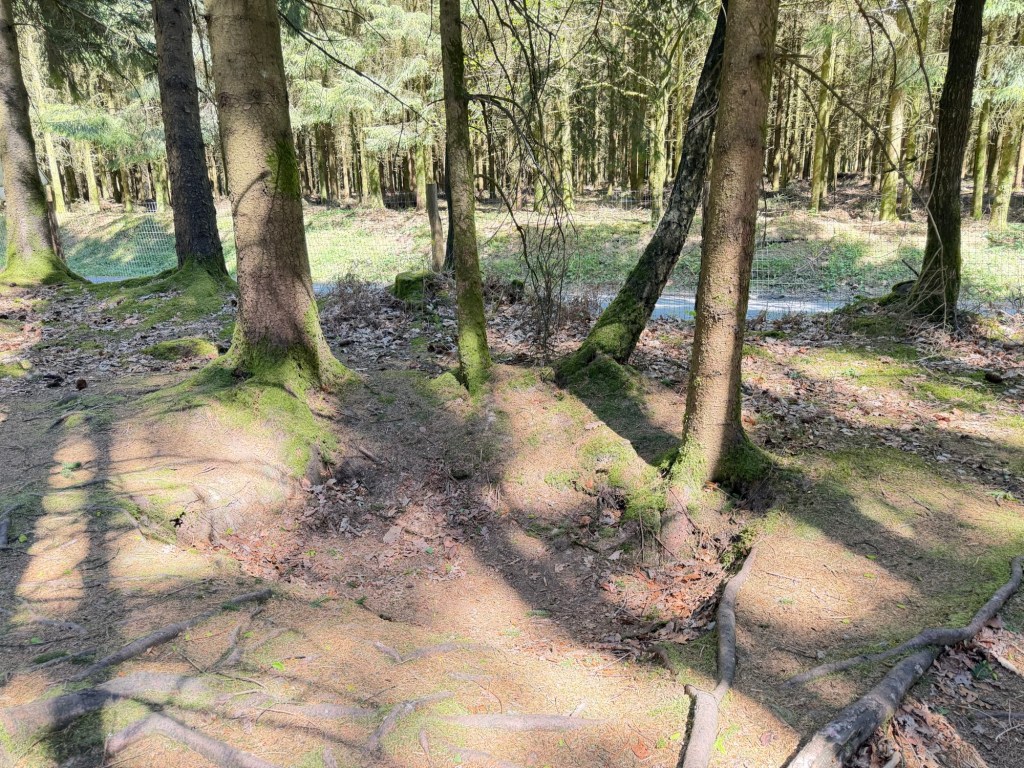
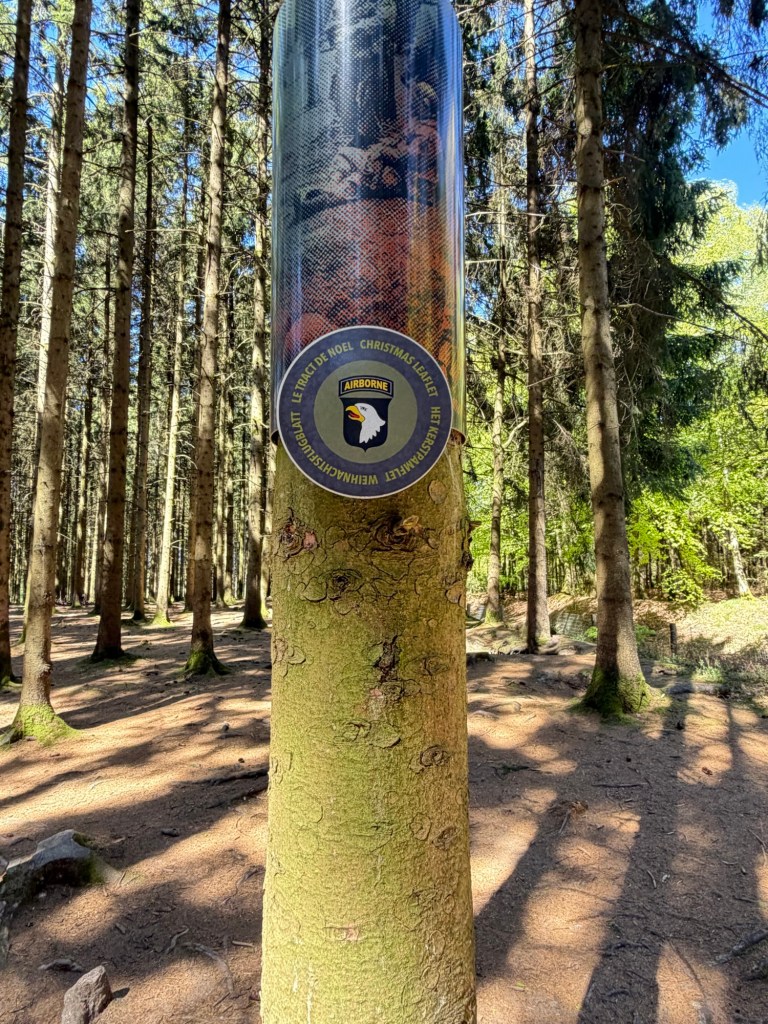
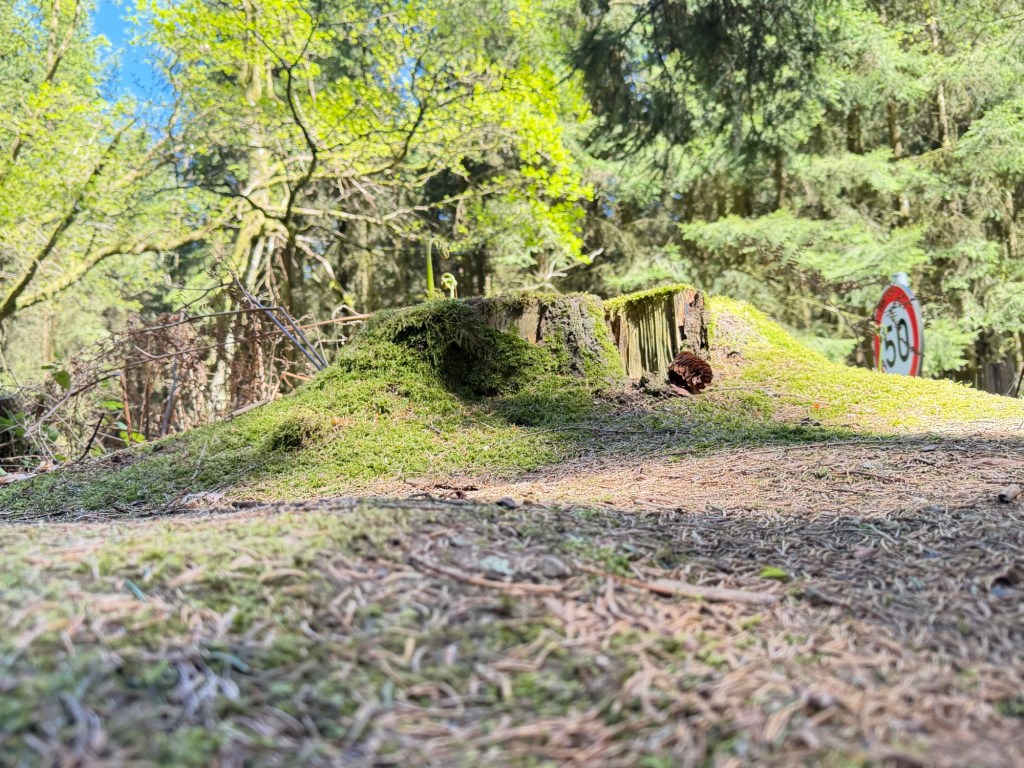
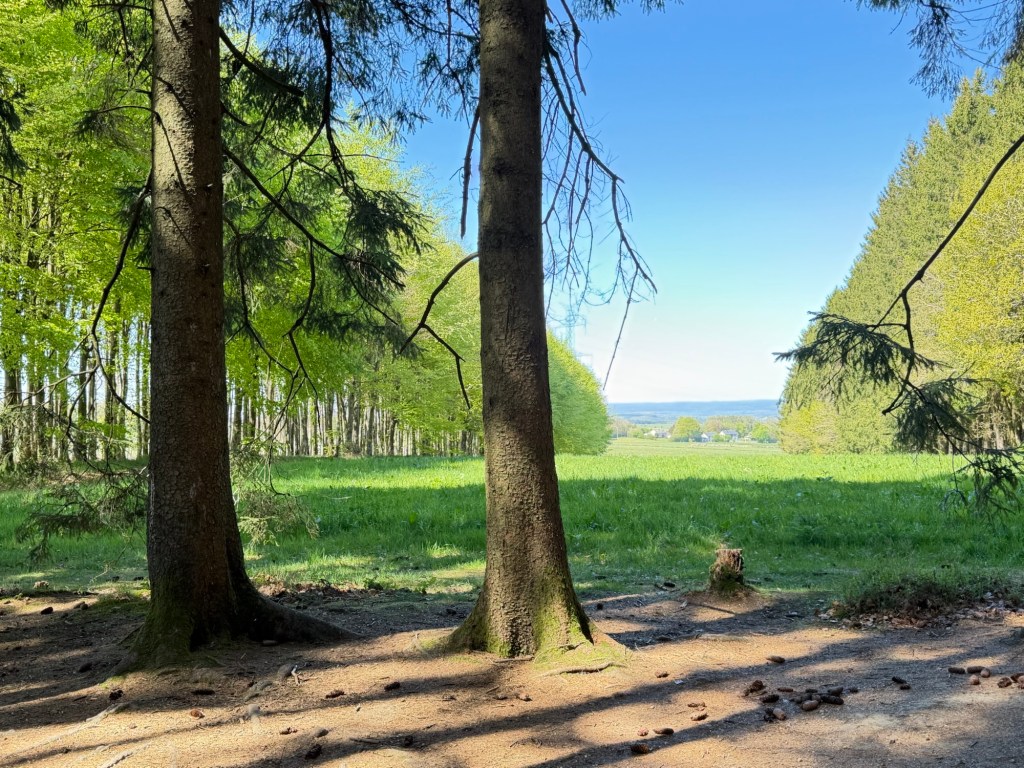
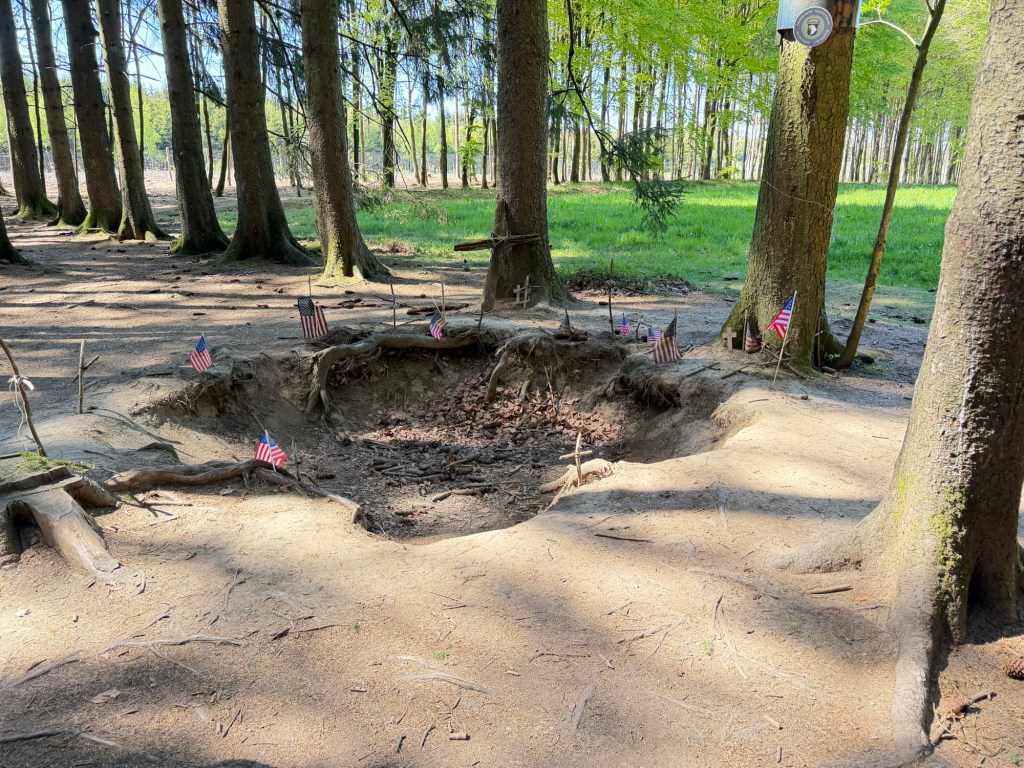
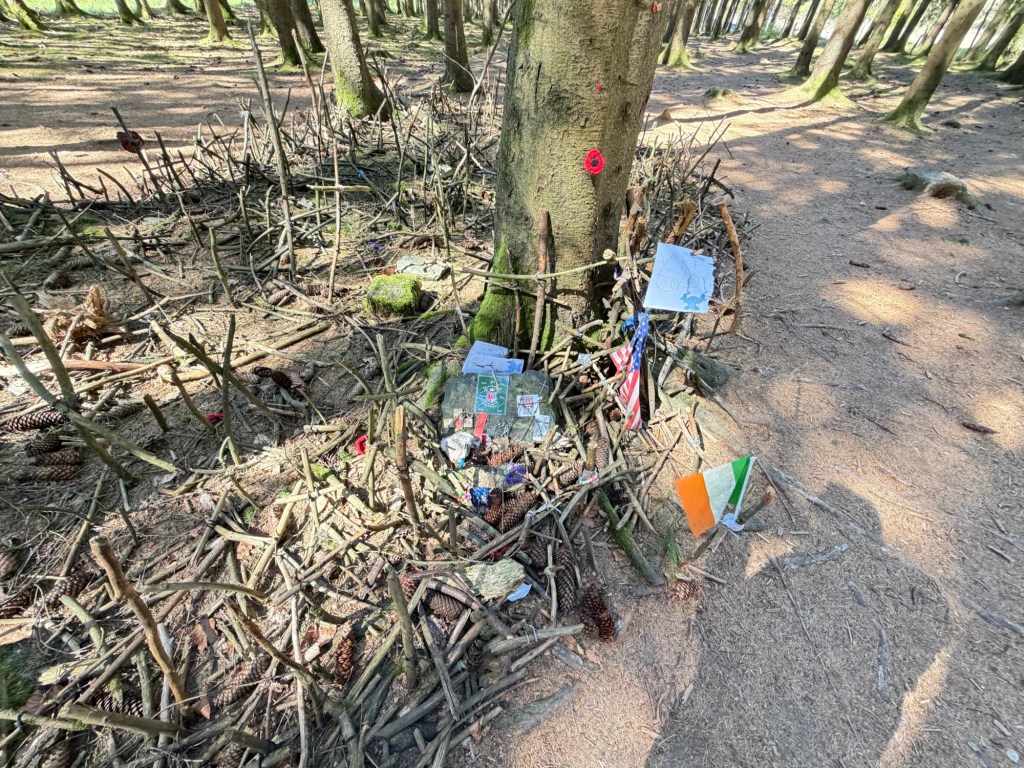
Today the forest is calm. Sunlight filters through the trees. Birds sing. Moss covers the earth. But scattered throughout the woods are still-visible foxholes — shallow fighting positions dug by American soldiers during the brutal winter of 1944–45.
Standing there was surreal.
Nearby, a memorial lists the names and faces of soldiers who never made it home. Looking at their photographs is especially sobering. So many of them were barely more than boys.
Places like this remind us that history did not happen on a movie screen. It happened in forests like these, in freezing foxholes, to real people with names, families, fears, and futures that were cut short.
Lest we forget.
101st Airborne Museum
We visited the 101st Airborne Museum in Bastogne, Belgium — a place dedicated to preserving the story of the Battle of the Bulge and the soldiers who fought here during the winter of 1944–45.
Housed in a historic building that survived the war, the museum feels less like a collection of artifacts and more like a time capsule. Inside were recreated wartime scenes, airborne equipment, uniforms, weapons, personal effects, and exhibits devoted to the siege of Bastogne.
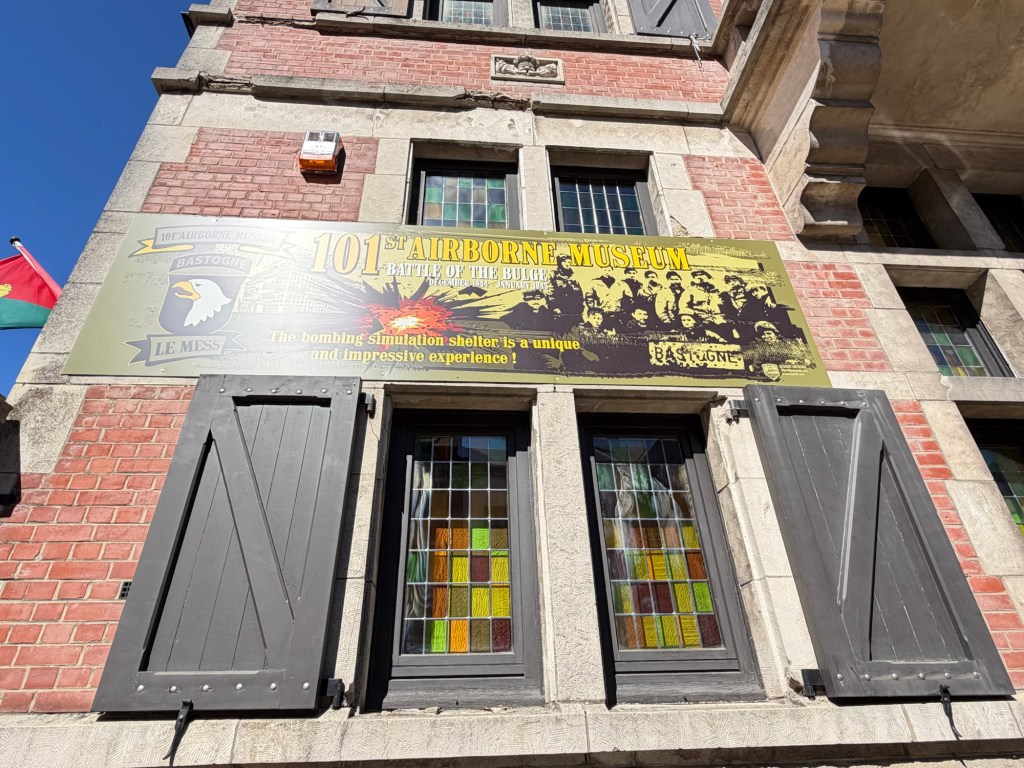
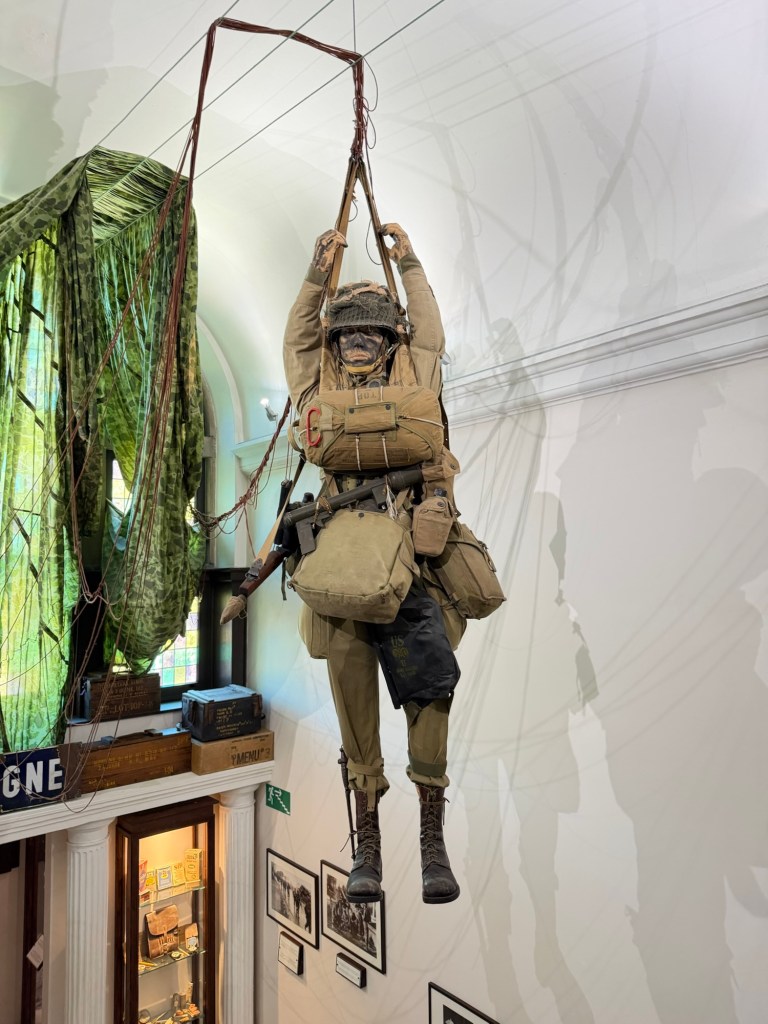
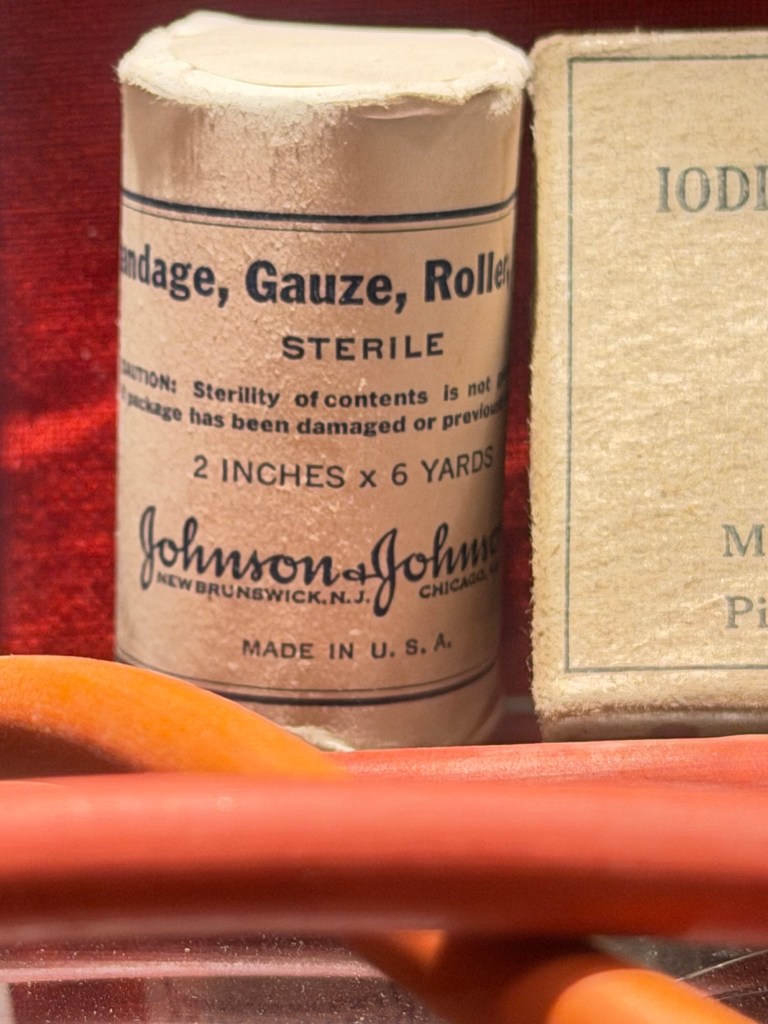
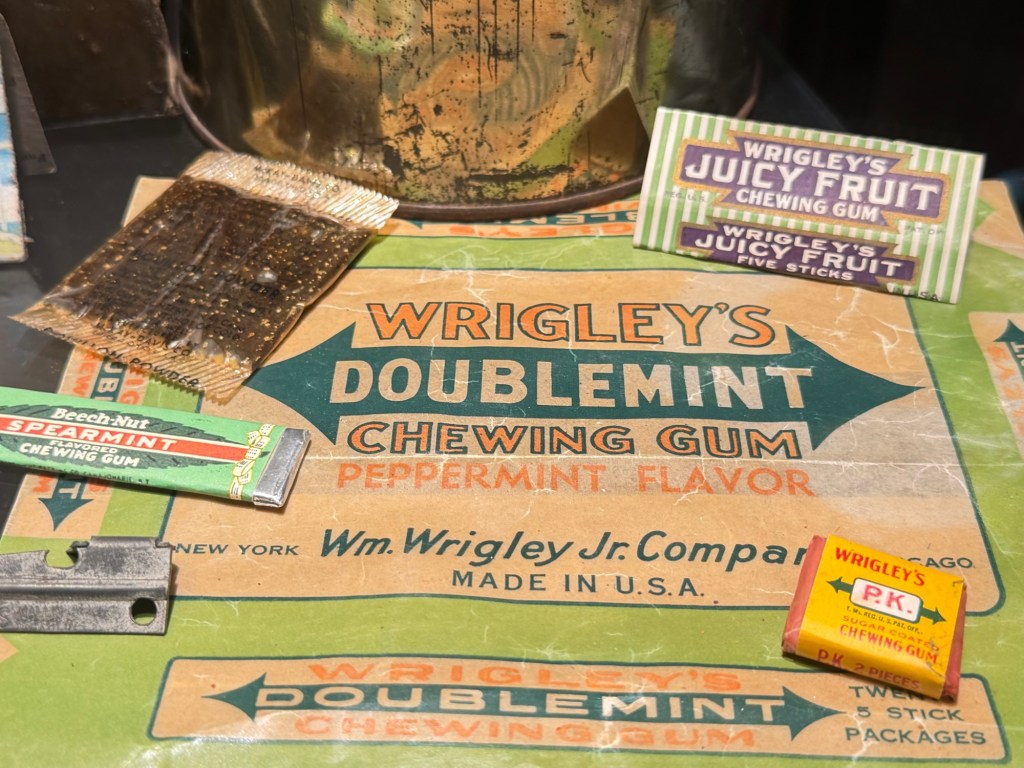
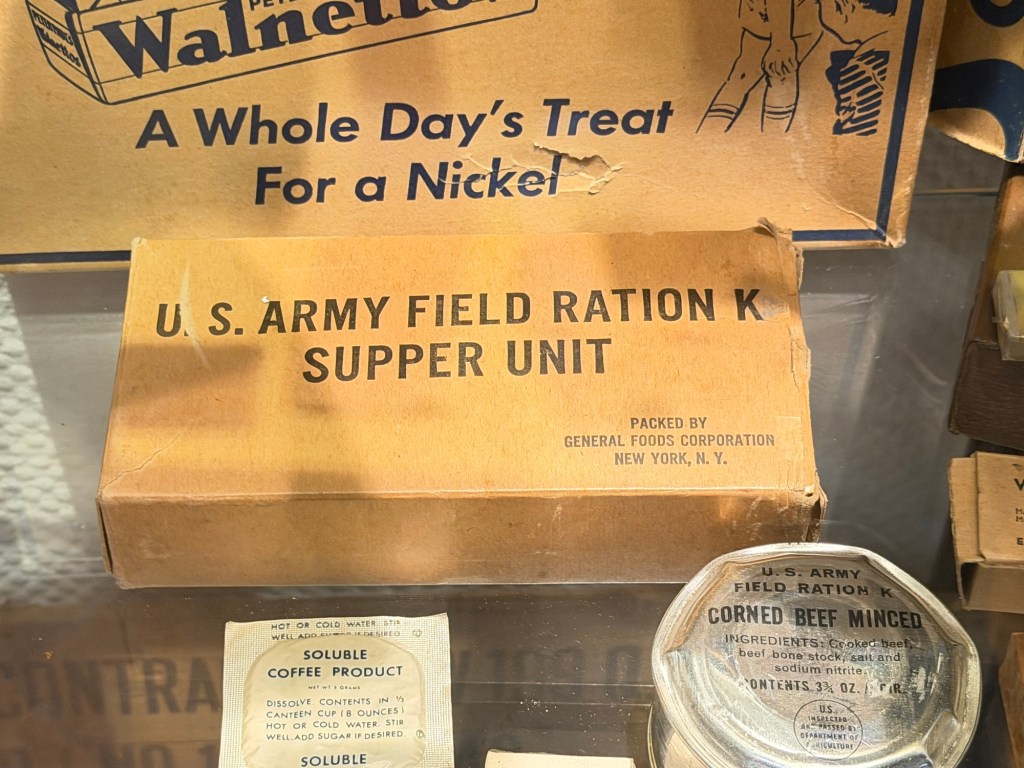
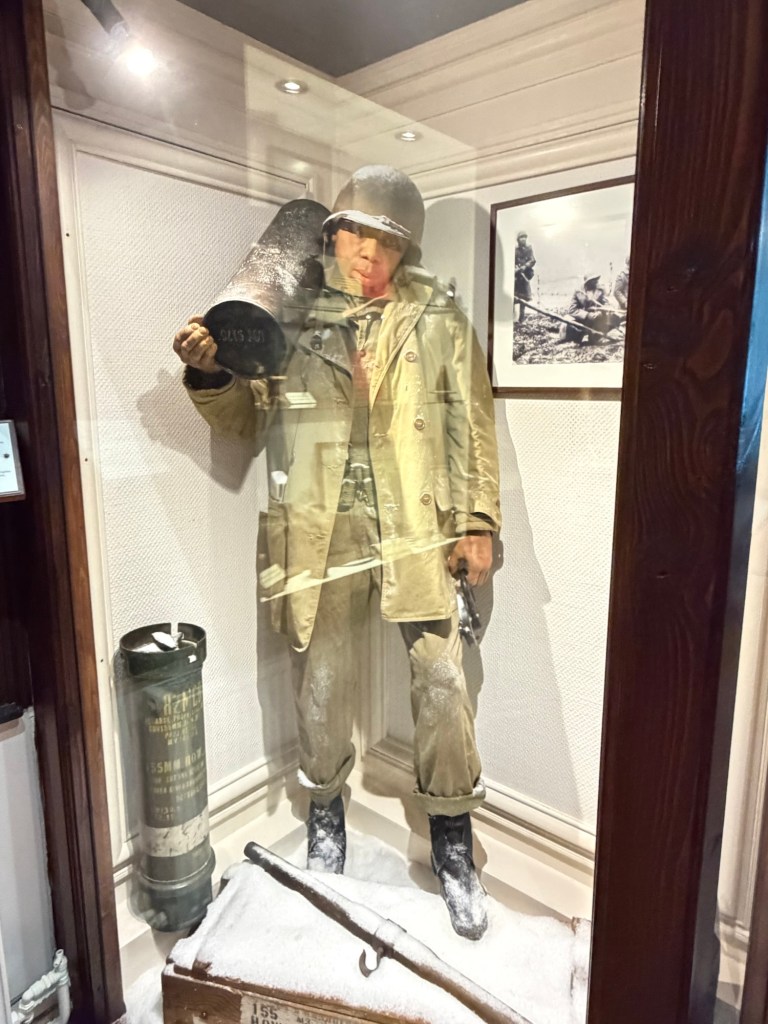
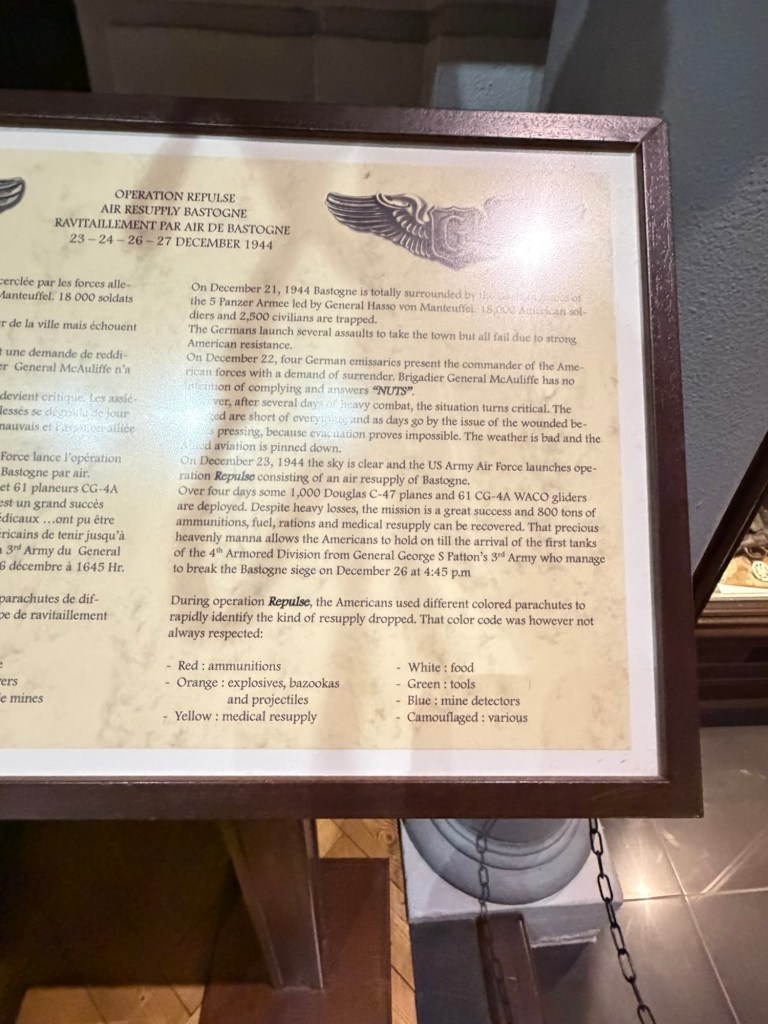
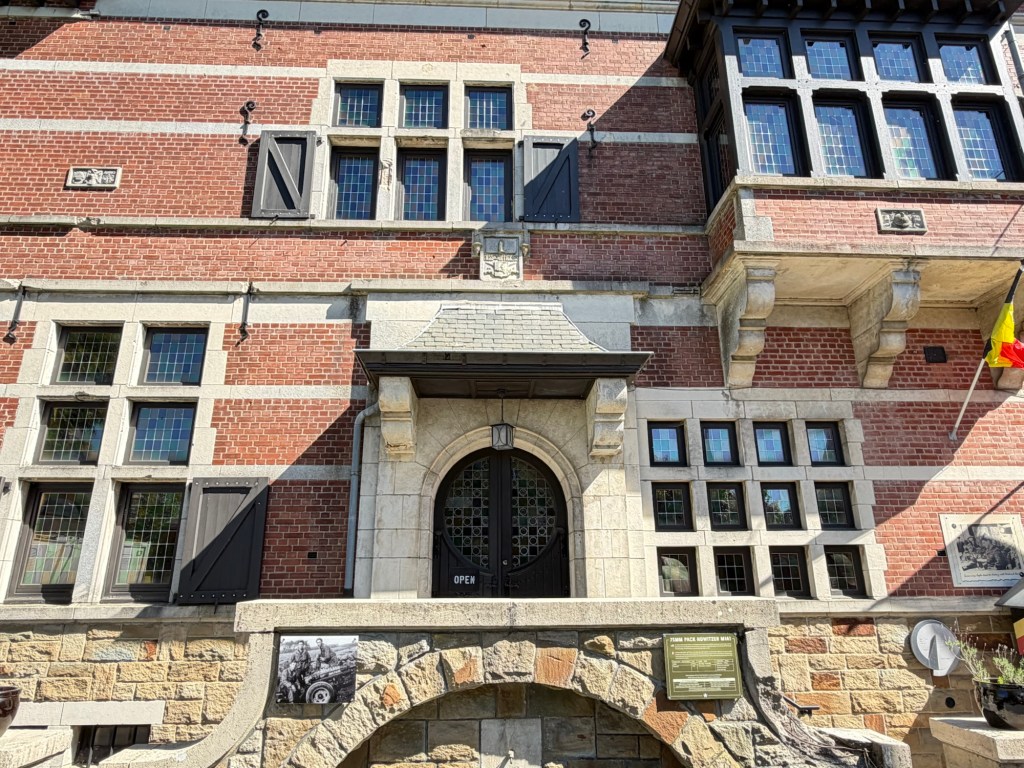
One exhibit explained the desperate Allied air resupply missions that kept the surrounded American forces alive after German troops encircled the town. Another recreated a Belgian cafe during the occupation, capturing the uneasy intersection of ordinary civilian life and war.
In another exhibit, we sat underground while a bombing simulation unfolds overhead. The lights dim, explosions shake the room, and the sounds of war echo through the space. Even knowing it was only a recreation, it was genuinely terrifying. For a few moments, it became easier to imagine what civilians and soldiers in Bastogne experienced during the siege — trapped underground while artillery and bombs crashed above them in the freezing winter of 1944.
There were reminders everywhere of how young so many of the soldiers were — paratroopers barely out of high school who suddenly found themselves fighting in frozen forests under artillery fire.
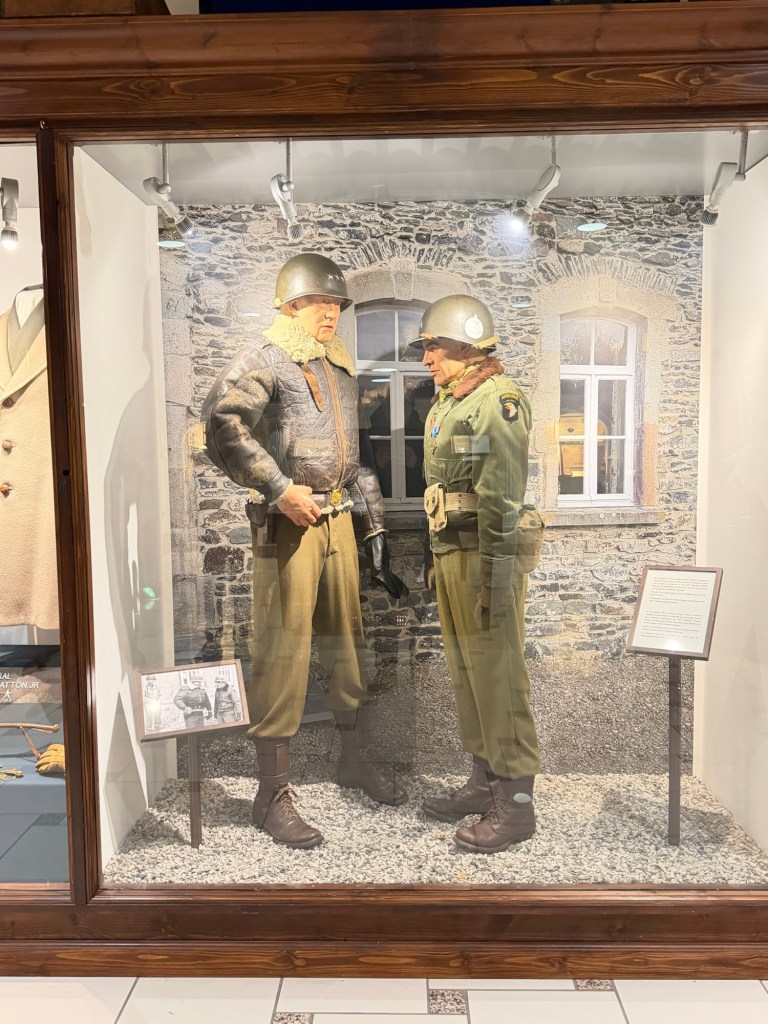
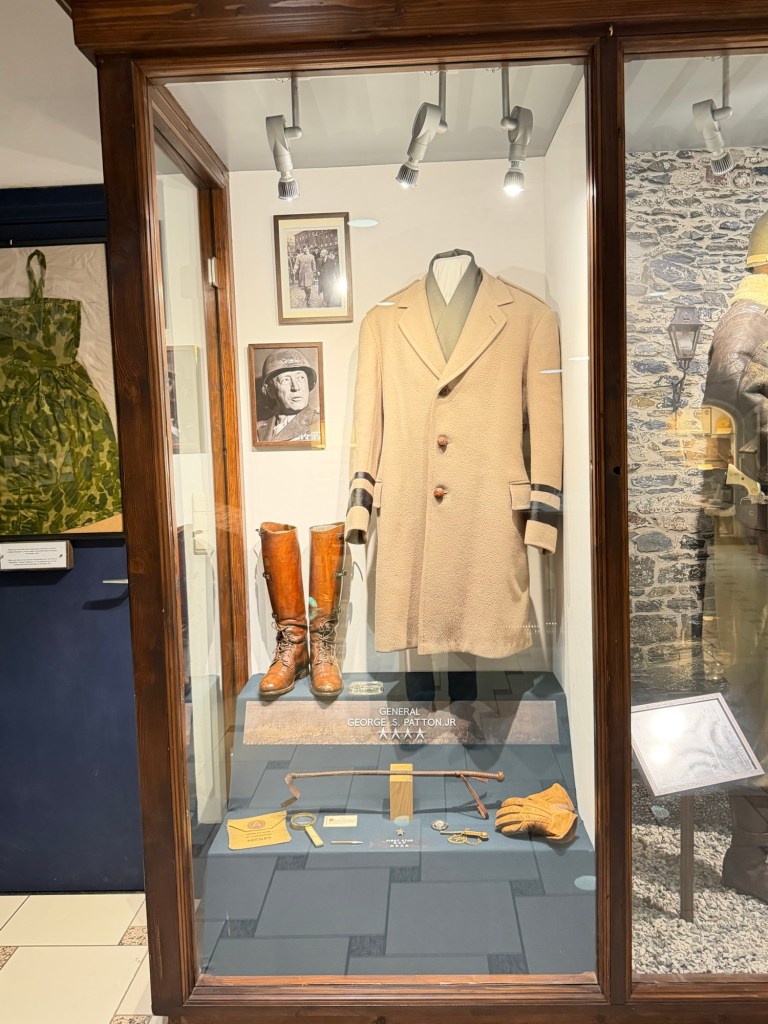
One display featured items connected to George S. Patton, whose Third Army ultimately helped relieve Bastogne after the famous refusal to surrender — General McAuliffe’s unforgettable reply: “NUTS!”
What makes places like this so powerful is not simply the military history. It is the humanity. A winter coat. A helmet. A gum wrapper. A foxhole. Ordinary objects that once belonged to young men trying to survive extraordinary circumstances.
Bob had once more surprise. He took us to a nearby building in Bastogne, and then showed us a picture in which Hitler was standing in the exact same location.
Today Bastogne is calm, beautiful, and welcoming. But beneath that peace remains the memory of one of the most desperate battles fought by American forces during World War II.
Bastogne War Rooms
One of the most remarkable places we visited in Bastogne was the former headquarters used during the siege of the town in the Battle of the Bulge — now known as the “NUTS!” Bastogne War Rooms.
This was not simply another museum exhibit. This was an actual command center where American officers worked during some of the darkest days of December 1944, while Bastogne was surrounded by German forces.
It was here that Brigadier General Anthony McAuliffe gave his legendary one-word response to the German surrender demand: “NUTS!”
Today the building stands quietly under blue skies in a peaceful Belgian town. But inside are reminders of the desperation of that winter: maps, uniforms, weapons, wartime communications, and exhibits explaining the siege and the relief effort led by George S. Patton and the Third Army.
Outside sits an American armored vehicle — an M10 tank destroyer nicknamed “Barracuda” — a reminder of the armor battles that raged across the Ardennes.
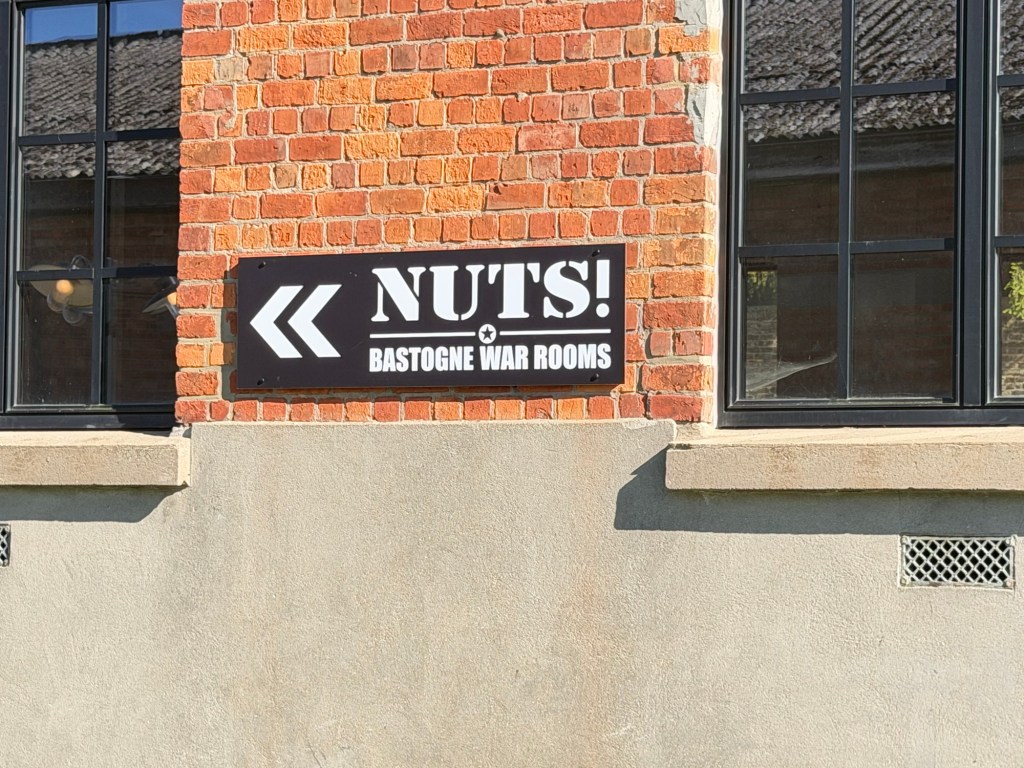
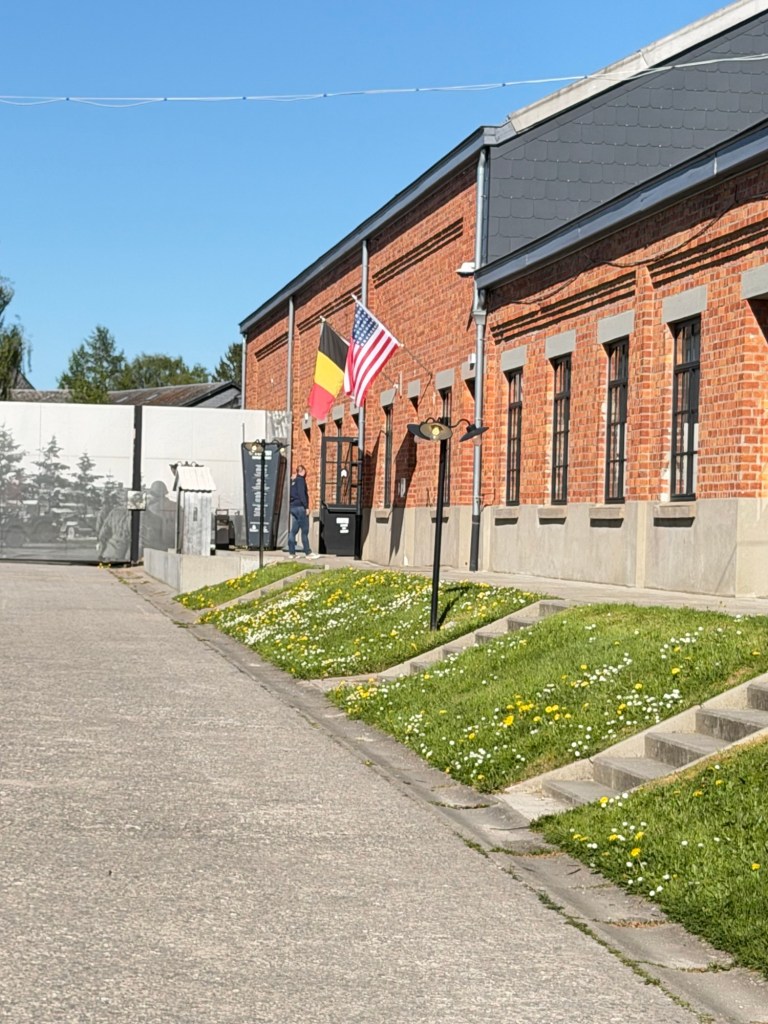
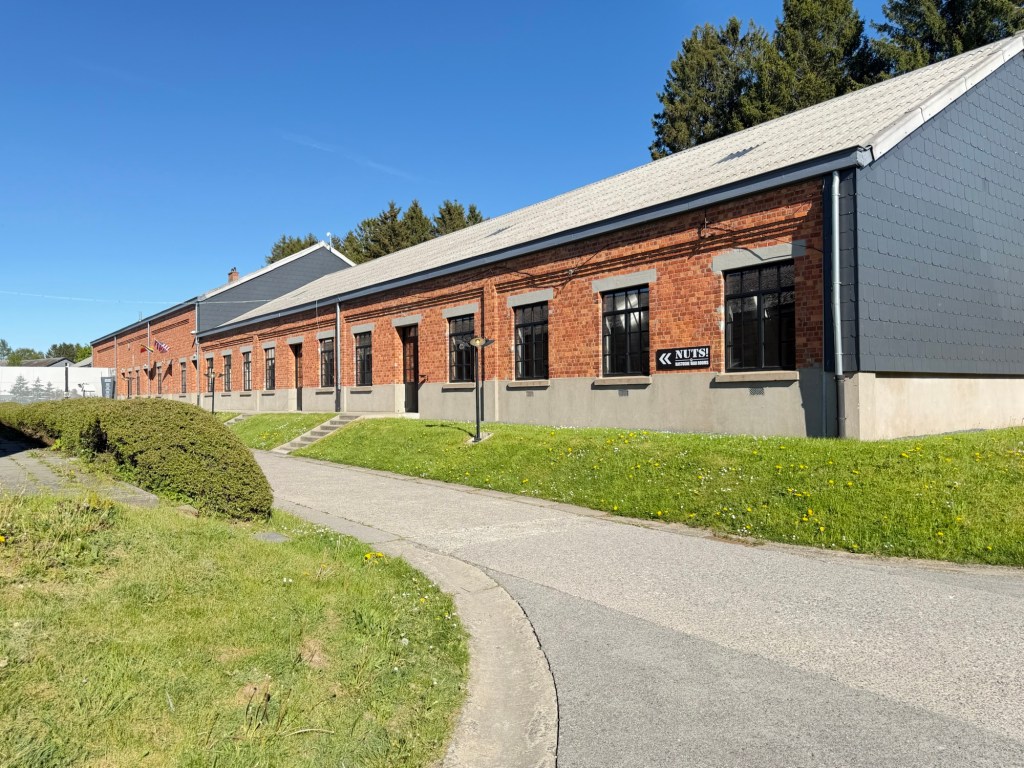
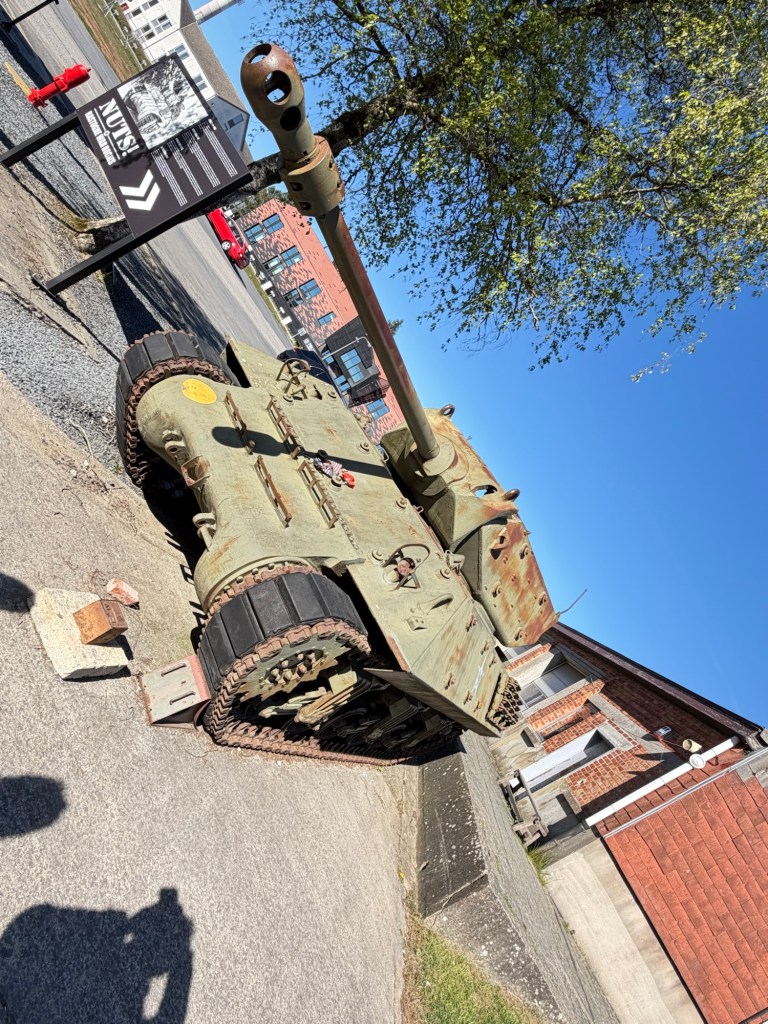
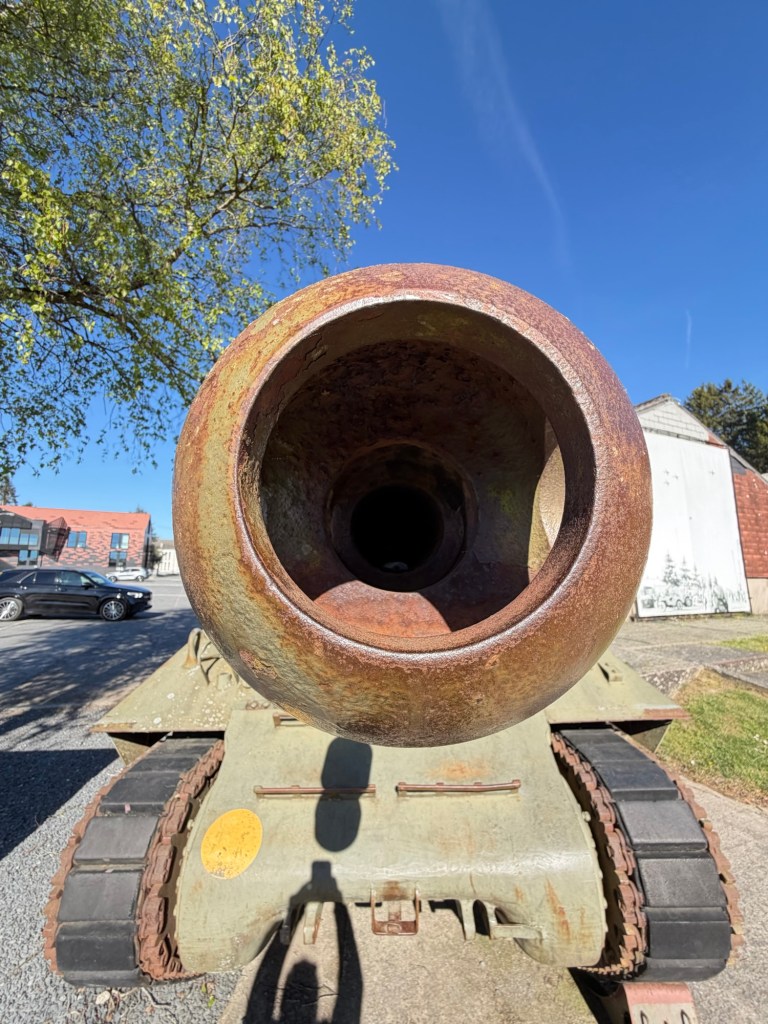
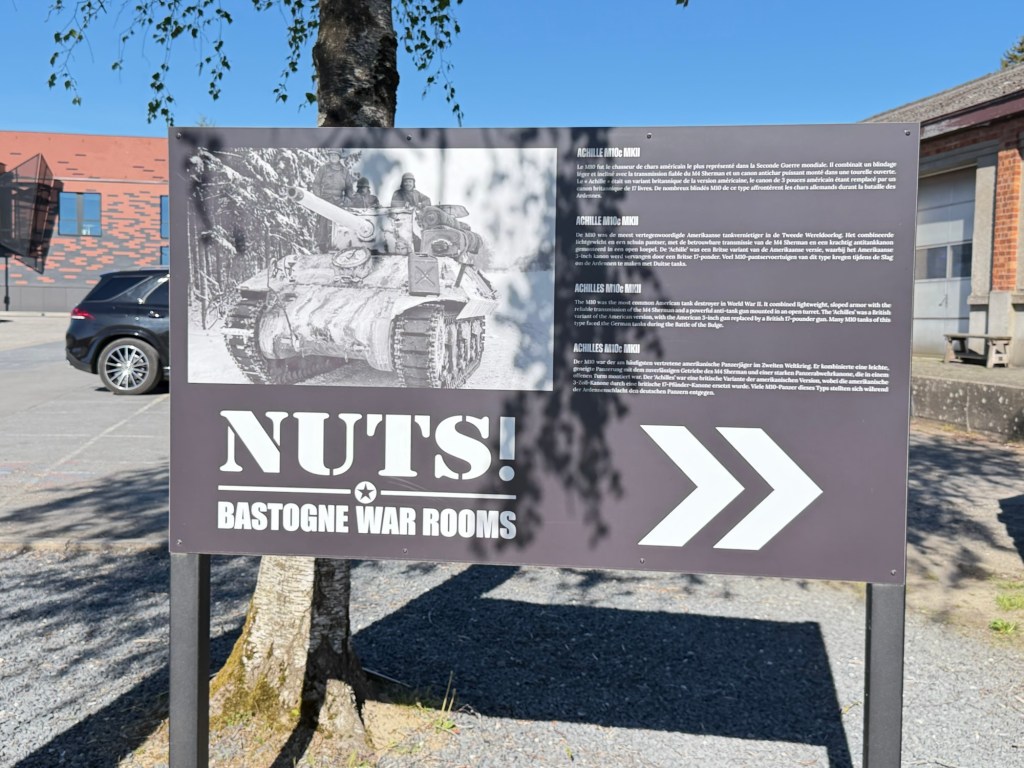
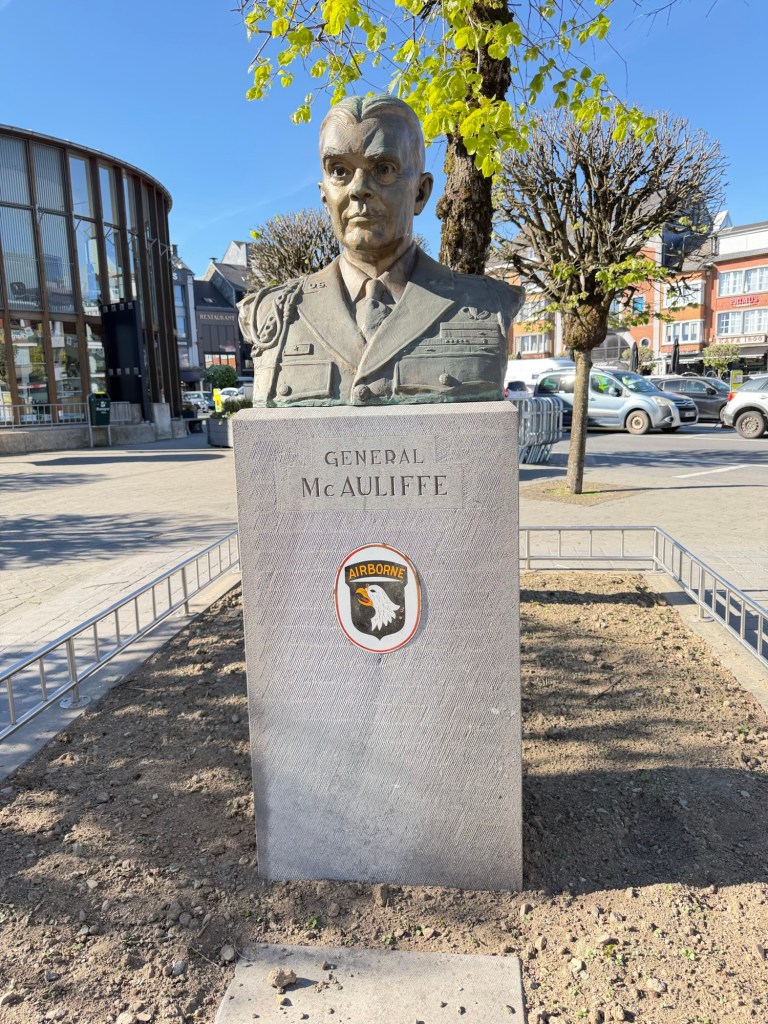
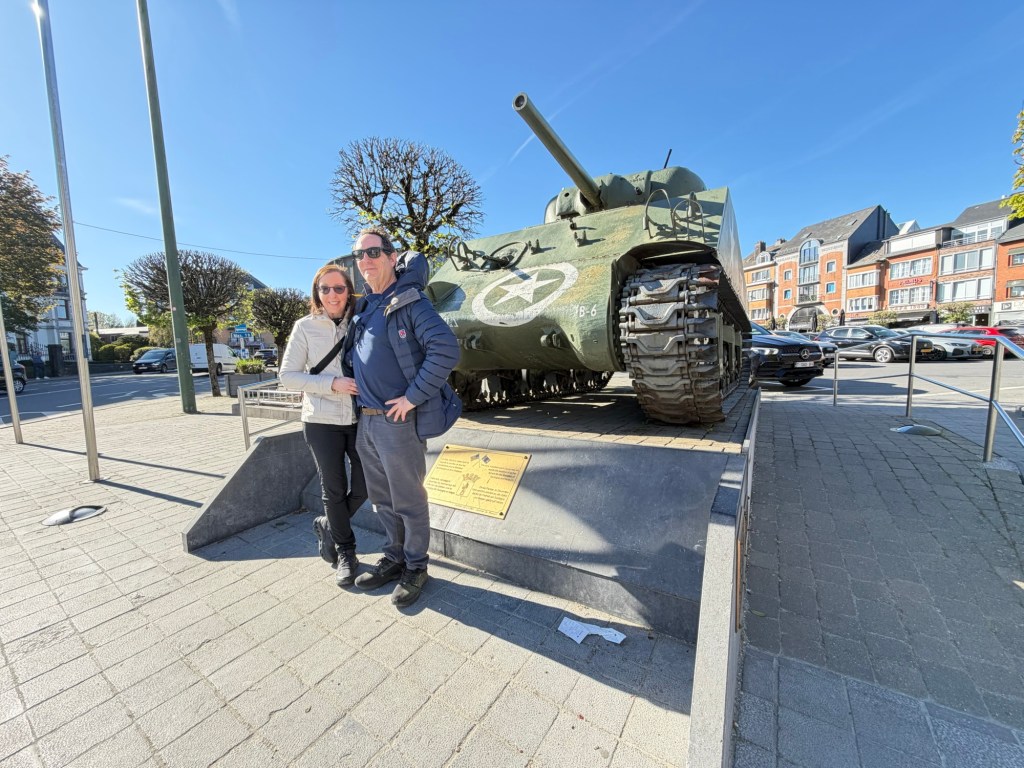
What struck me most was the contrast between then and now. The lawns are green. Cars pass by quietly. People walk the streets without a second thought. Yet in December 1944 this same place was at the center of one of the most desperate moments of the war, with exhausted young soldiers holding the line against overwhelming pressure in bitter cold and snow.
The word “NUTS!” has become famous in American military history, almost humorous in hindsight. But standing there, it felt less like bravado and more like determination — a refusal to give up when the outcome was far from certain.
Bastogne today is peaceful. But the memory of what happened here still lingers in the walls, the forests, and the stories preserved by places like this.
This was a sobering day.
Today we walked through Bastogne and the forests of the Ardennes, places that are peaceful and beautiful now, but which once witnessed some of the most brutal fighting of World War II. My wife saw the place her great uncle Herb was killed.
At the museum and memorials, we saw reminders everywhere of the courage and suffering of the soldiers and civilians who endured the siege during the winter of 1944–45. We stood in reconstructed foxholes, saw exhibits about the desperate air resupply missions that kept surrounded American troops alive, and sat through a bombing simulation in a basement that was unsettling even as a modern recreation.
The forests are quiet now. The fields are green. But beneath that calm lies the memory of freezing temperatures, relentless shelling, fear, confusion, and extraordinary sacrifice.
It was impossible not to think about how young so many of these soldiers were.
This was a giant reminder that freedom isn’t free. It never was. It never will be. Not in Belgium, nor 3860 miles away in Wilmington Delaware.