We left Bruges for Spa, stopping for several hours in Ghent—a city very different from Bruges. Where Bruges feels preserved and almost suspended in time, Ghent feels larger, livelier, and unmistakably lived in. Students on bicycles move past medieval towers, cafes spill into old squares, and the city’s university energy gives it a more contemporary pulse.
Unlike Bruges, whose historic center is a designated UNESCO World Heritage Site with strict external preservation oversight, Ghent is managed more internally. The result is a city that feels less frozen and more organically layered, where medieval architecture coexists more freely with modern urban life.
There also seemed to be fewer tourists, though that may simply have been the luck of timing and circumstance.
We met up again with Sophie Steen, our guide from Bruges, who now lives here with her family and once attended Ghent University. Seeing the city through her eyes made the stop feel less like tourism and more like being shown someone’s home.
Our first stop with Sophie is Ghent City Hall, one of those buildings that seems to tell the story of an entire city in stone. As Sophie explained, constructed over different centuries, its appearance changes dramatically depending on where you stand.
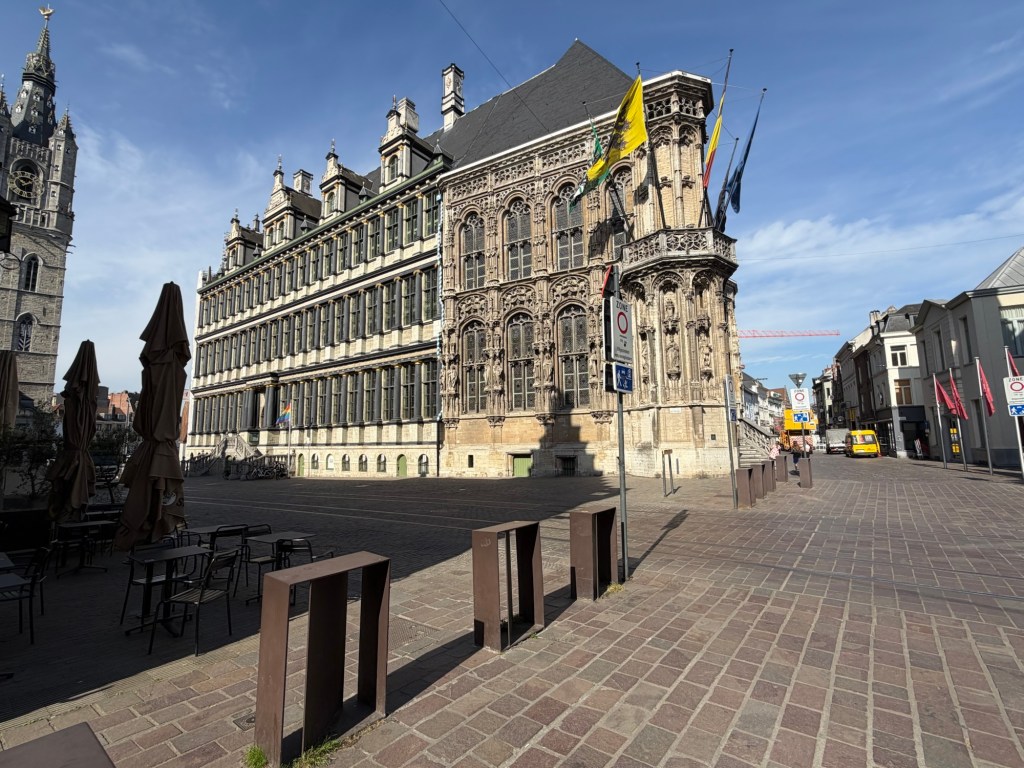
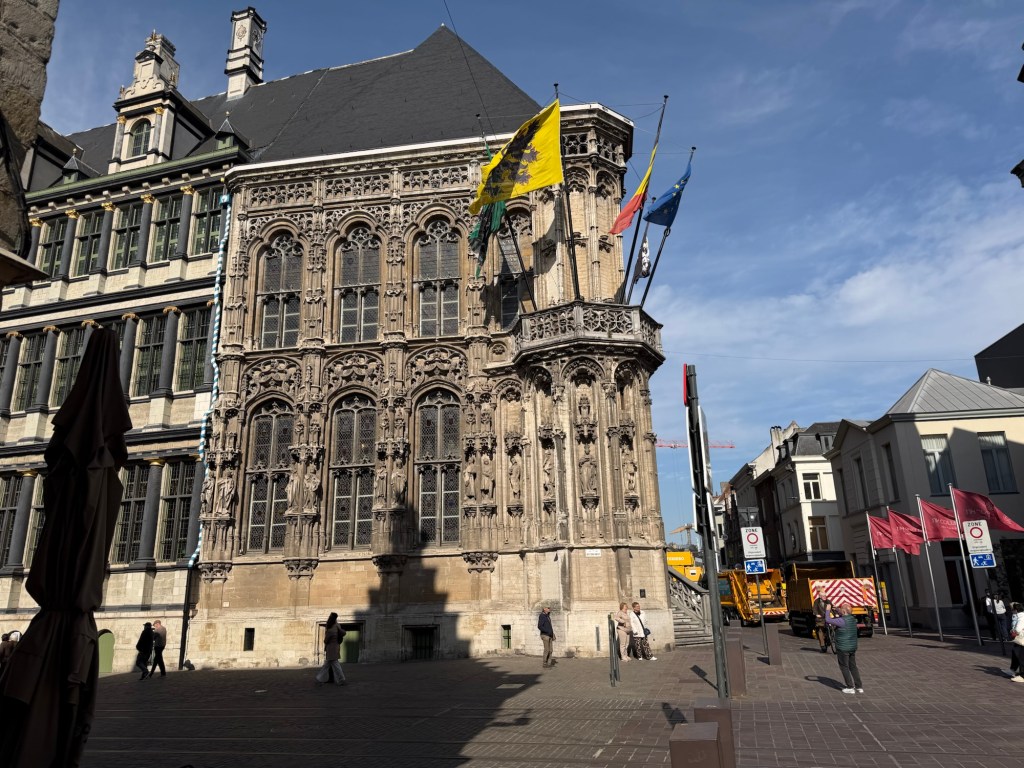
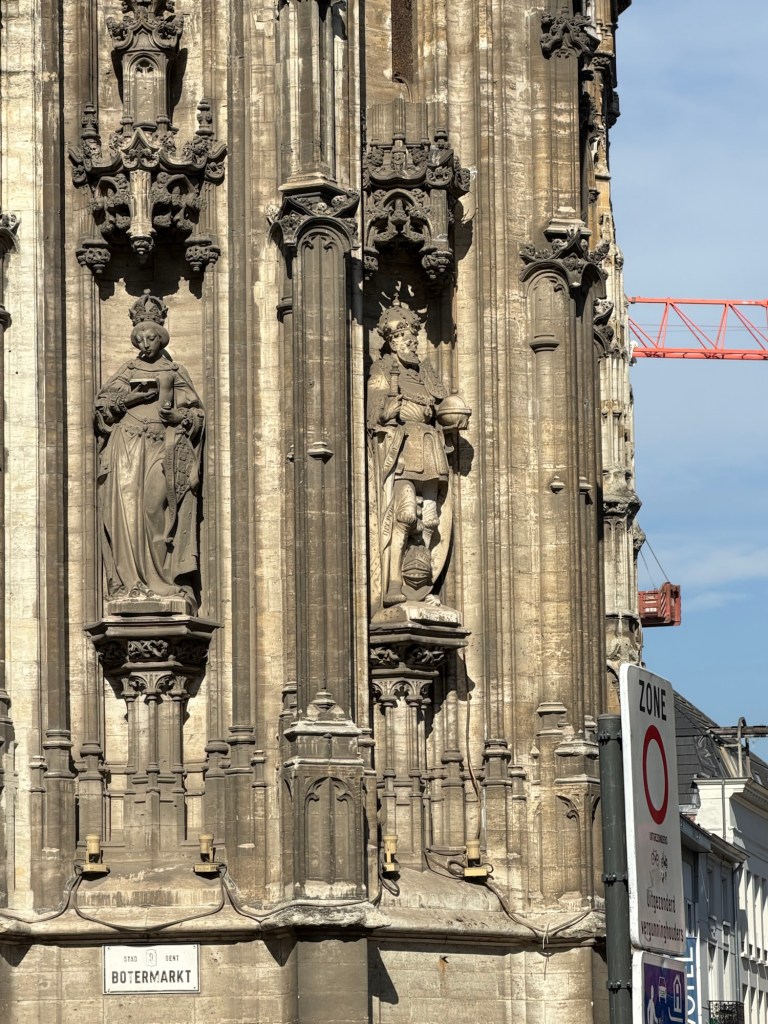
The side facing the Botermarkt was begun around 1518 in the exuberant Brabantine Gothic style. Every surface seems animated with carved detail: pointed arches, lace-like tracery, pinnacles, niches, and rows of statues climbing upward toward the roofline. The façade has the soaring vertical energy typical of late Gothic architecture, drawing the eye upward and creating the impression that the stone itself is striving toward heaven.
Then, almost abruptly, the building shifts styles. The wing along the Hoogpoort side, built later in the late 16th century around the 1590s, reflects Renaissance architecture—more restrained, symmetrical, and classically ordered. The windows widen, the lines calm down, and the decoration becomes disciplined rather than exuberant. The result is almost like a timeline in stone. Walking around the building, you can literally see Europe moving from the medieval world into the Renaissance.
Rather than disguise those differences, Ghent left them visible. The building wears its centuries openly.
Sophie also spoke about Charles V, whose birthplace was Ghent. Though the city was proud of its famous native son, their relationship later turned bitter after Ghent rebelled against his taxes. Charles crushed the revolt, executed leaders, and publicly humiliated others by forcing them to march through the city wearing nooses around their necks. Rather than erase the memory, Ghent embraced it. Even today, citizens are sometimes known as the “Stroppendragers” — the noose bearers.
As we moved on, Sophie paused beside a doorway and quizzed us about a curious iron projection jutting from the stone wall.
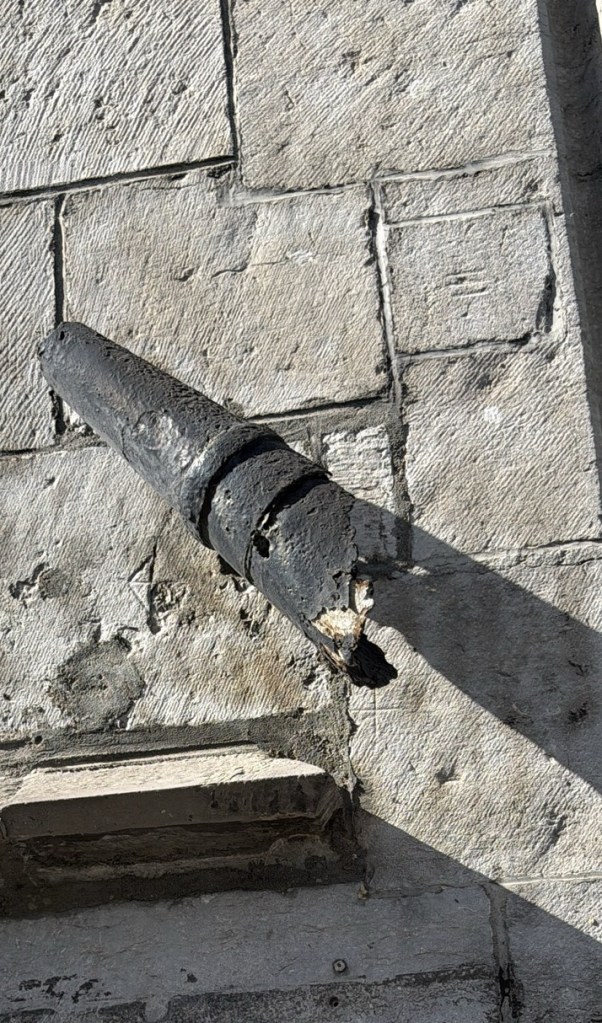
At first glance it looked like a broken hinge or pipe, but it was actually used to extinguish torches. In the days before modern street lighting, people carrying open flames through the city would press the torch into the metal holder to safely snuff it out before entering a building.
Sophie noted something else. Eventually, time itself will erase it. The iron is slowly corroding away, century by century, worn down by weather and neglect. One day it may simply disappear into the wall and be forgotten. It was one of those small details easy to miss, yet once pointed out it suddenly opened a window into everyday medieval life. Ghent is filled with these quiet remnants of earlier centuries woven into the modern cityscape.
Unlike Bruges, where preservation can feel almost museum-like, Ghent allows its history to remain embedded in daily life—less polished perhaps, but somehow more alive.
Adoration of the Mystic Lamb
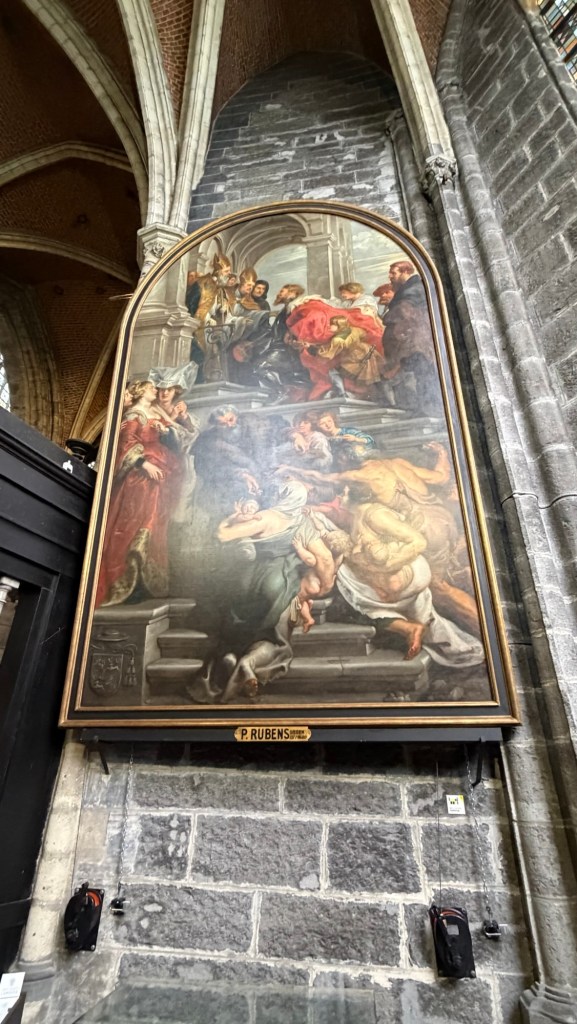
We then moved on toward Saint Nicholas’ Church (www.sintniklaaskerk.be) its great tower rising above the square at the busy heart of modern Ghent. Begun in the 13th century and constructed from the region’s distinctive blue-gray Tournai stone, the church stands as one of Belgium’s finest examples of Scheldt Gothic architecture, its massive columns, pointed arches, and layered stonework giving it both strength and elegance against the surrounding cityscape.
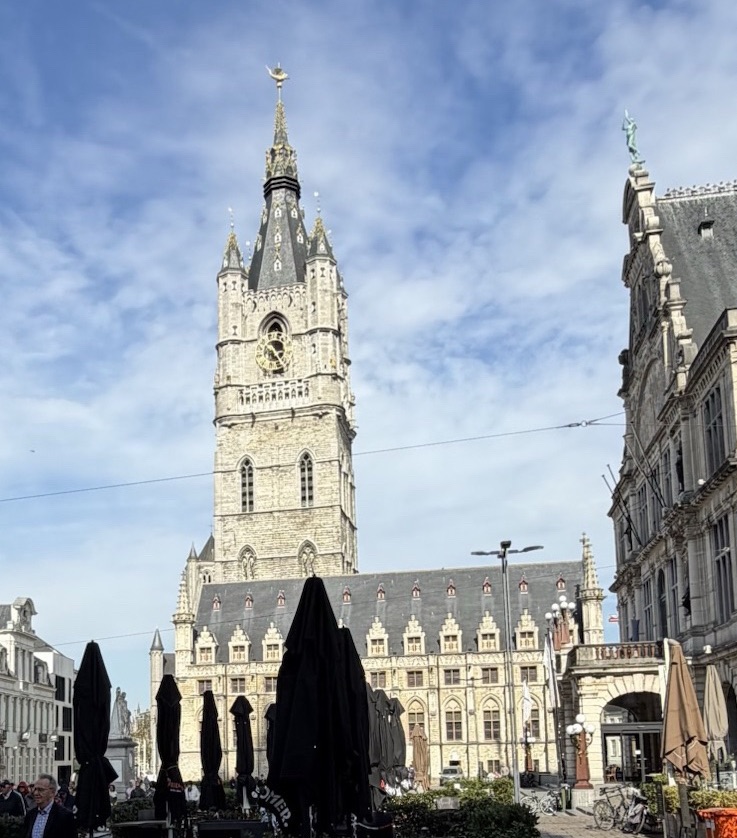
Outside, the church feels woven directly into the life of the city. Cafes, bicycles, trams, students, and office workers move around it almost casually, as if centuries of history have simply learned to coexist with everyday urban life.
Inside, however, the atmosphere changes immediately. The noise of the square disappears beneath soaring vaults and long stone columns that pull the eye toward the altar far in the distance. The vast interior feels austere yet peaceful, with the ribbed Gothic ceiling creating a rhythm that seems almost musical overhead.
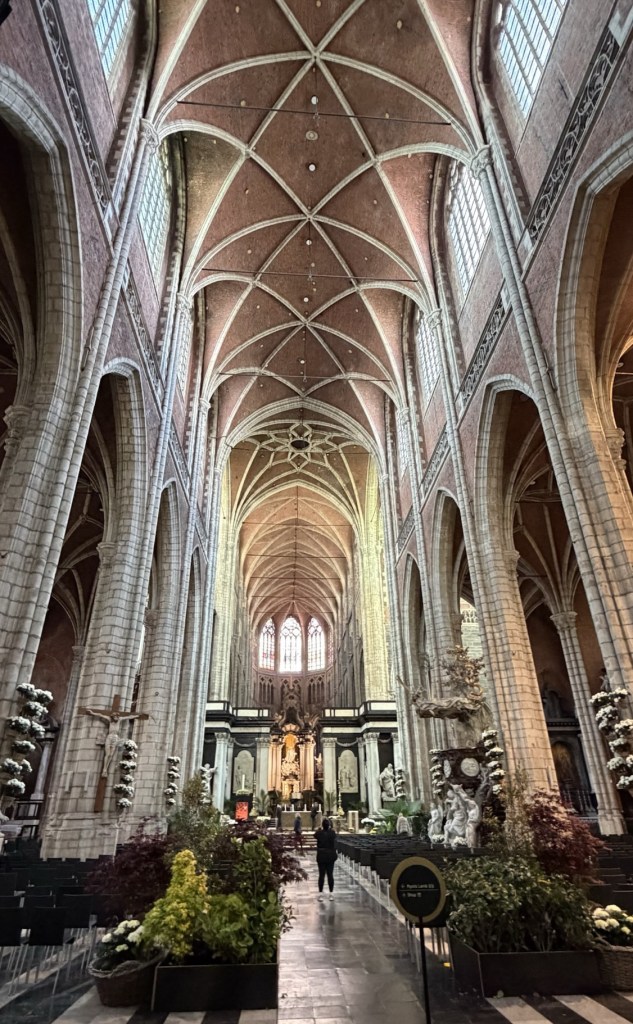
But it was not only the architecture that brought us there. What we had really come to see lay inside. One of the great artistic treasures of Europe, the legendary Adoration of the Mystic Lamb by Jan van Eyck (and others).
This was the same Jan van Eyck whose work at KMSKA Royal Museum of Fine Arts Antwerp had captivated me earlier in the trip. Seeing work there had already revealed an almost unbelievable mastery of light, texture, and human detail. But standing here, before the masterpiece most closely associated with his name, felt different entirely, as though everything we had seen so far had been leading toward this moment.
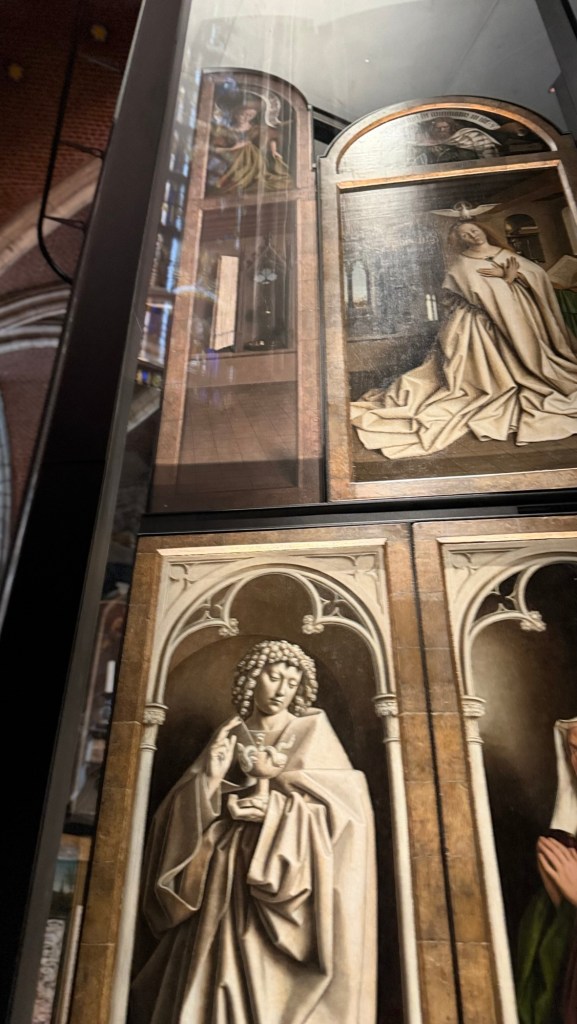
The Adoration of the Mystic Lamb is not a single painting but a vast polyptych—more commonly called the Ghent Altarpiece—composed of multiple hinged panels that open and close like doors.
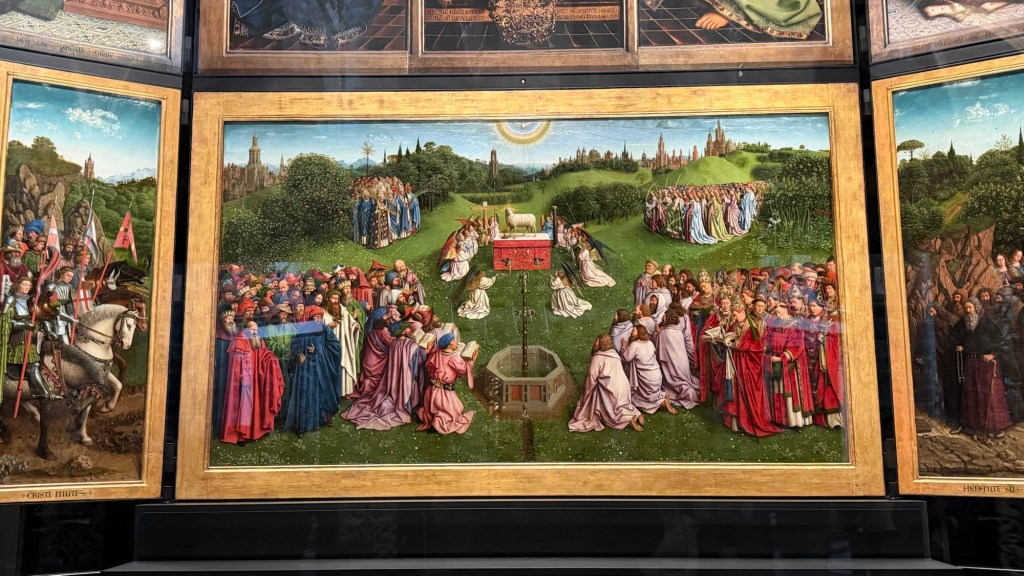
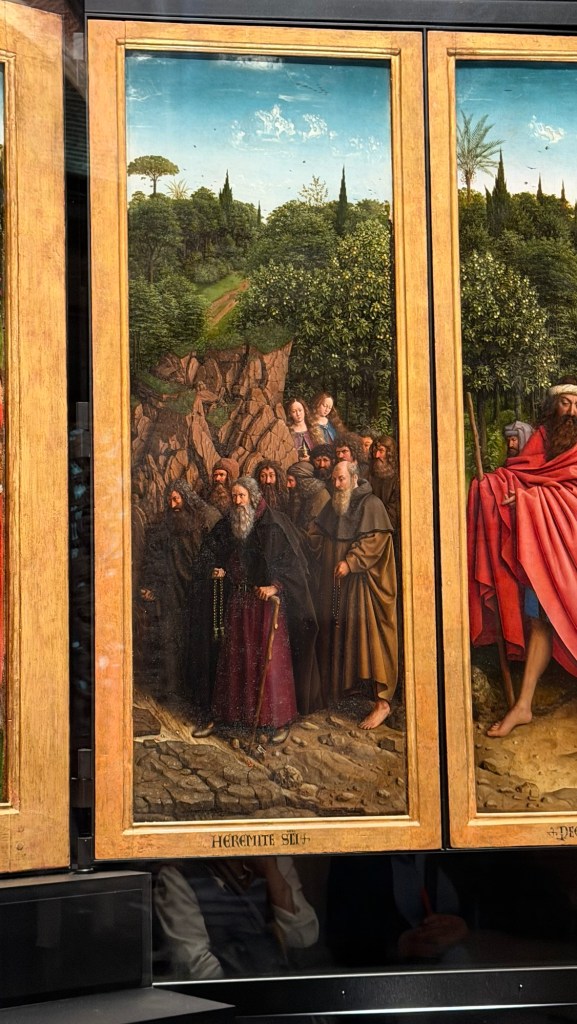
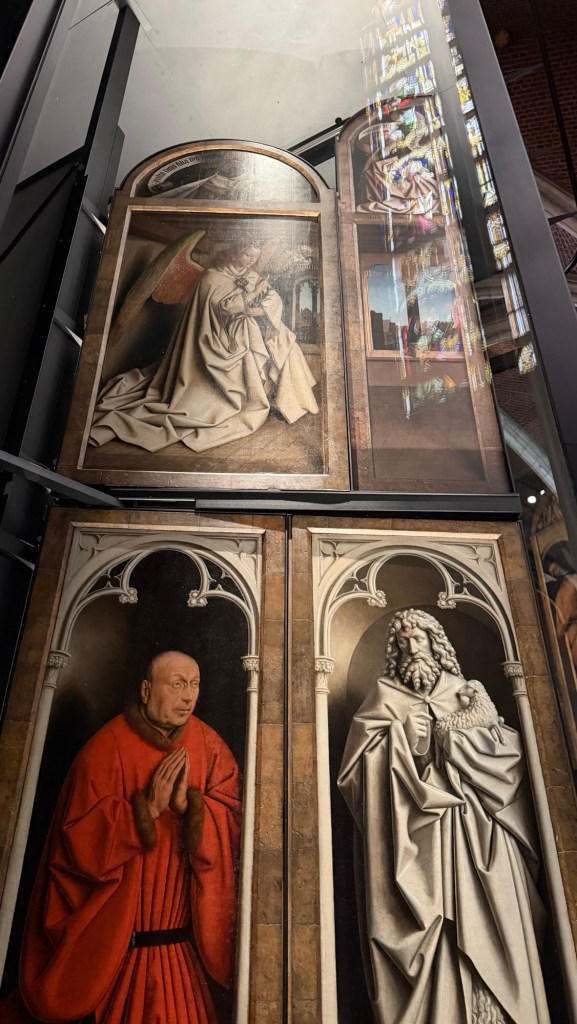
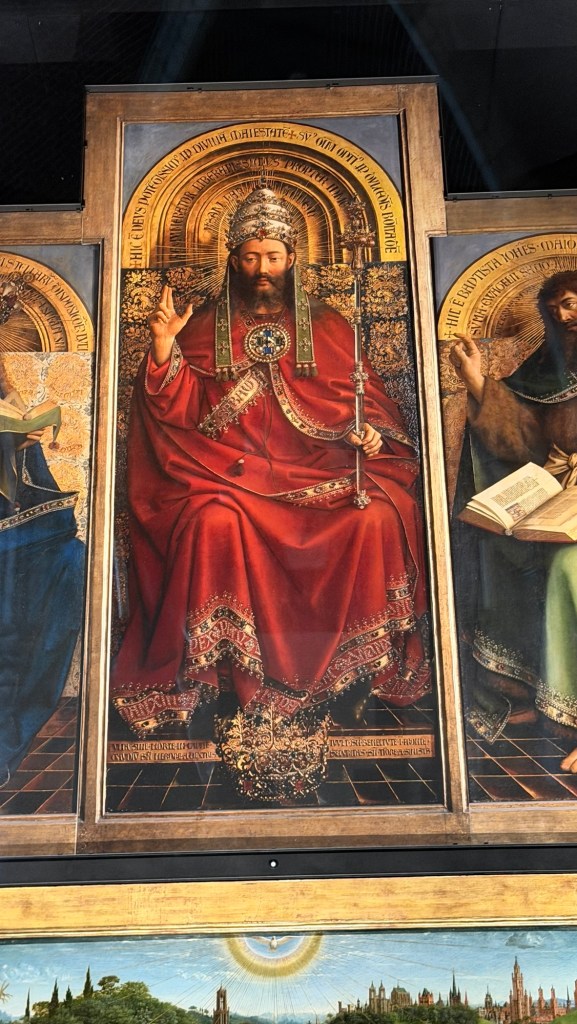
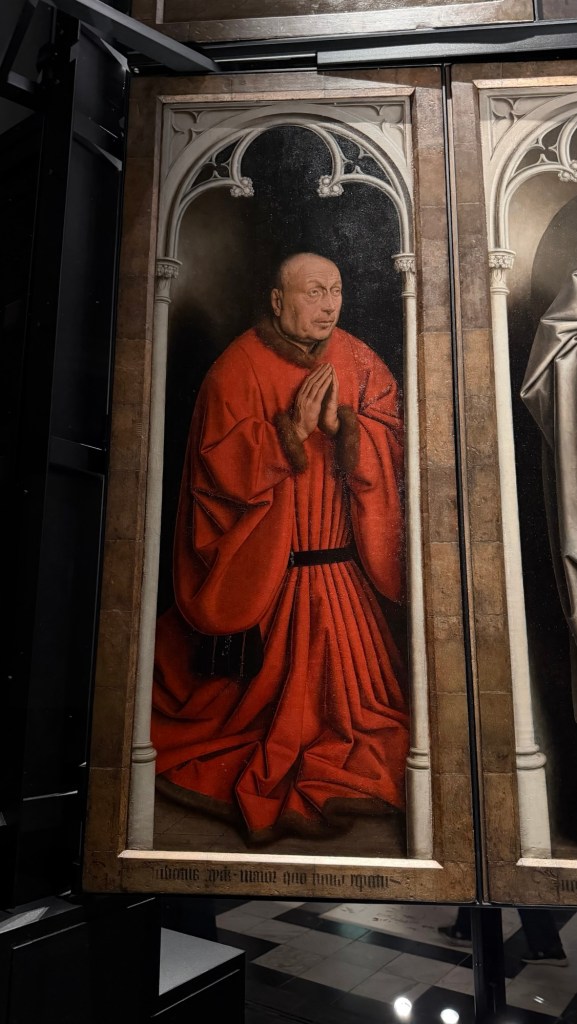
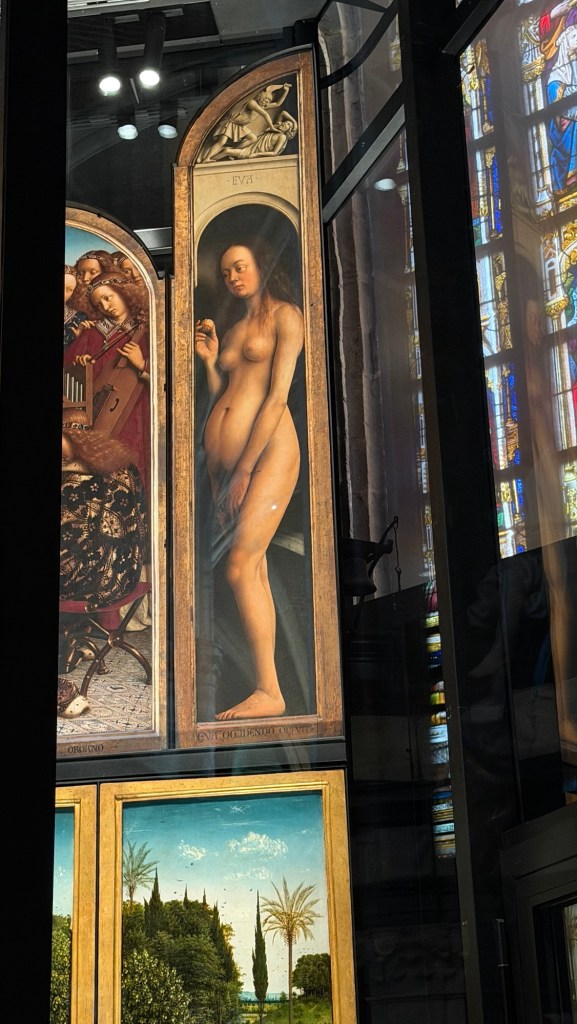
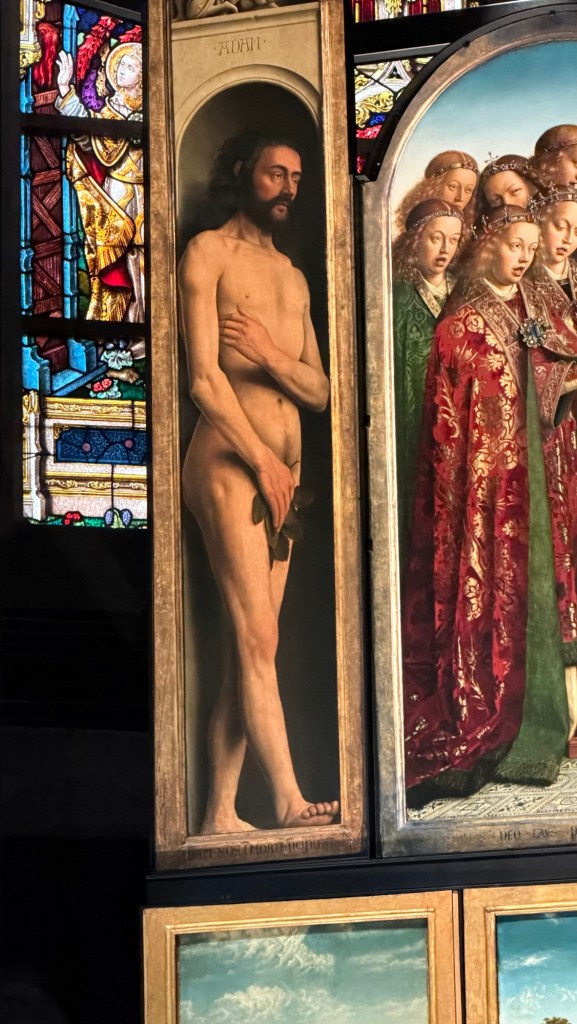
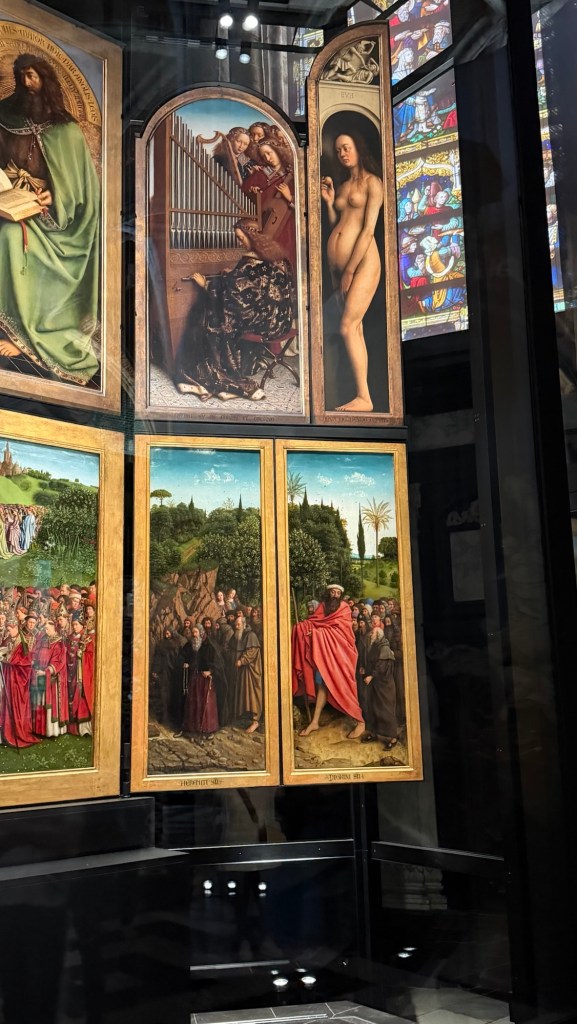
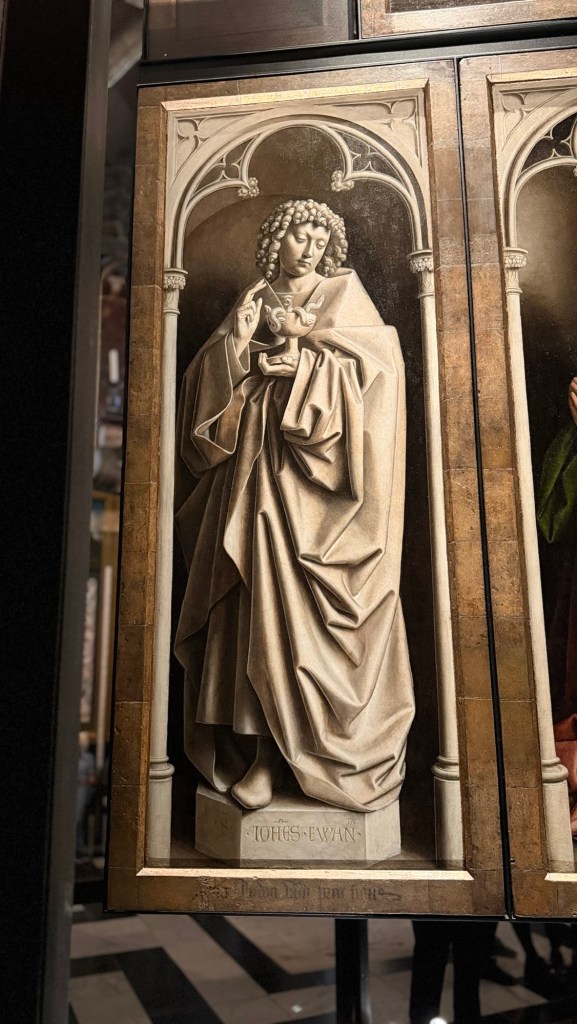
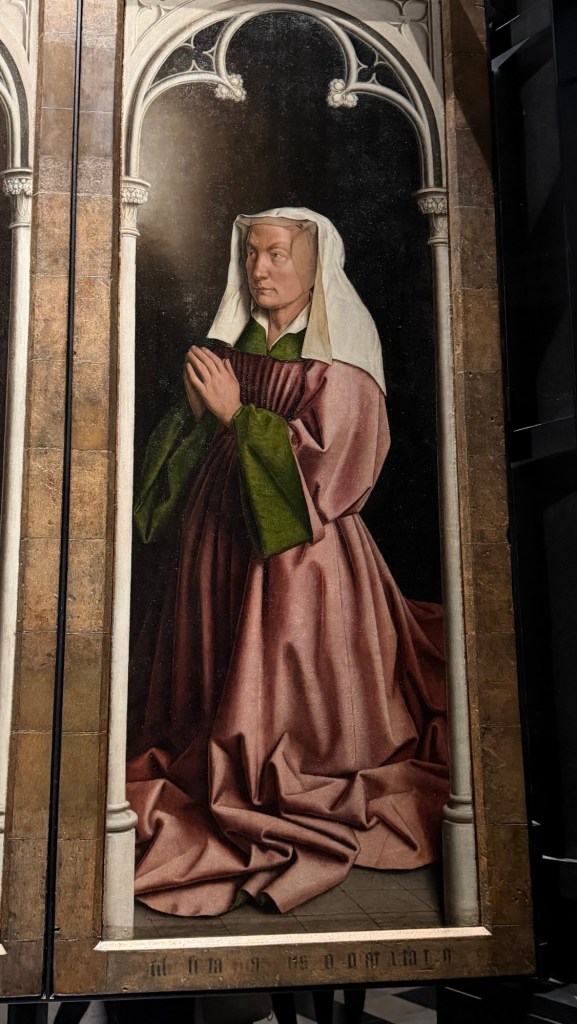
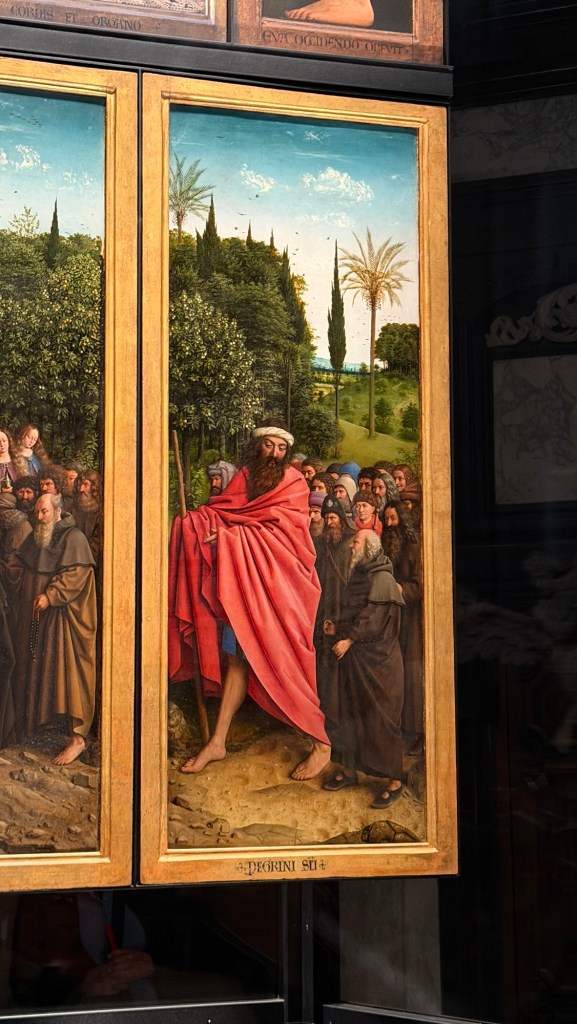
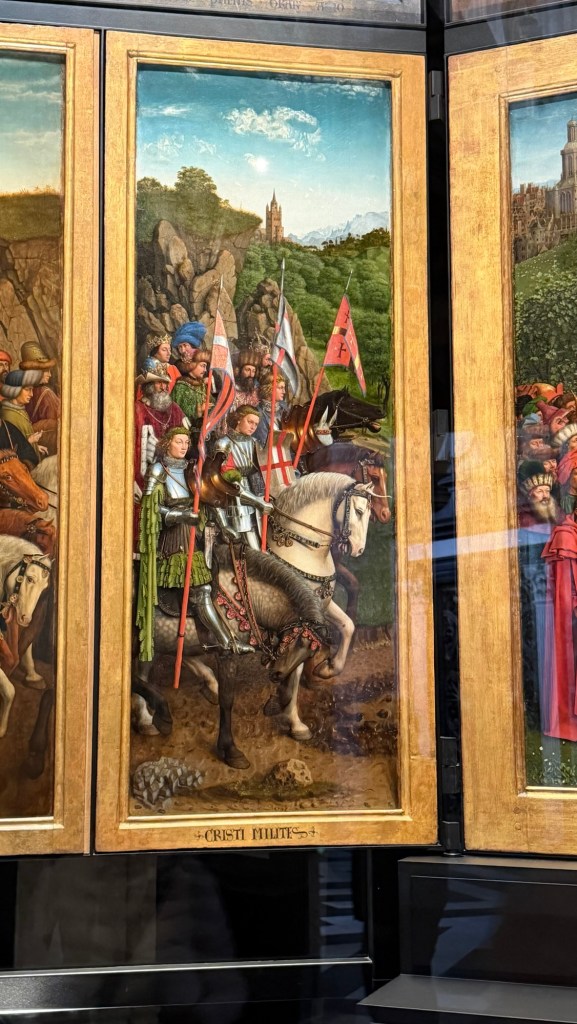
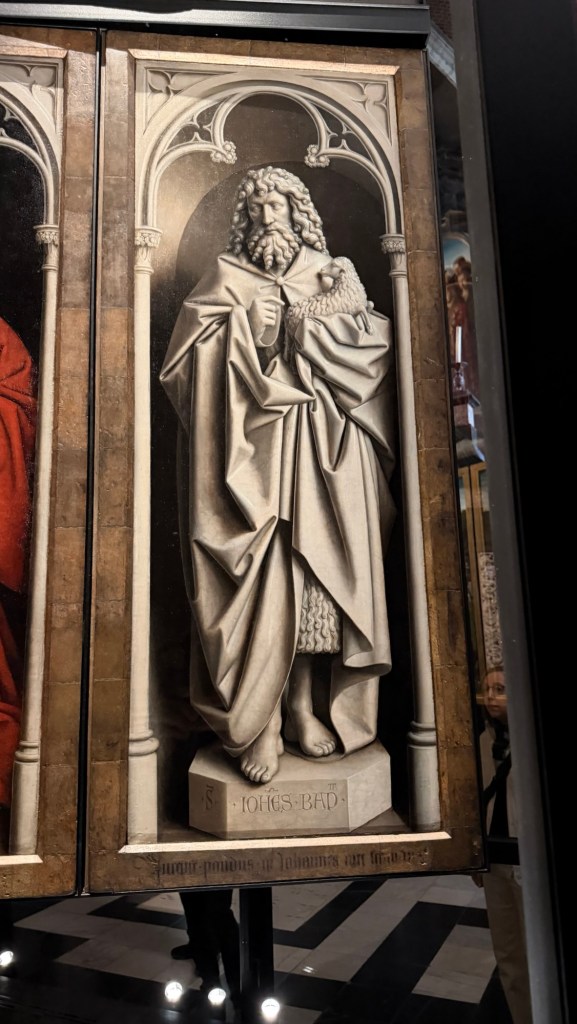
Completed in 1432, it was revolutionary for its time and is often considered one of the foundational masterpieces of Northern Renaissance art.
From almost the moment it was completed, the Ghent Altarpiece ceased to belong solely to the cathedral that housed it. Kings, conquerors, collectors, revolutionaries, and thieves all recognized that it is something extraordinary.
Over the centuries, parts of the work were hidden from religious iconoclasts, seized during political upheavals, carried off by Napoleon to Paris, recovered, dispersed again, and repeatedly fought over as empires rose and fell around it.
But the altarpiece’s most perilous journey came during World War II.
Following the Nazi occupation of Belgium, the altarpiece was confiscated and transported deep into the Austrian Alps, hidden inside the Altaussee salt mines alongside thousands of looted artworks destined for Hitler’s planned Führermuseum.
As the Third Reich collapsed, retreating Nazi officials reportedly prepared explosives to destroy the mines rather than allow the artworks to fall into Allied hands. The destruction was ultimately prevented, and in 1945 the Allied “Monuments Men” helped recover the Ghent Altarpiece from the salt mine before it could vanish forever.
Yet despite surviving emperors, revolutions, war, and the Nazis, one mystery surrounding the altarpiece remains unresolved.
In 1934, years before the Nazi seizure, one of its panels — The Just Judges — was stolen from Saint Bavo’s Cathedral under circumstances that remain baffling to this day. The thief demanded ransom and returned a companion panel as proof he possessed the original, but The Just Judges itself was never recovered.
On his deathbed, the primary suspect reportedly claimed that he alone knew where the missing panel had been hidden, adding cryptically that it could not be retrieved without attracting public attention.
Somewhere, perhaps still hidden within Ghent itself, one of the most sought-after missing works of art in the world may still exist.
To this day, the original panel remains missing.
Closed, the altarpiece appears restrained and solemn, painted in muted tones with saints, prophets, donors, and scenes of the Annunciation. But when opened, it explodes into color, detail, and symbolism.
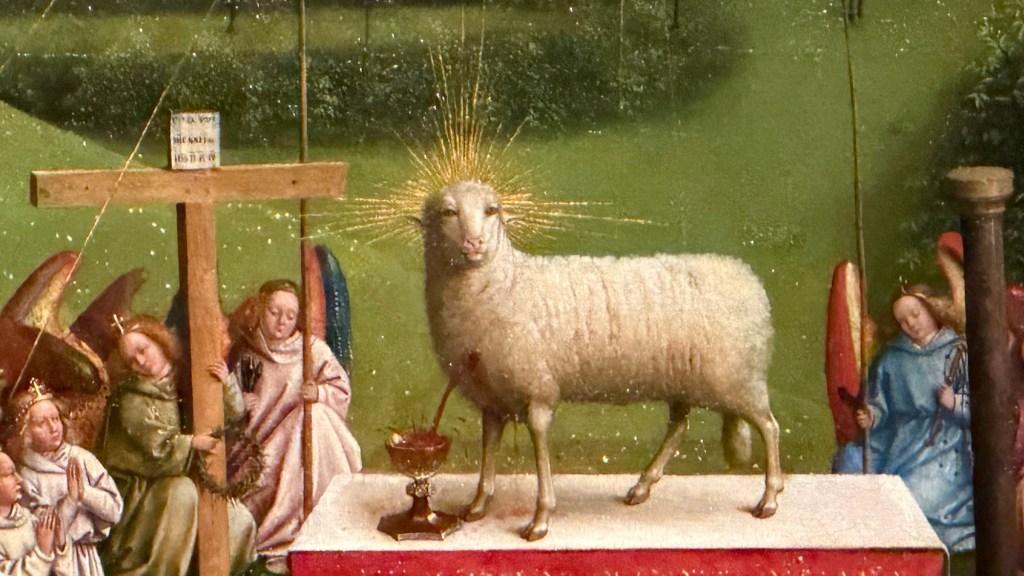
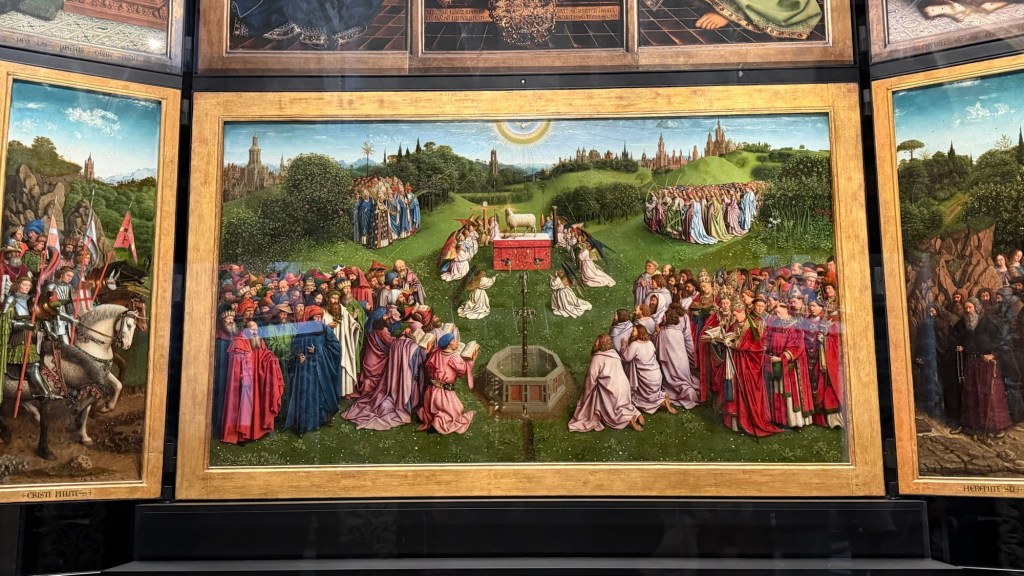
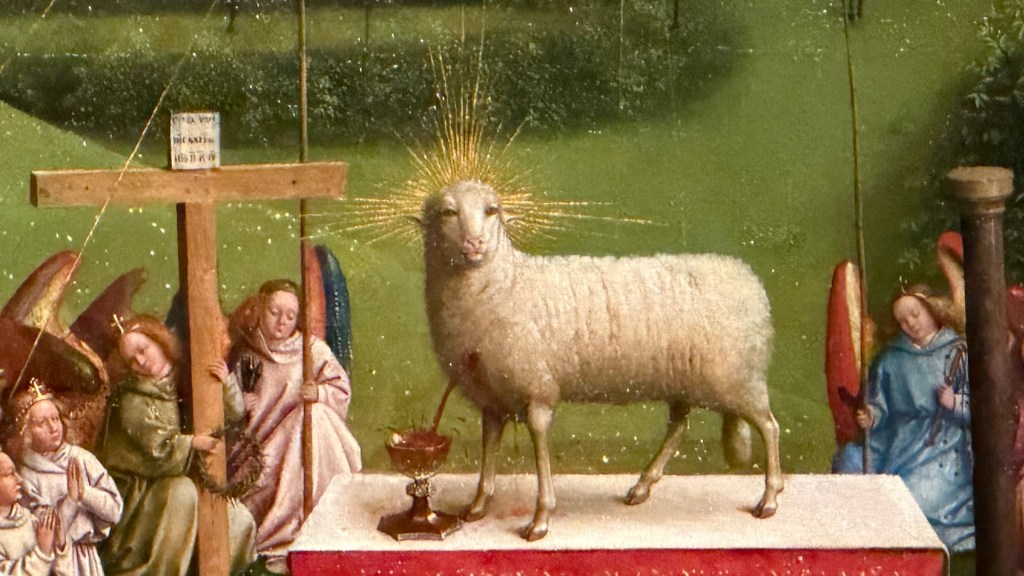
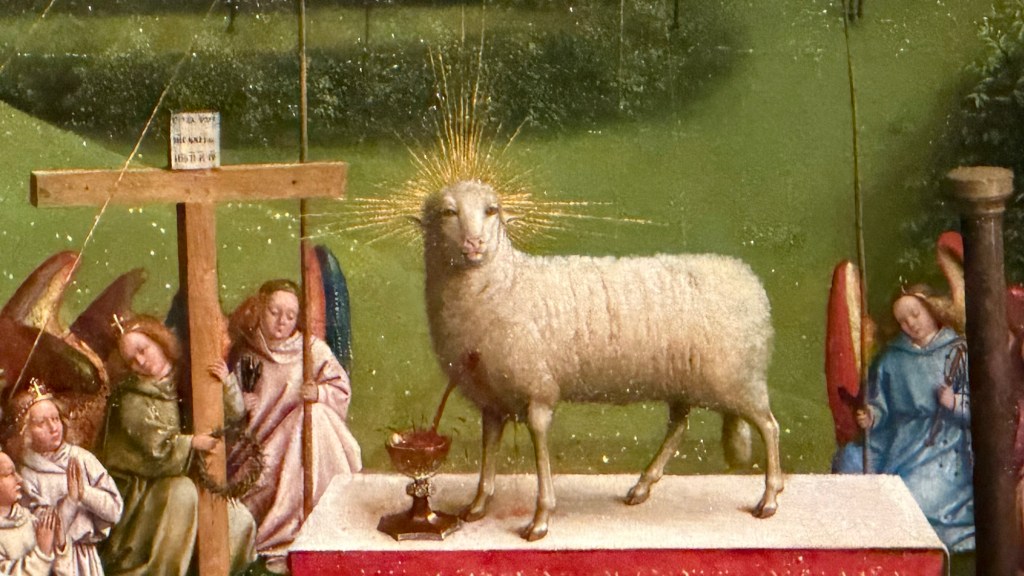
At the center stands the mystical lamb upon an altar, blood flowing into a chalice — the central symbol of Christ’s sacrifice — while saints, martyrs, pilgrims, judges, knights, and worshippers converge toward it from every direction across an impossibly lush heavenly landscape.
What astonishes most is not only the symbolism, but the realism. Armor catches and reflects light as though polished yesterday. Fabrics gather and fold with natural weight. Jewels glimmer. Flowers, grasses, and individual strands of hair are rendered with microscopic precision. Faces seem inhabited by actual thought rather than painted expression.
Even after nearly six centuries, the panels appear somehow illuminated from within, as though light is emanating from the painting itself rather than merely falling upon it.
And then there is the lamb itself.

After a painstaking sixteen-year restoration, conservators uncovered something astonishing. Beneath centuries of overpainting, the original face painted by Jan van Eyck emerged — and the lamb’s eyes were strikingly, almost unsettlingly, human.
Looking closely, the effect becomes even more uncanny. The eyes sit unusually forward and meet the viewer directly, not with the passive expression of an animal, but with something closer to human awareness. The ears stand sharply alert, slightly asymmetrical, as though listening. The gaze feels conscious. Intentional.
For generations, viewers had known only the later overpainted version, whose face appeared softer and more conventionally animal-like. The restoration revealed that van Eyck’s original vision was far stranger, more direct, and far more confrontational.
And that raises the question: for a painting so obsessed with realism and microscopic detail, why deliberately give the lamb human eyes?
Van Eyck was clearly capable of rendering animals naturally. Every fold of wool, every blade of grass, every reflection and texture throughout the altarpiece demonstrates astonishing observational skill. Which makes the gaze impossible to dismiss as accident. The eyes are a choice.
Standing before it, the thought kept returning: Humanity, what have you done?
The lamb’s stare does not feel passive or innocent. It feels knowing. Confrontational. Almost accusatory. To modern eyes, it can seem less like a sacred symbol looking upward toward heaven and more like a living being looking directly back at mankind itself.
Learning the layers, symbolism, and hidden details of these panels could take a lifetime. Every figure, gesture, flower, jewel, and landscape seems to carry meaning. Scholars have spent centuries studying the Ghent Altarpiece and still debate aspects of it today.
I only had minutes.
Yet even in that short time, the work overwhelmed me — not just with technical brilliance, but with the sense that you are standing before something inexhaustible. The longer you look, the more the painting seems to open itself layer by layer, as though it contains far more than a single viewing could ever reveal.
Chocolatiers
From the Lamb we proceeded, perhaps appropriately, to no fewer than three chocolatiers.
If the Ghent Altarpiece represented the heights of Flemish art in the 15th century, Belgian chocolate seemed to demonstrate that the local obsession with craftsmanship never really disappeared—it simply found new materials.
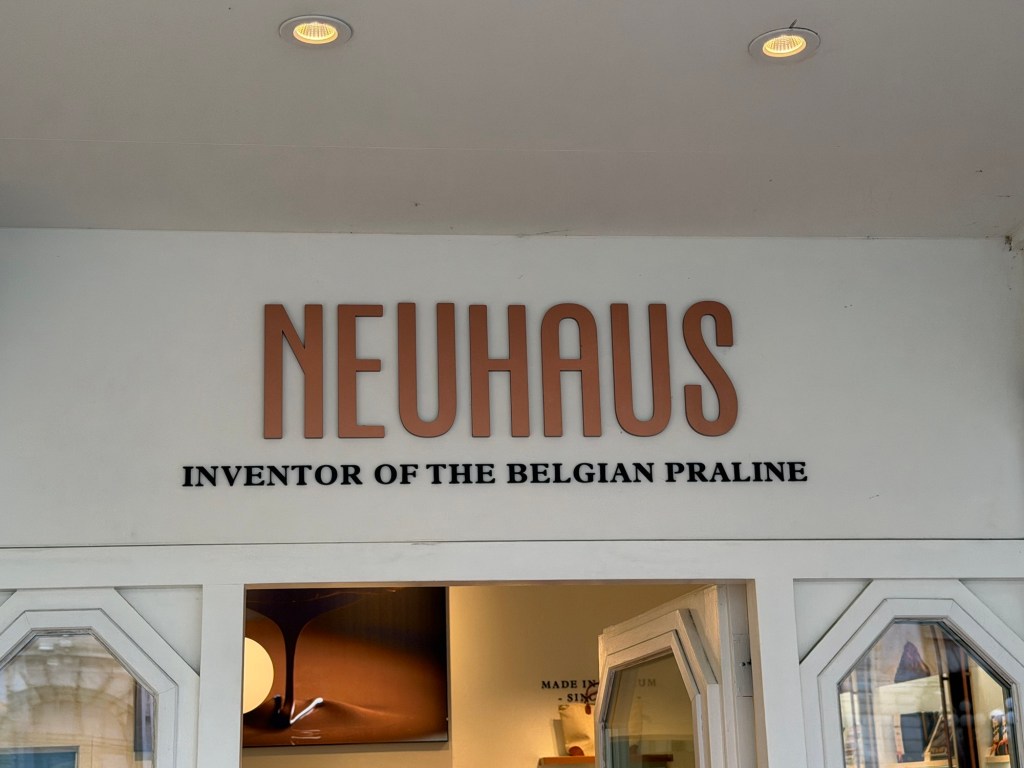
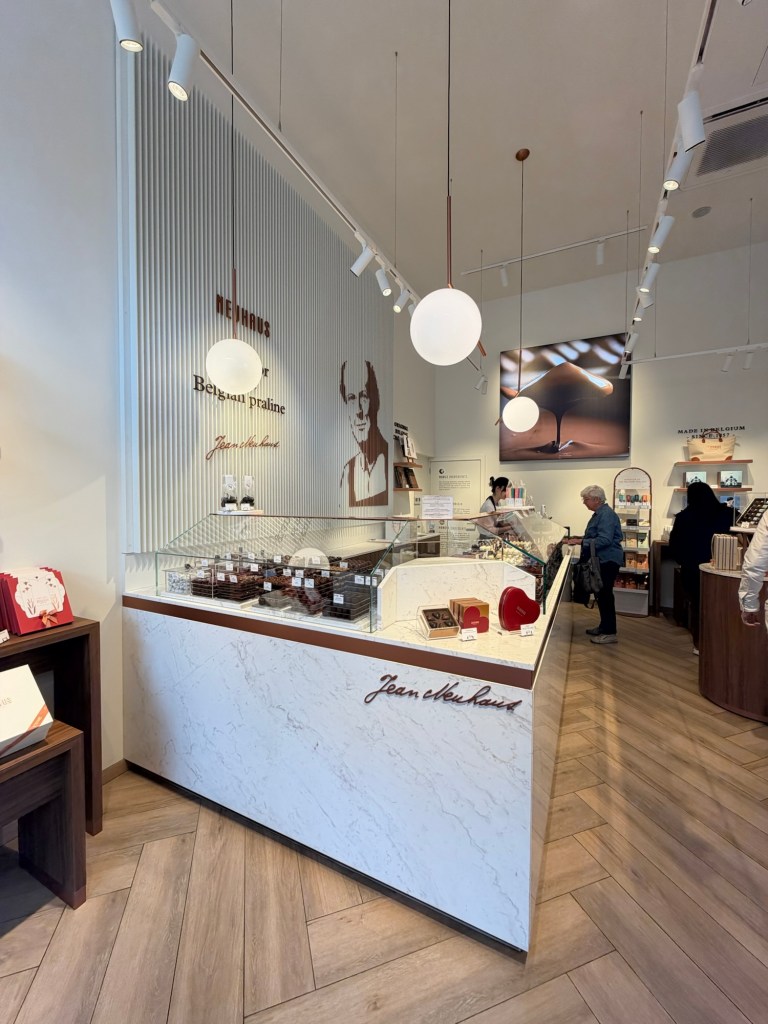
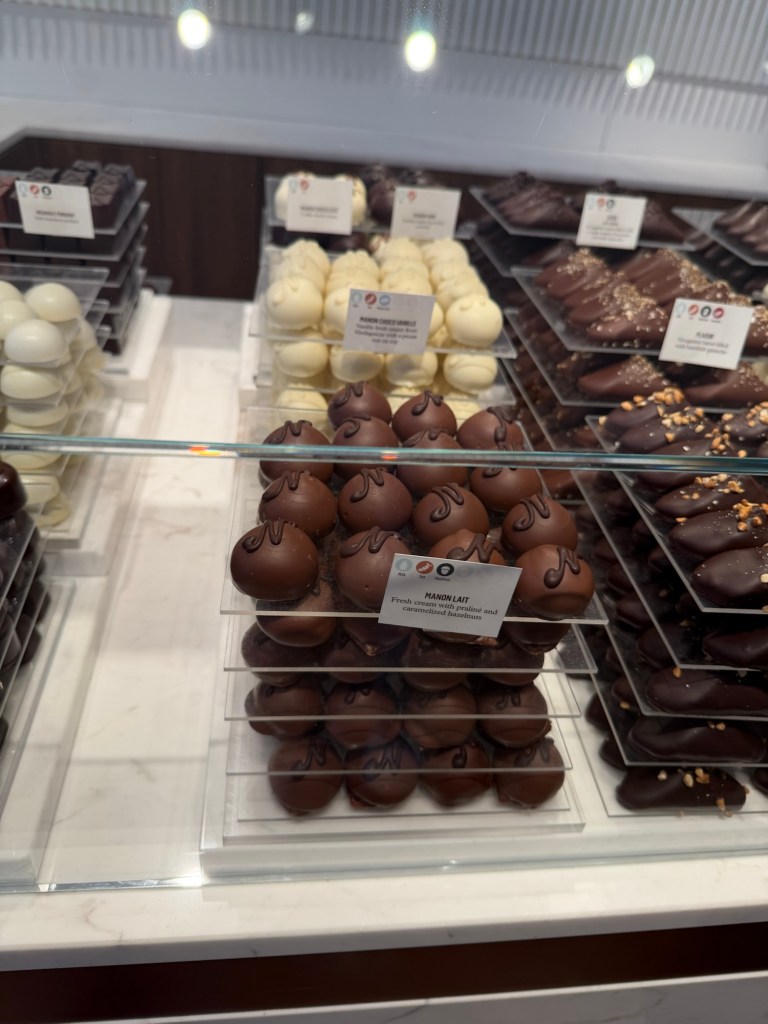
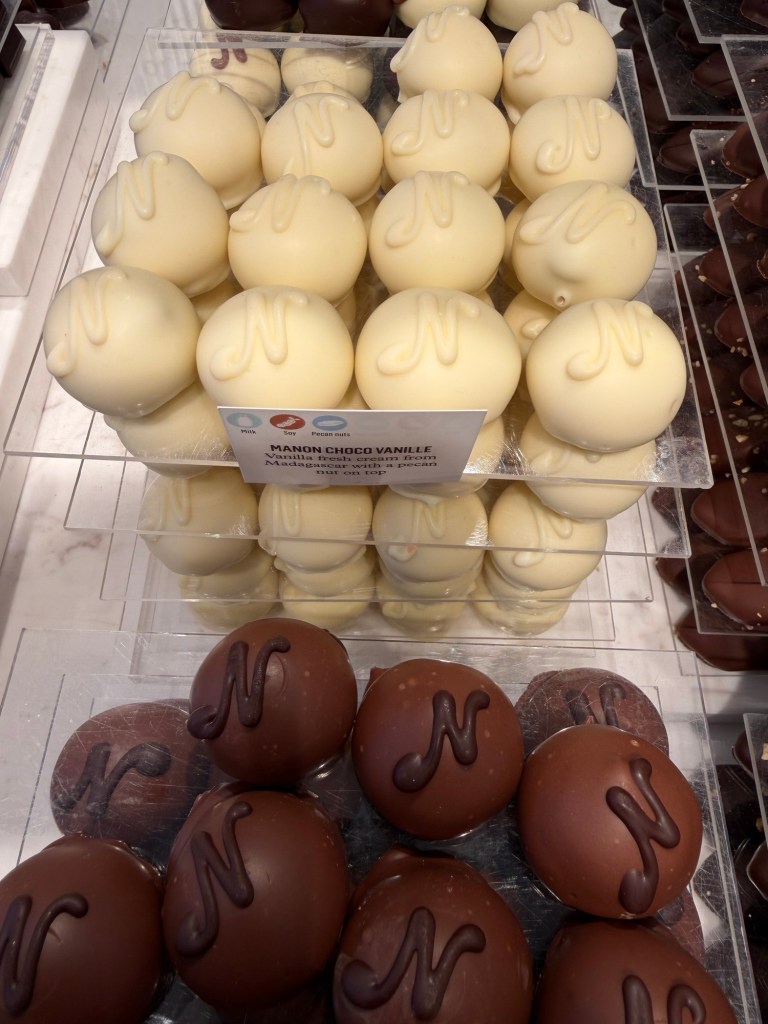
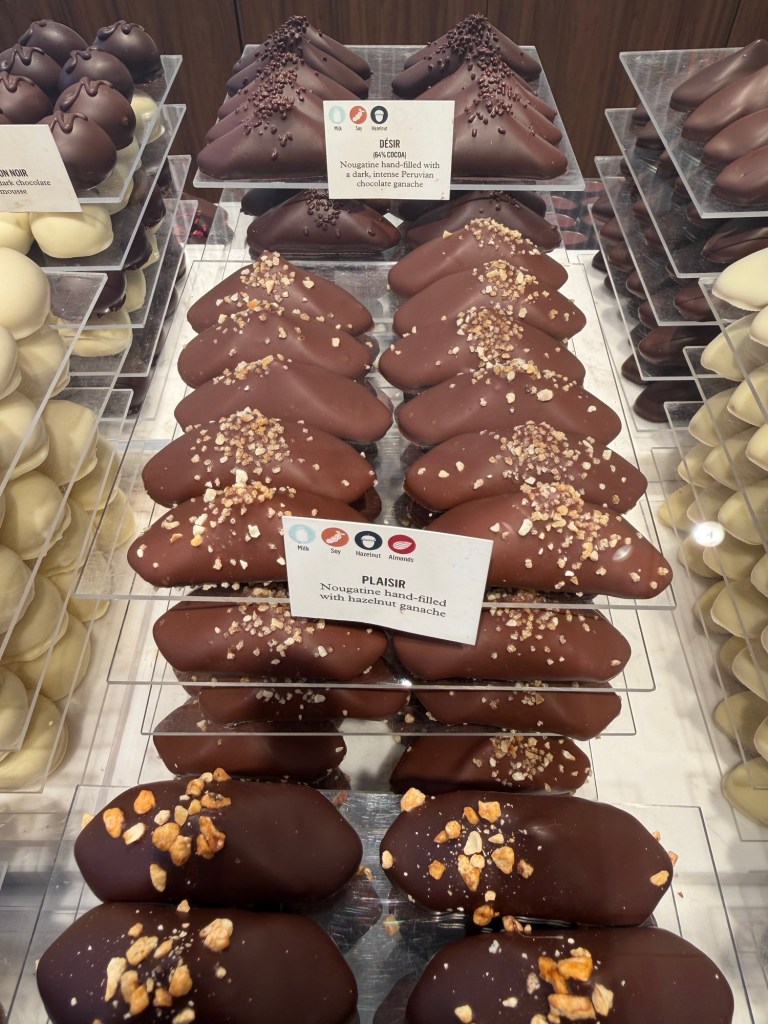
At Neuhaus (www.neuhauschocolates.com), proudly identifying itself as the inventor of the Belgian praline, the chocolates were presented almost like jewelry: geometric, polished, impossibly precise. Every surface gleamed. Even the packaging felt architectural.
Unlike some of the smaller artisanal shops we visited later, Neuhaus is a major Belgian chocolatier that originated in Brussels and has spread internationally, with boutiques now found around the world. Yet despite its scale, the quality remains unmistakable. This is seriously good chocolate — rich, refined, and crafted with the kind of precision Belgium seems to apply to nearly everything it values.

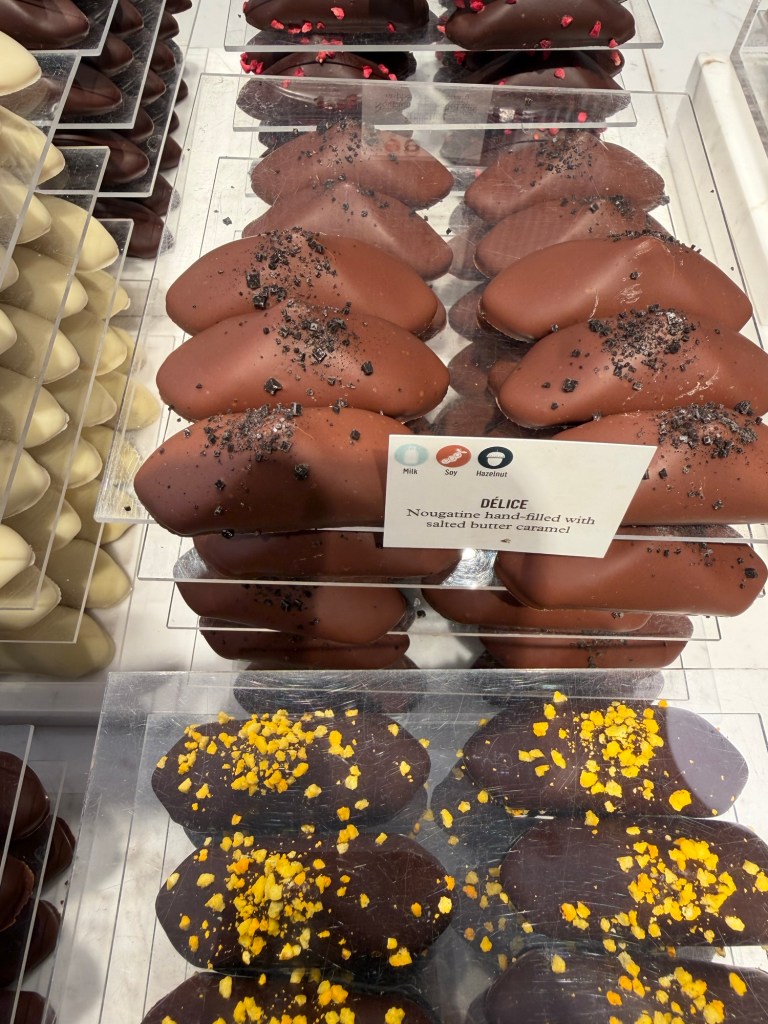
Then came Vanden Bouhede (www.chocolaterie-vandenbouhede.be), the chocolates moved beyond confection into something closer to edible sculpture. Some even resembled polished stones or planets.
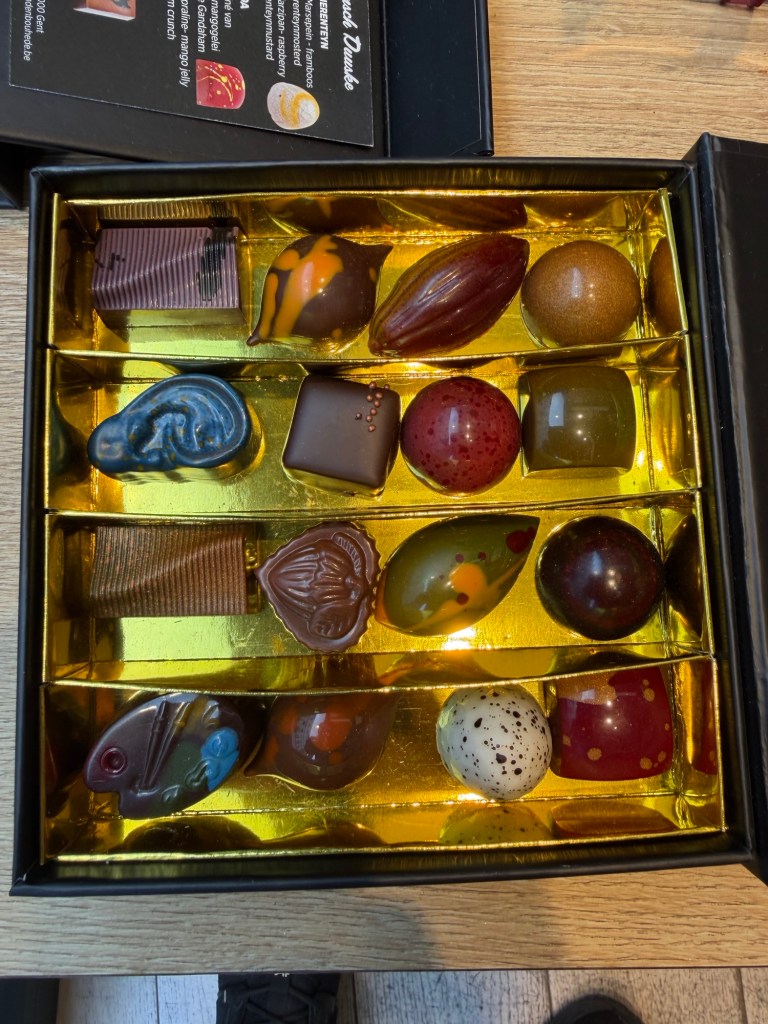
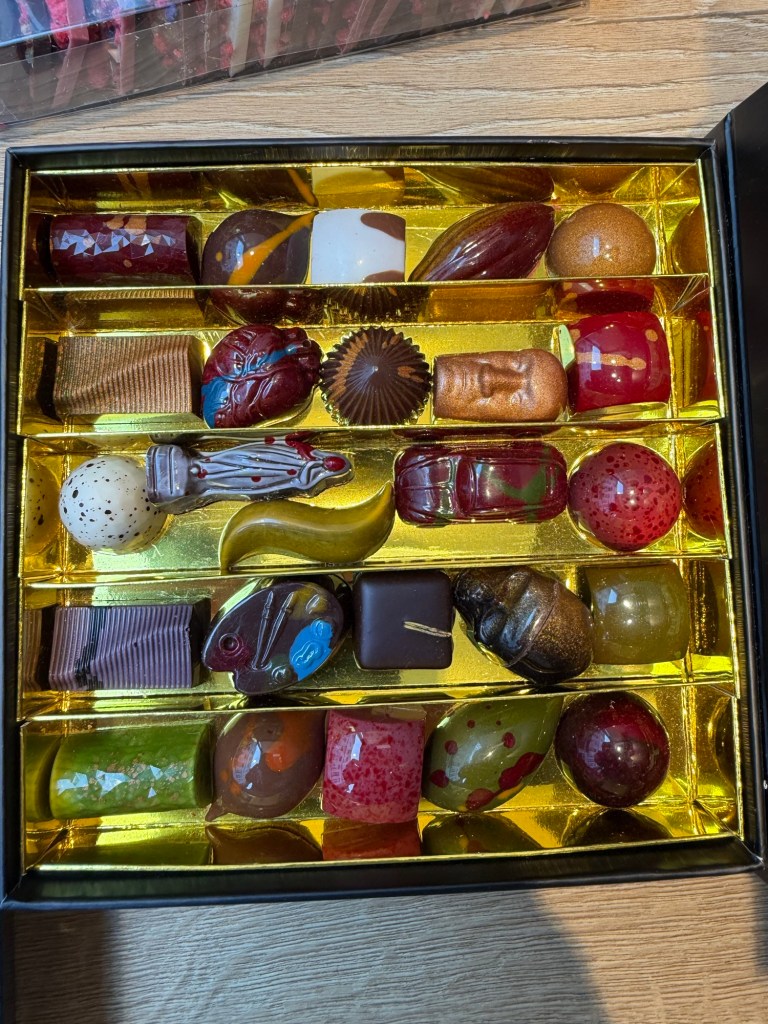
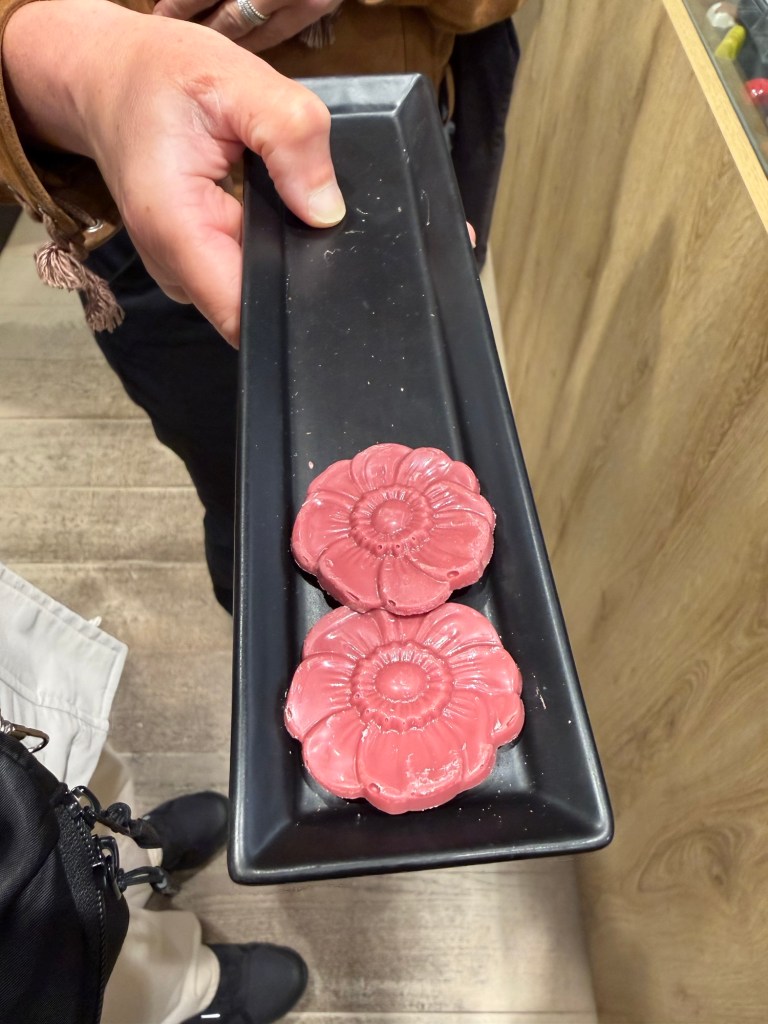
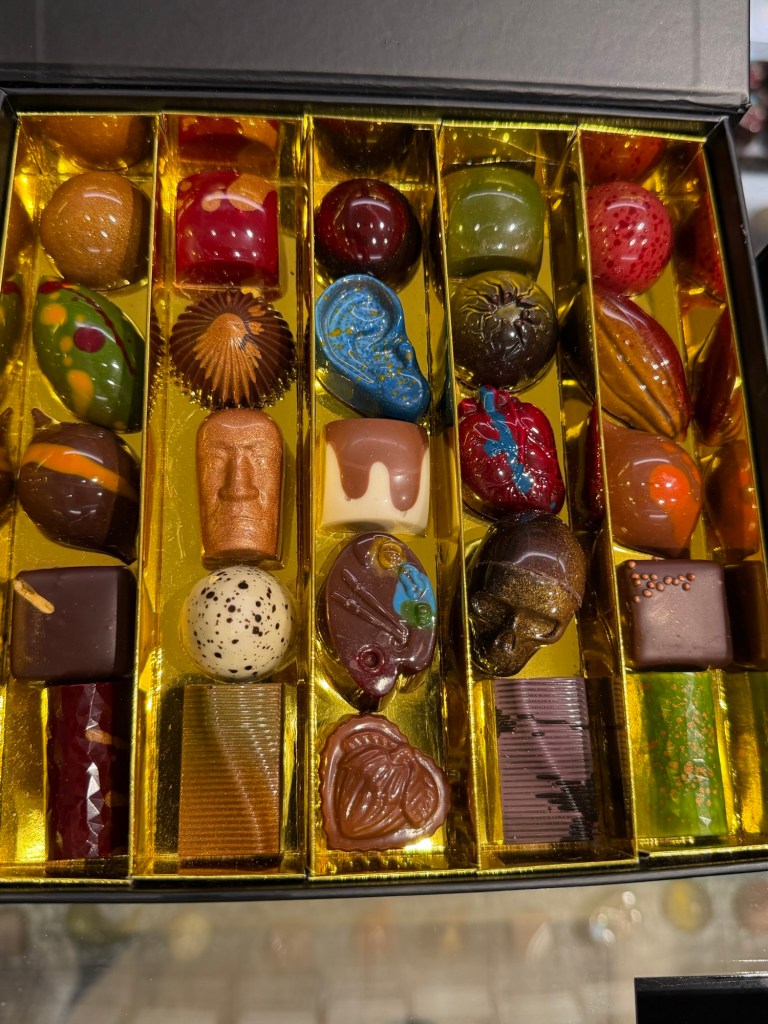
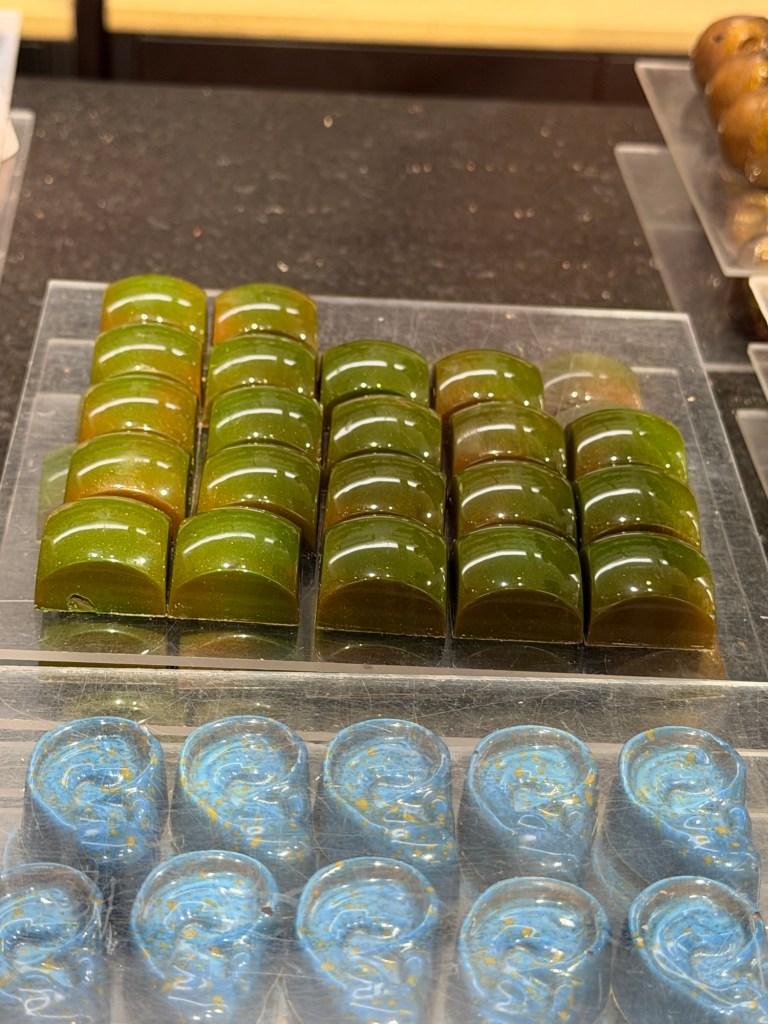
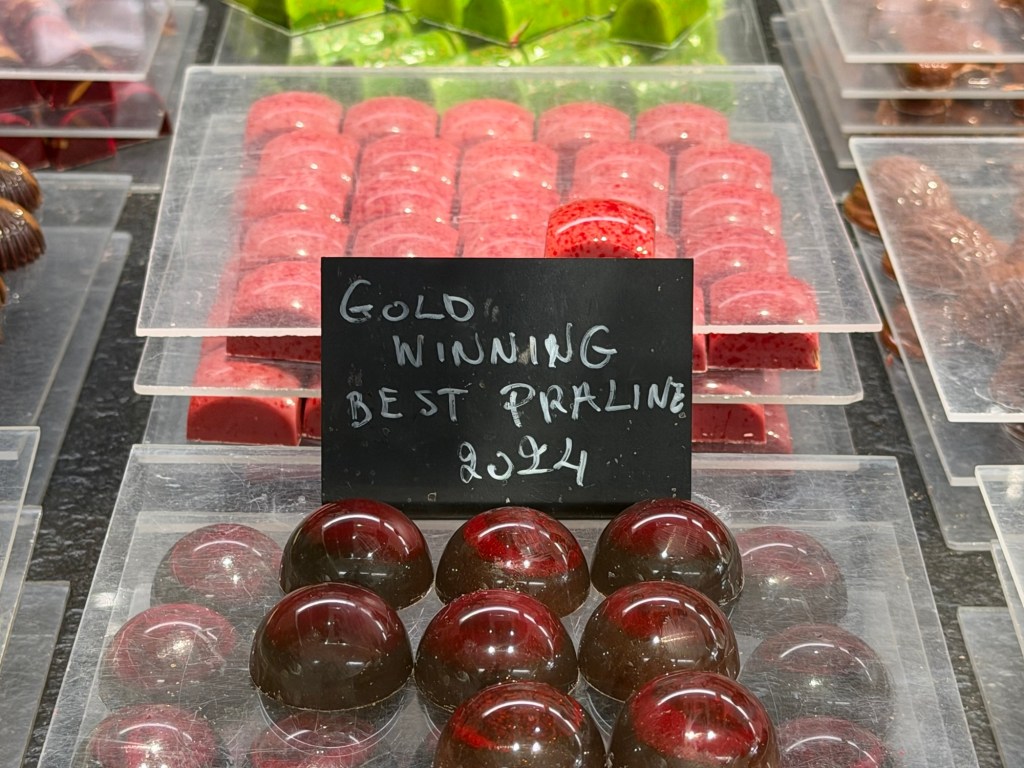
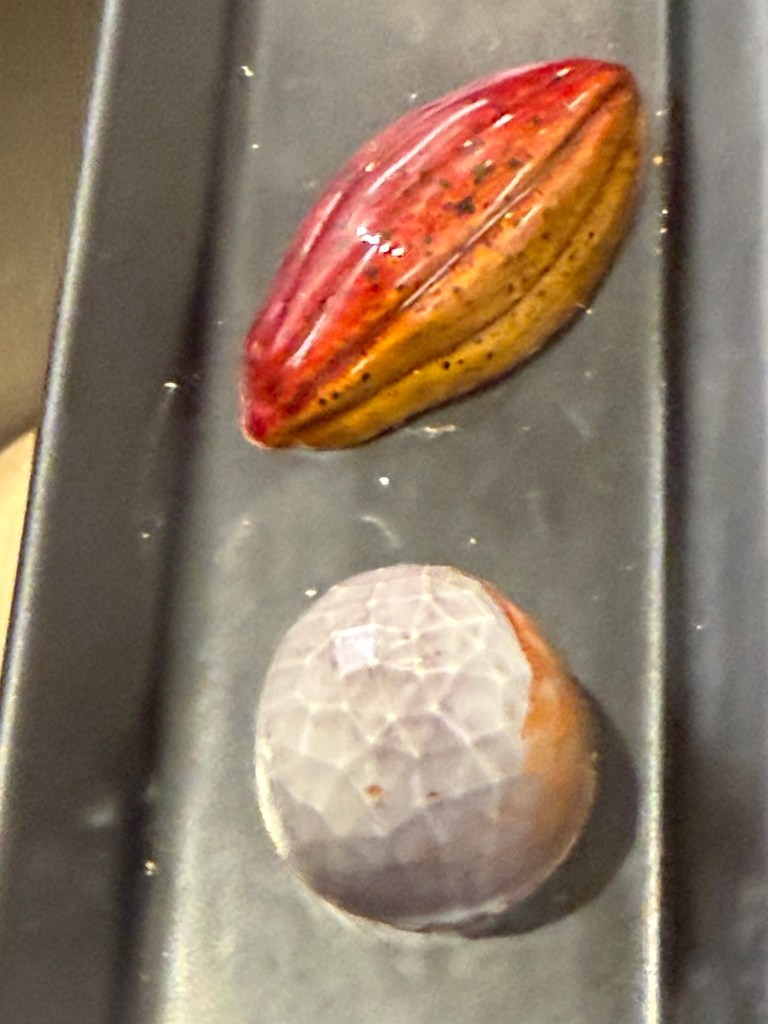
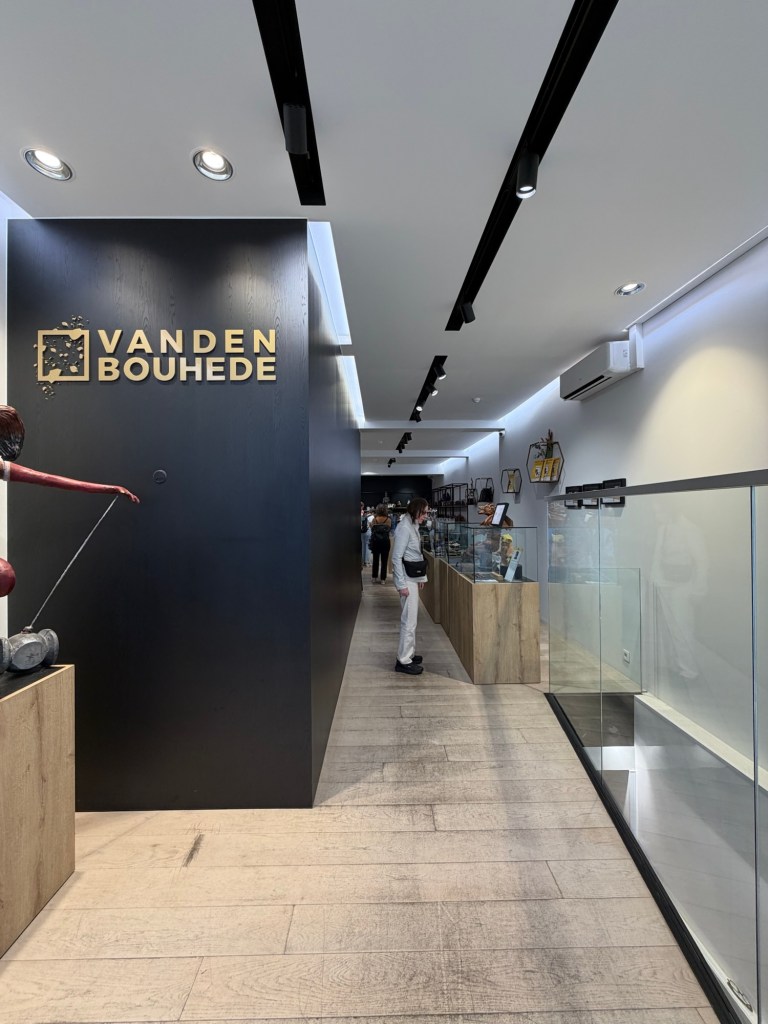
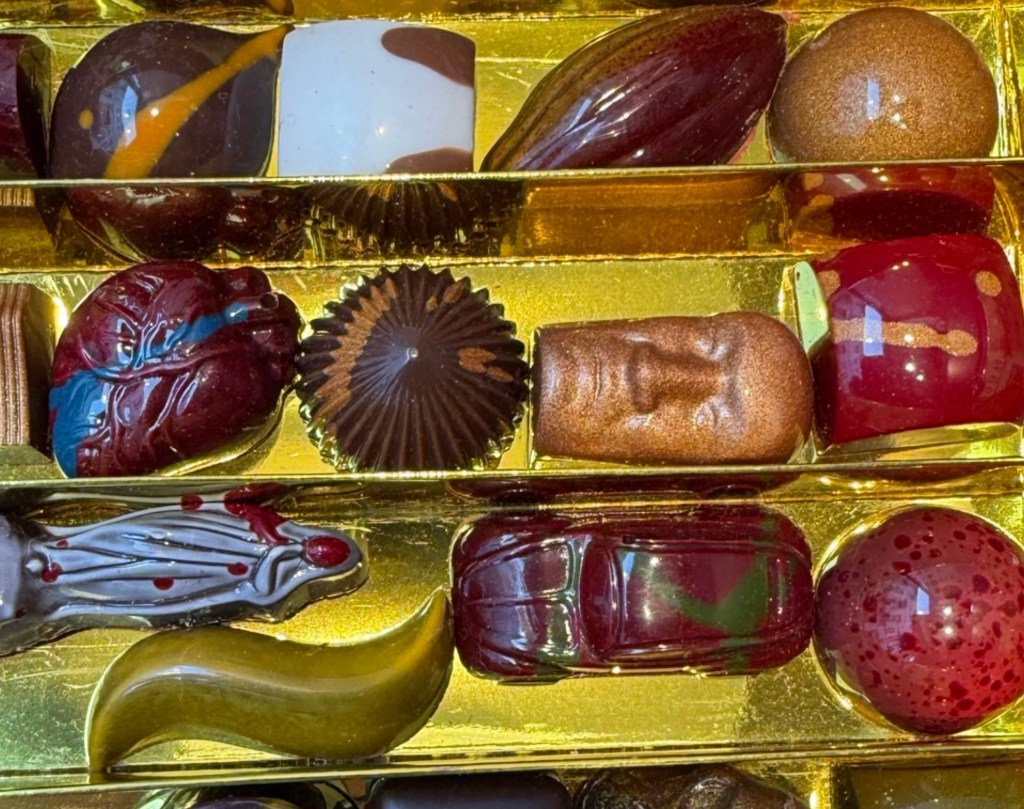
Others looked like abstract modern art. One piece appeared to be a tiny bronze-like human face emerging from the tray like an artifact from an archaeological dig. I tried one that included mustard as an ingredient.
The third stop was Eduard T’Syen Chocolatier (www.deduytschaever.be), which felt entirely different from the earlier shops. Where the pralines at Neuhaus were polished and jewel-like, and the creations at Vanden Bouhede leaned toward edible sculpture and artistic experimentation, T’Syen’s chocolates were restrained, minimalist, and almost architectural.
Many were sharply geometric — clean cubes, smooth domes, precise rectangles — finished in muted matte tones rather than glossy excess. Some appeared dusted in soft earth colors or wrapped in delicate textures that made them resemble tiny pieces of contemporary design more than candy. Even the packaging reflected the same aesthetic: understated, disciplined, and exact.
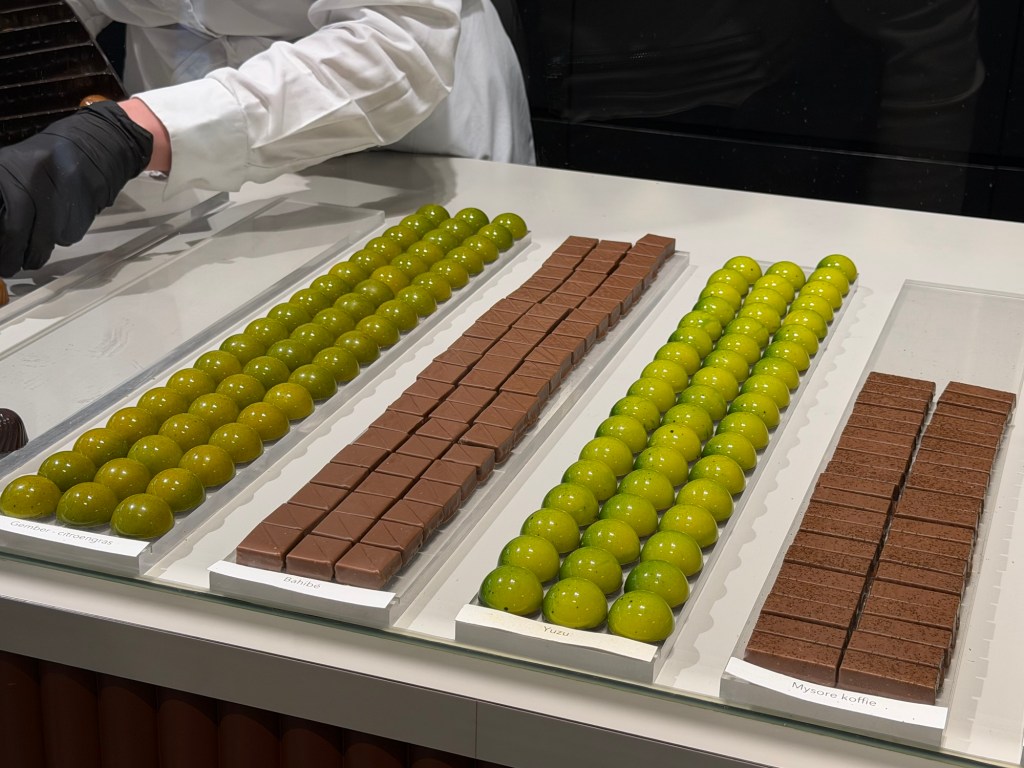
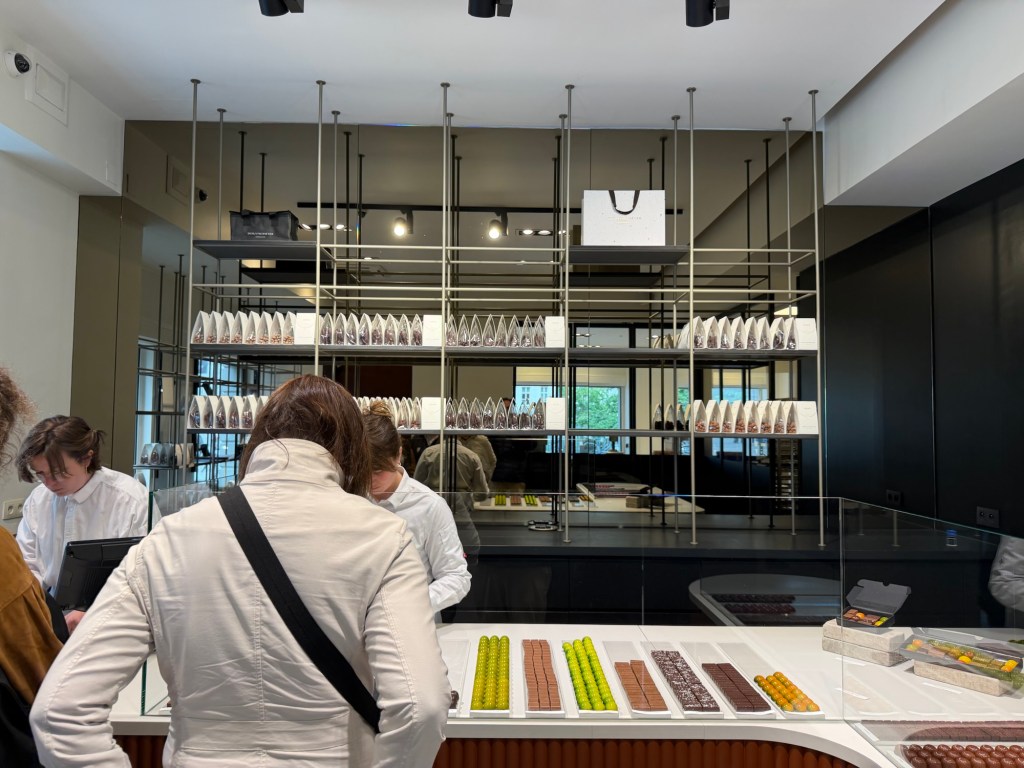
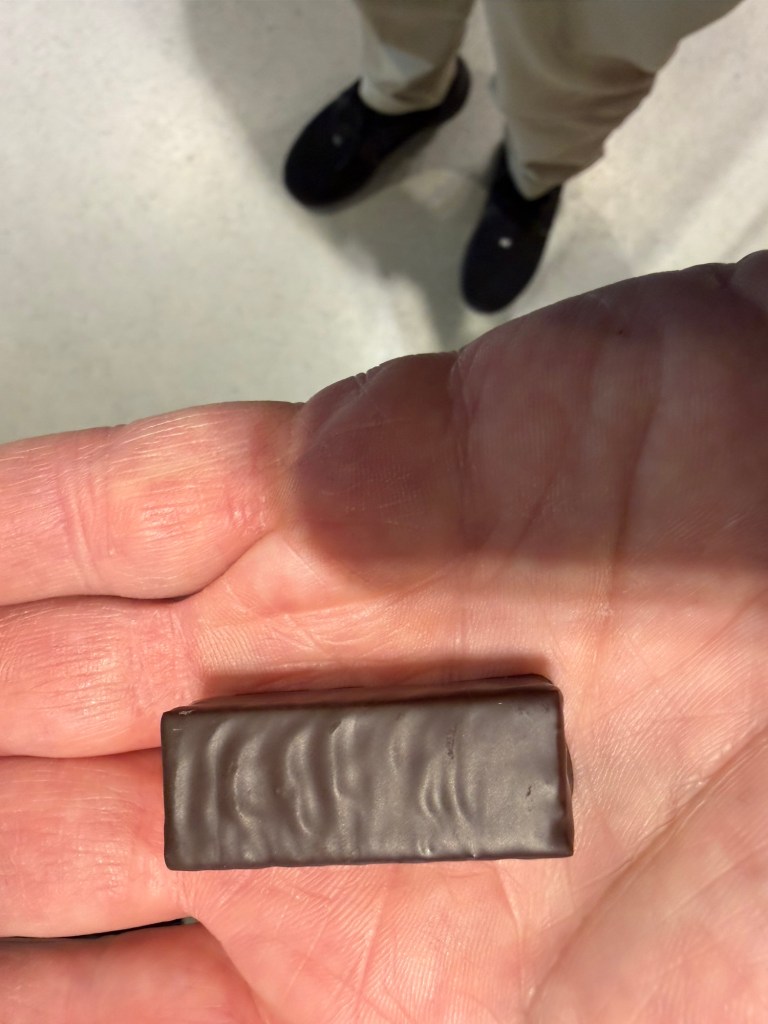
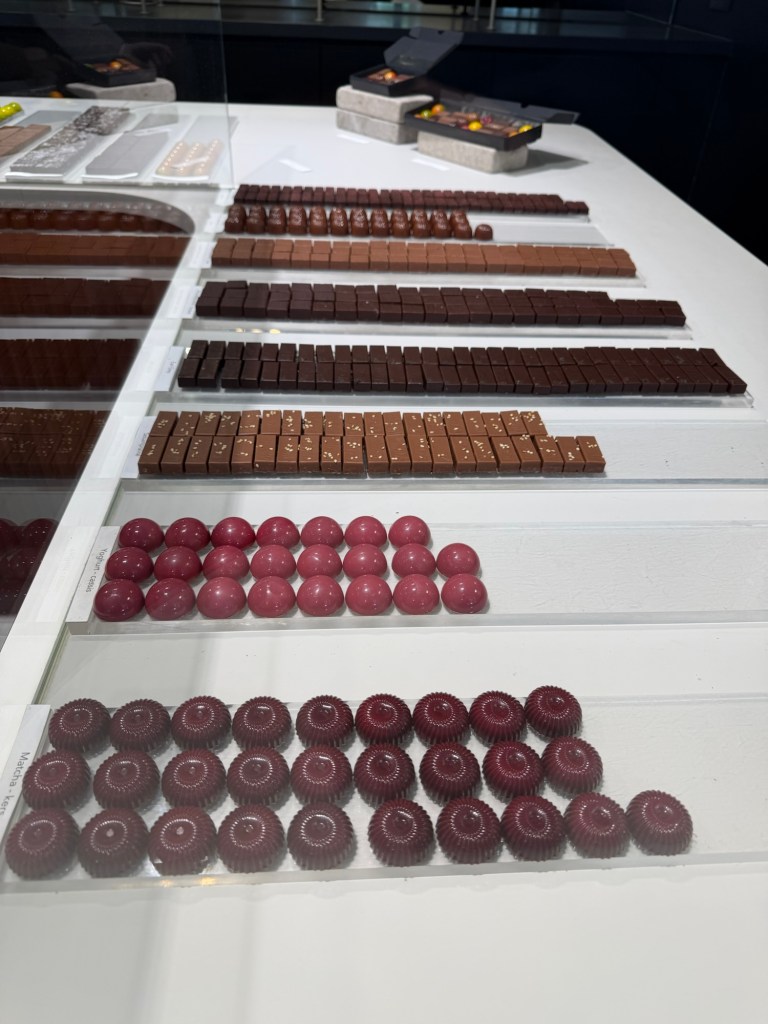
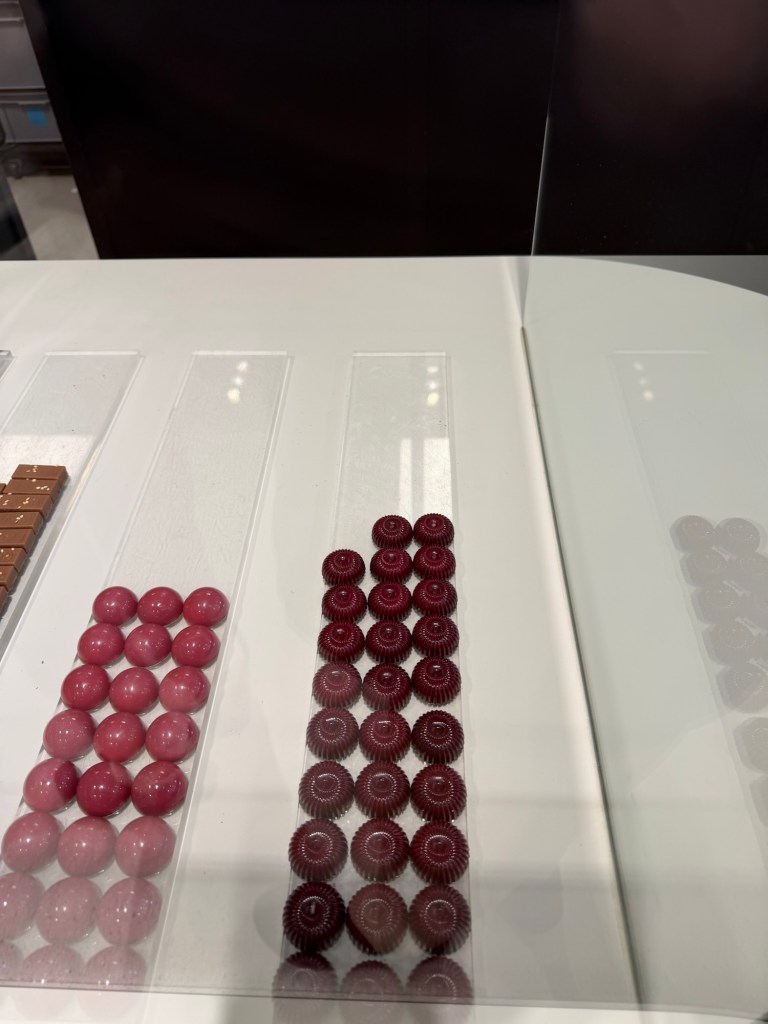
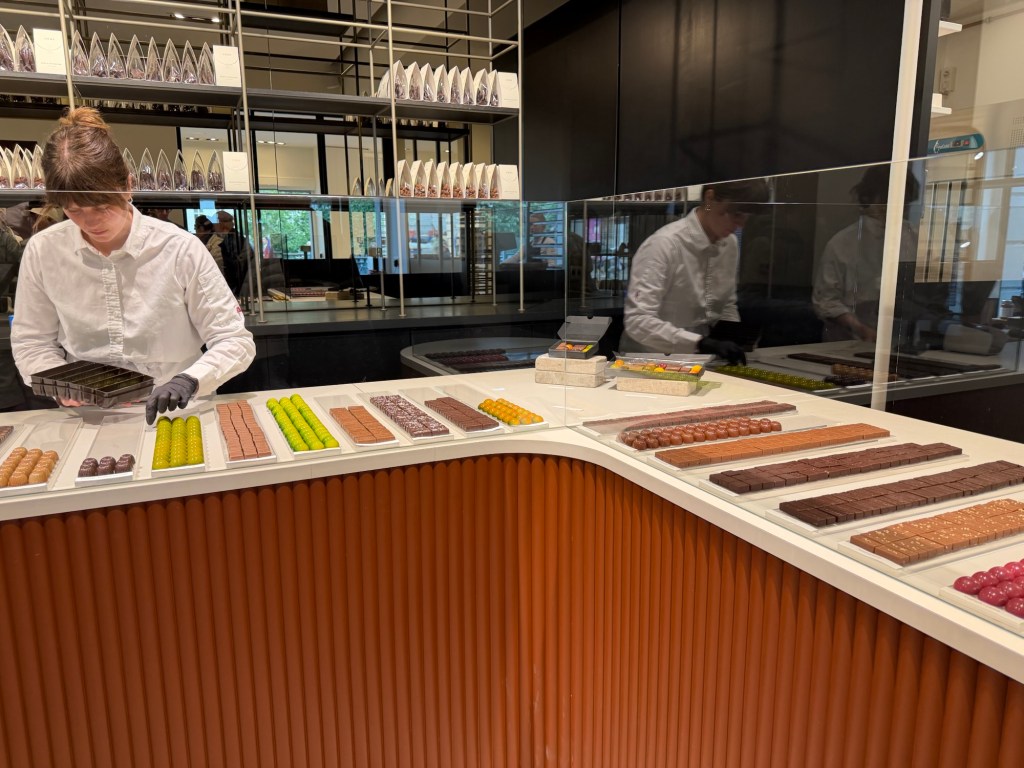
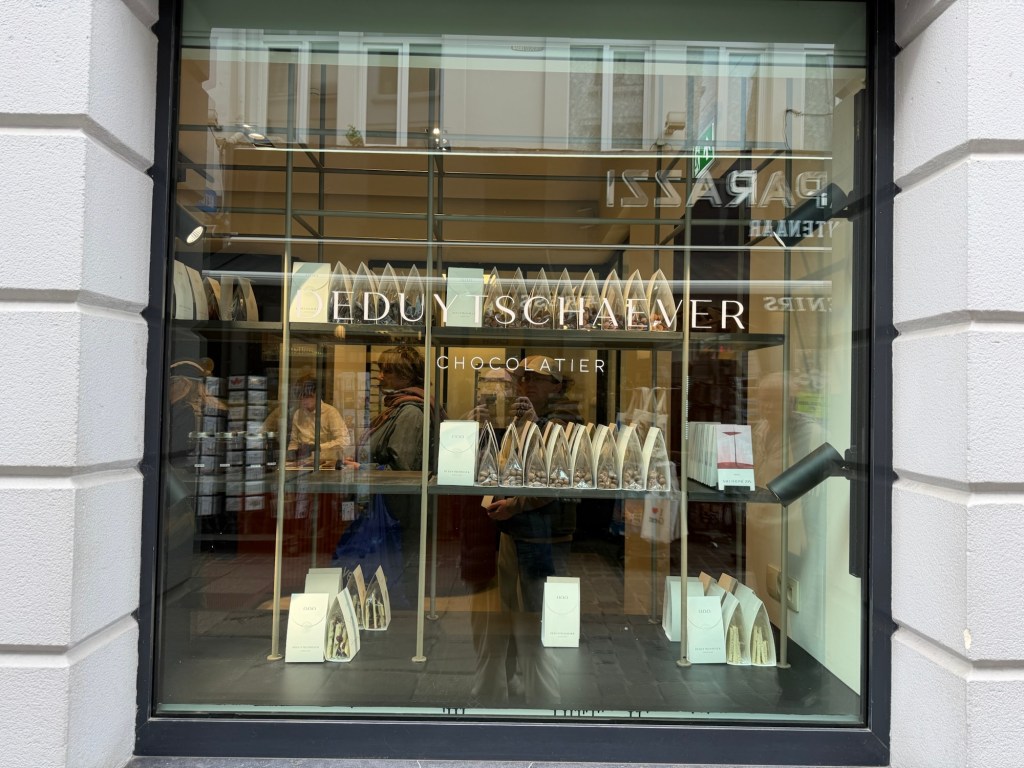
lf the earlier chocolatiers evoked Flemish richness and ornament, T’Syen felt distinctly modern Belgian — less theatrical, more controlled, relying on proportion, balance, and precision rather than visual exuberance. They looked less like sweets waiting to be eaten and more like objects displayed in a design gallery.
By then a pattern had become unmistakable: in Belgium, chocolate is treated less as candy and more as design, architecture, and craft.
Then Sophie led us into one of Ghent’s changing galleries — the graffiti alley, where the walls are never really finished and every layer covers another story beneath it.
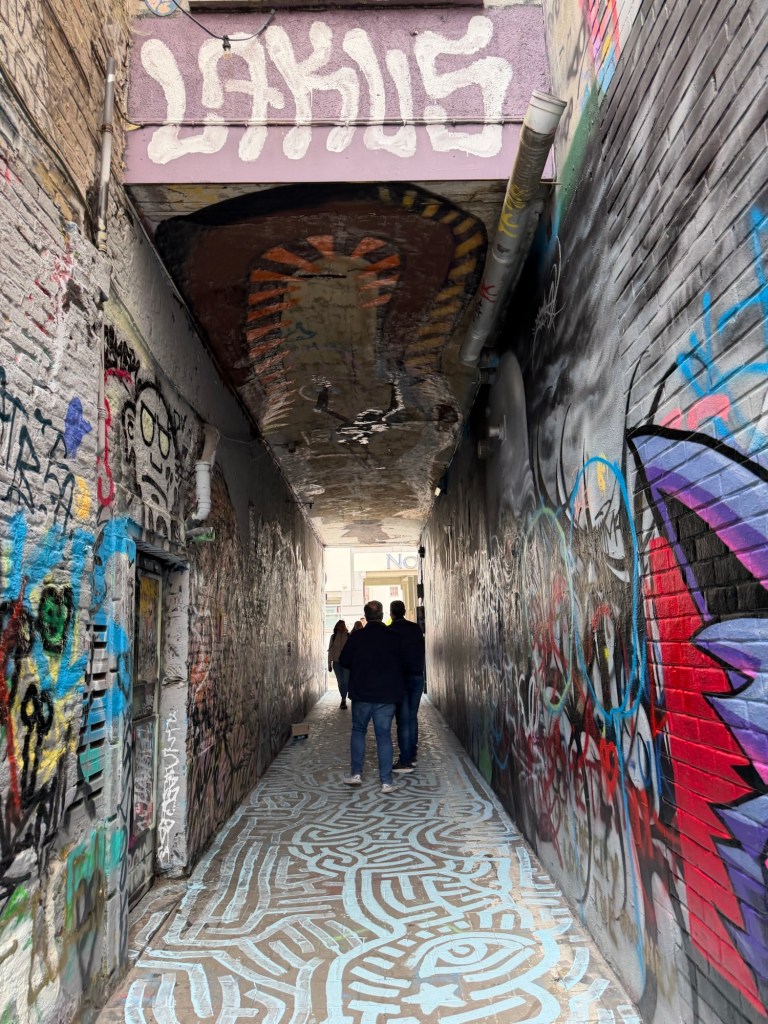
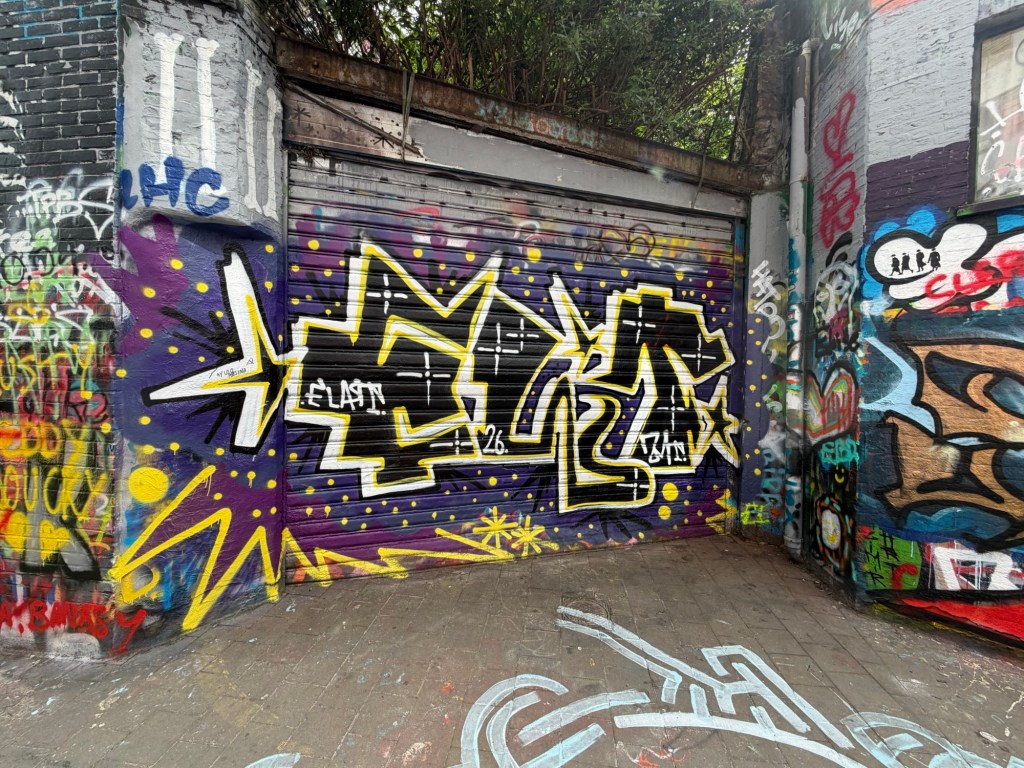
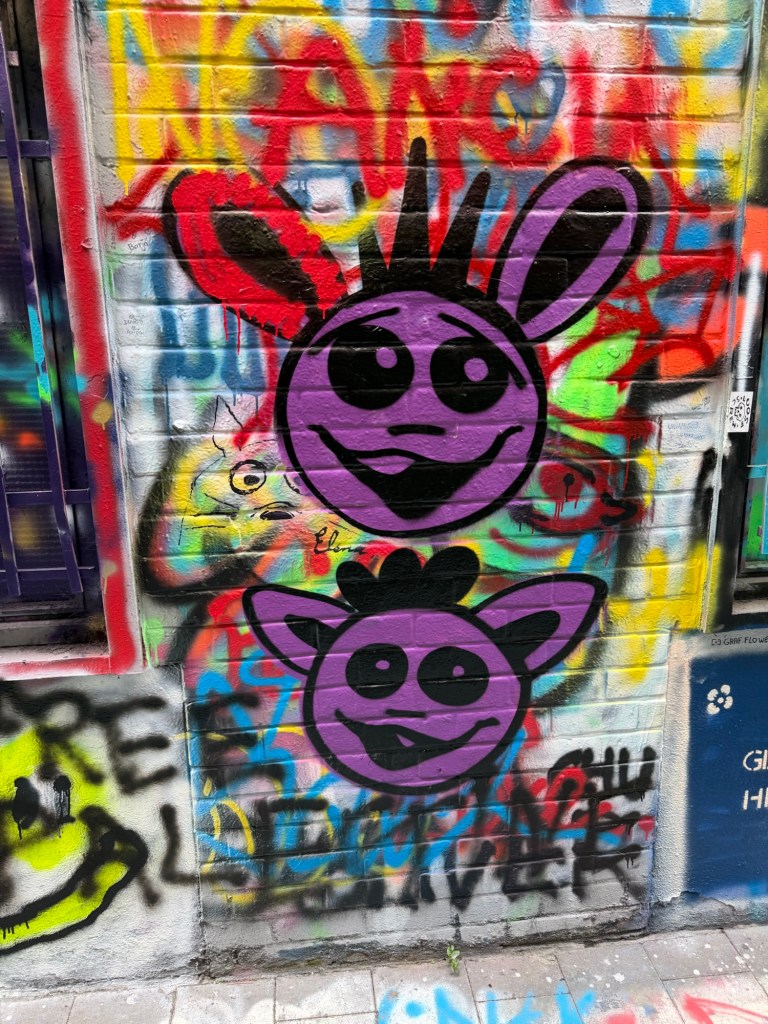
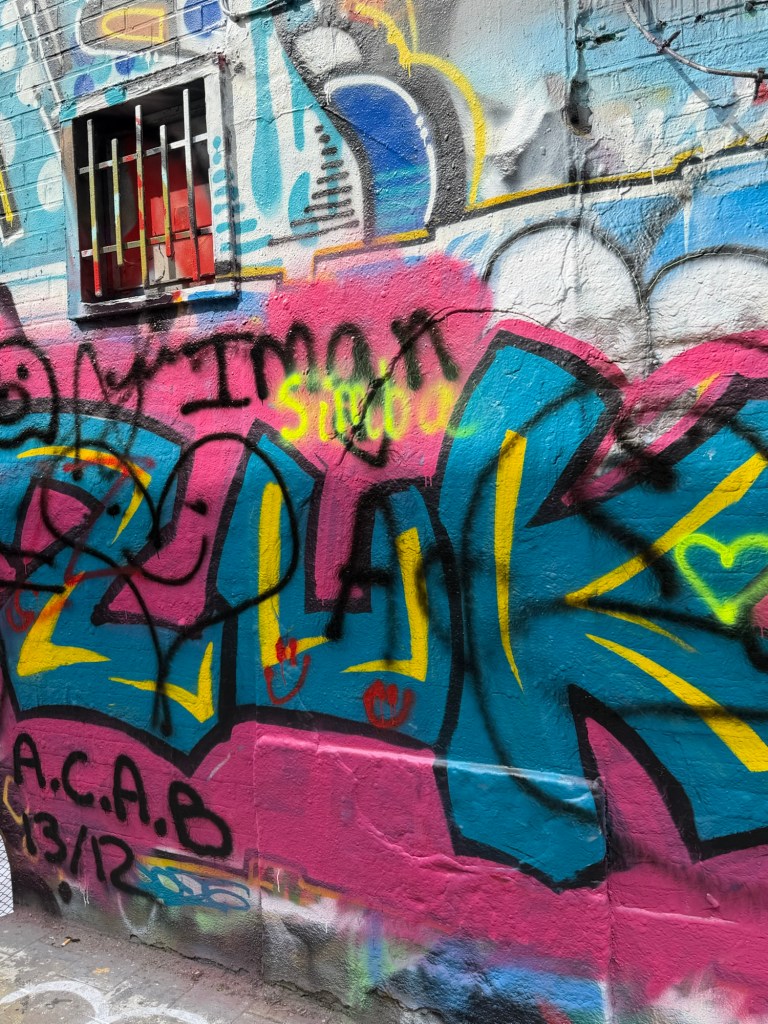
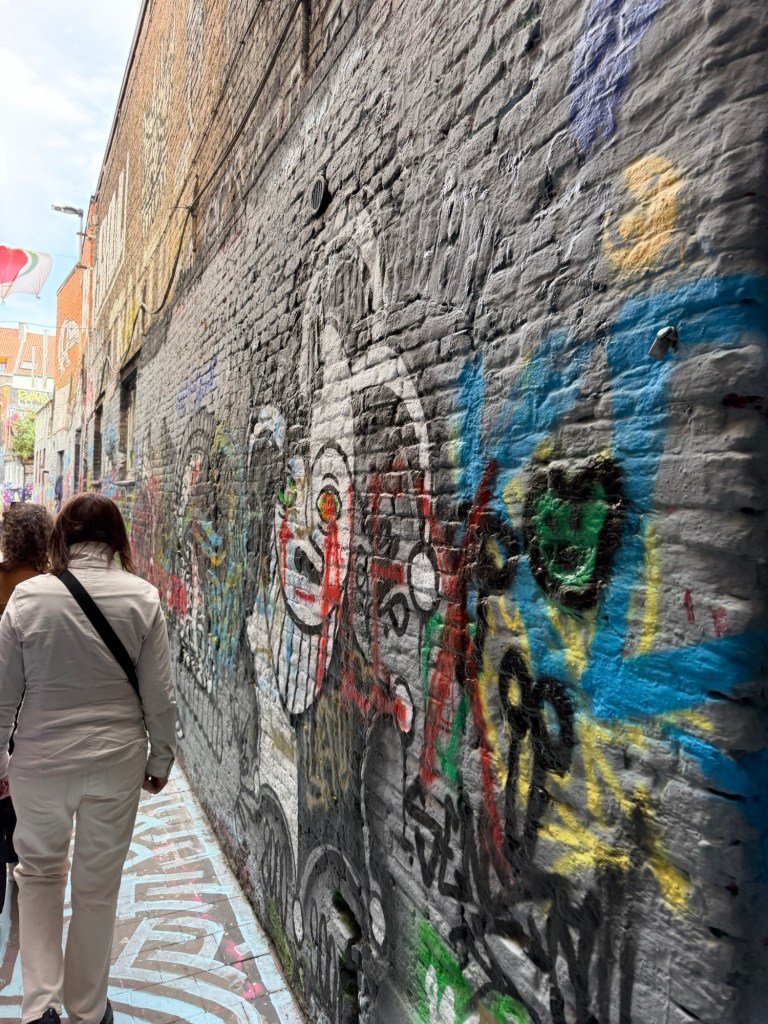
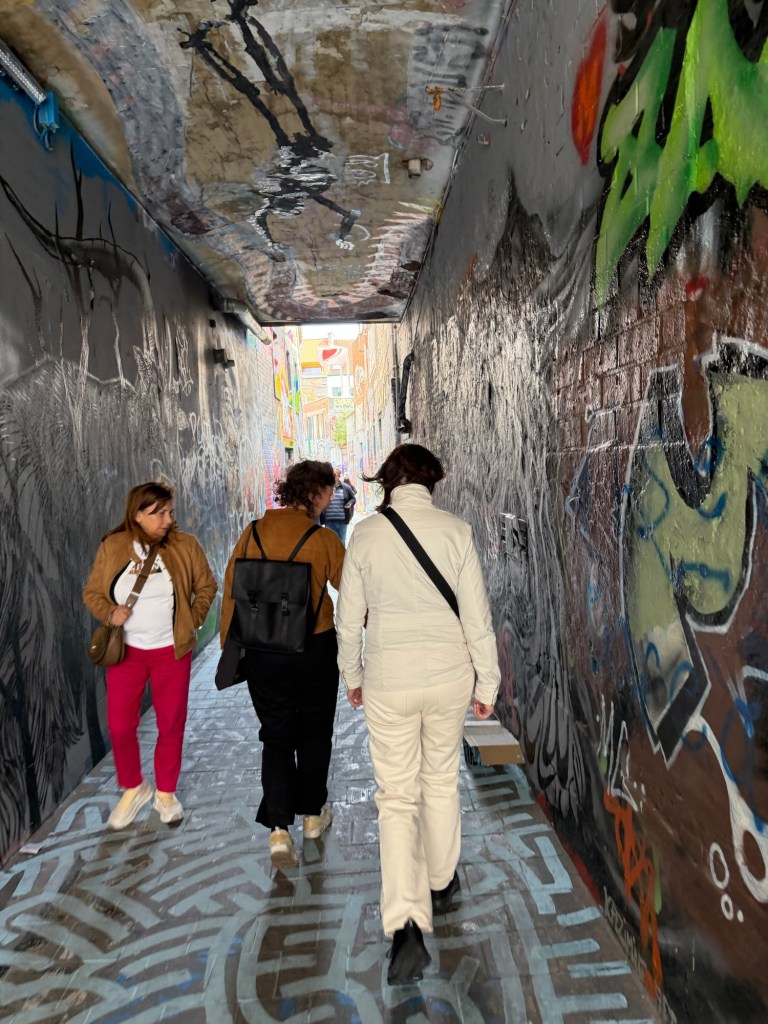
Armed with spray paint and absolutely no artistic credentials, we added two names of our own: our cat, and our granddaughter.
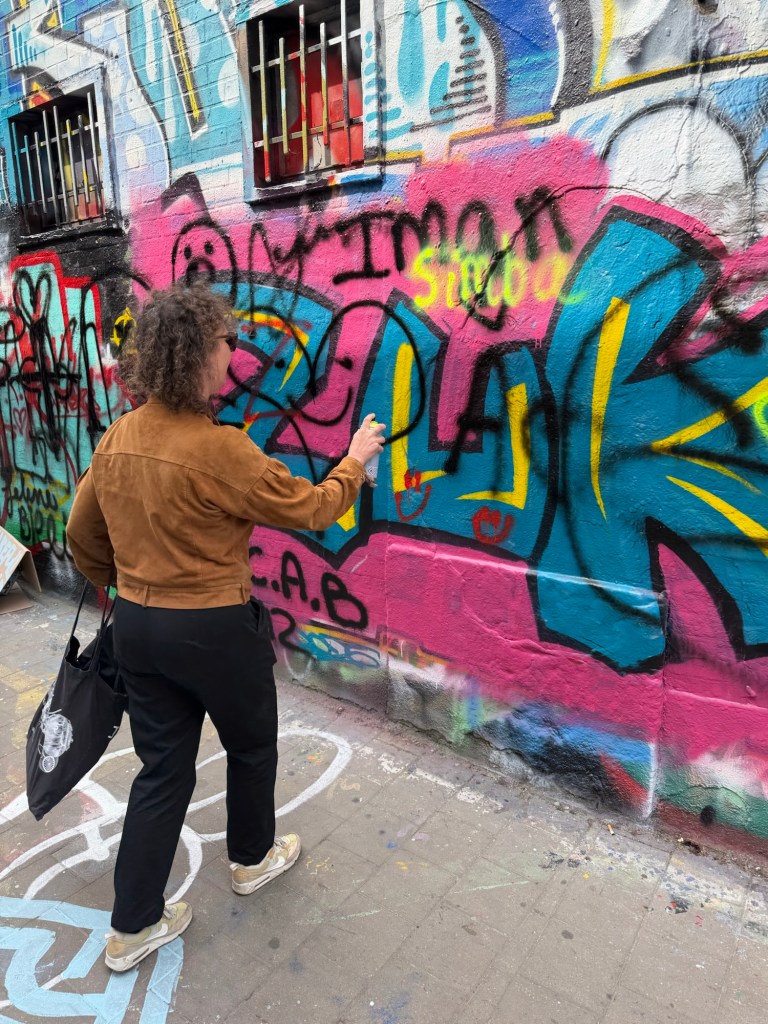
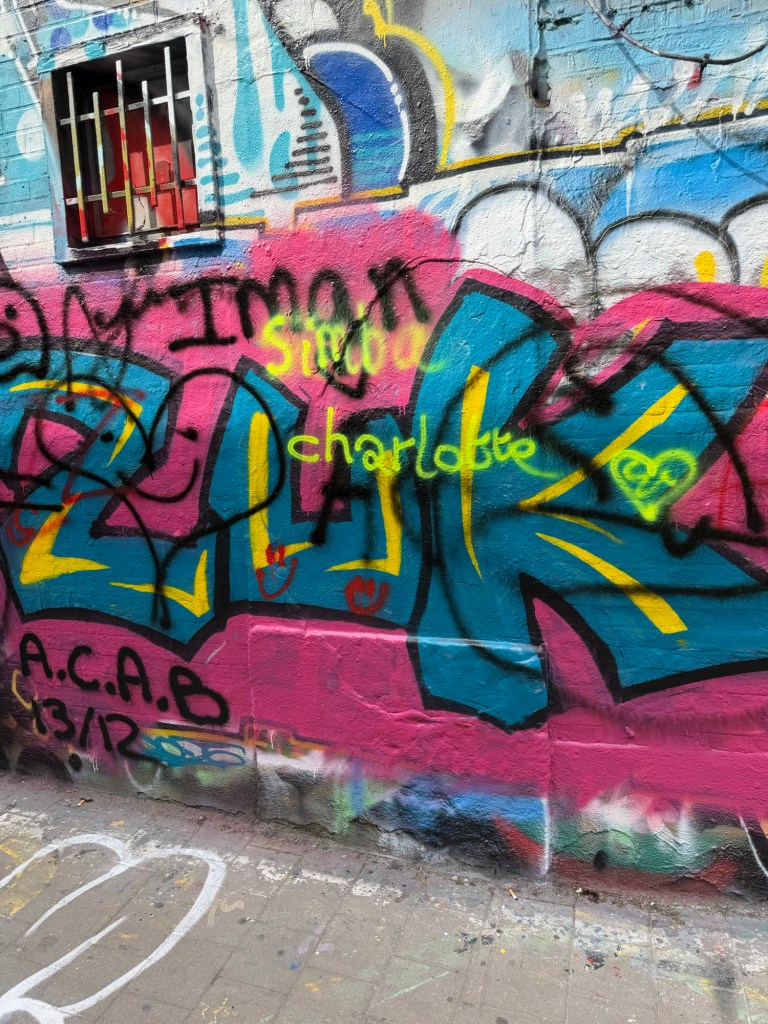
For a few moments, they became part of the city’s constantly shifting canvas — written in bright color between tags, murals, and overlapping signatures from strangers passing through from everywhere.
There was something oddly moving about it. Not polished. Not permanent. By tomorrow another artist may paint over it completely, and that is part of the point. Street art here is less about preservation than participation.
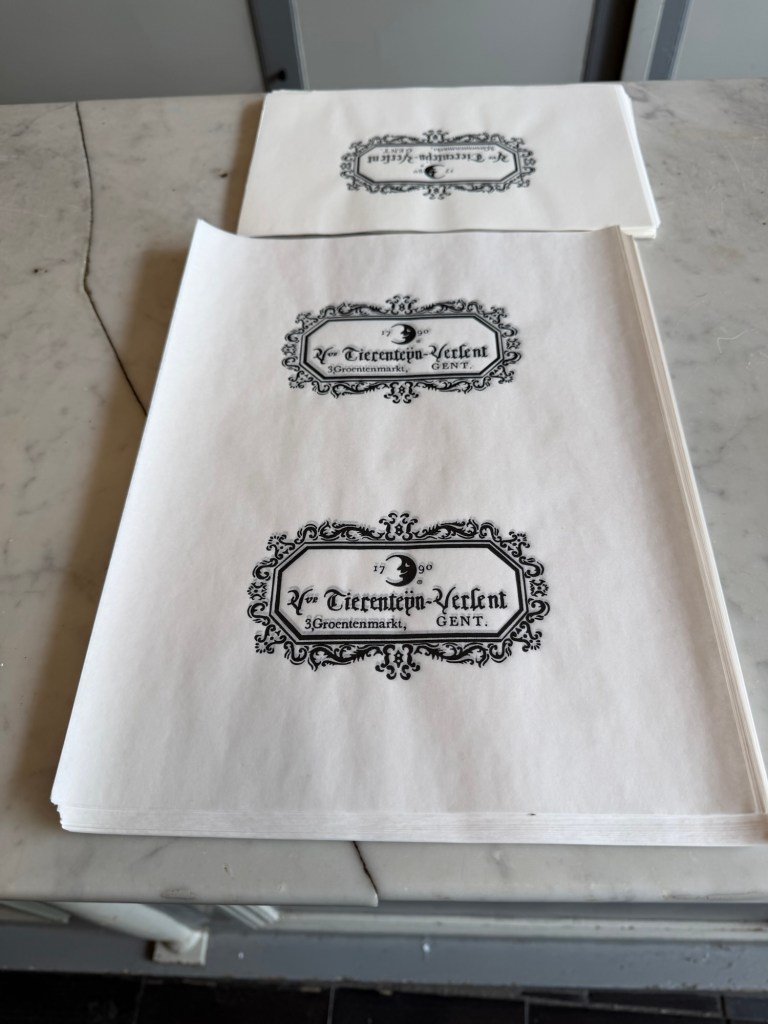
From there we stepped into the famed mustard shop Vve Tierenteyn-Verlent (www.tierenteyn-verlent.be), operating since 1790, where mustard is still mixed in oak barrels and sold from ceramic crocks and glass jars lining pale blue shelves.
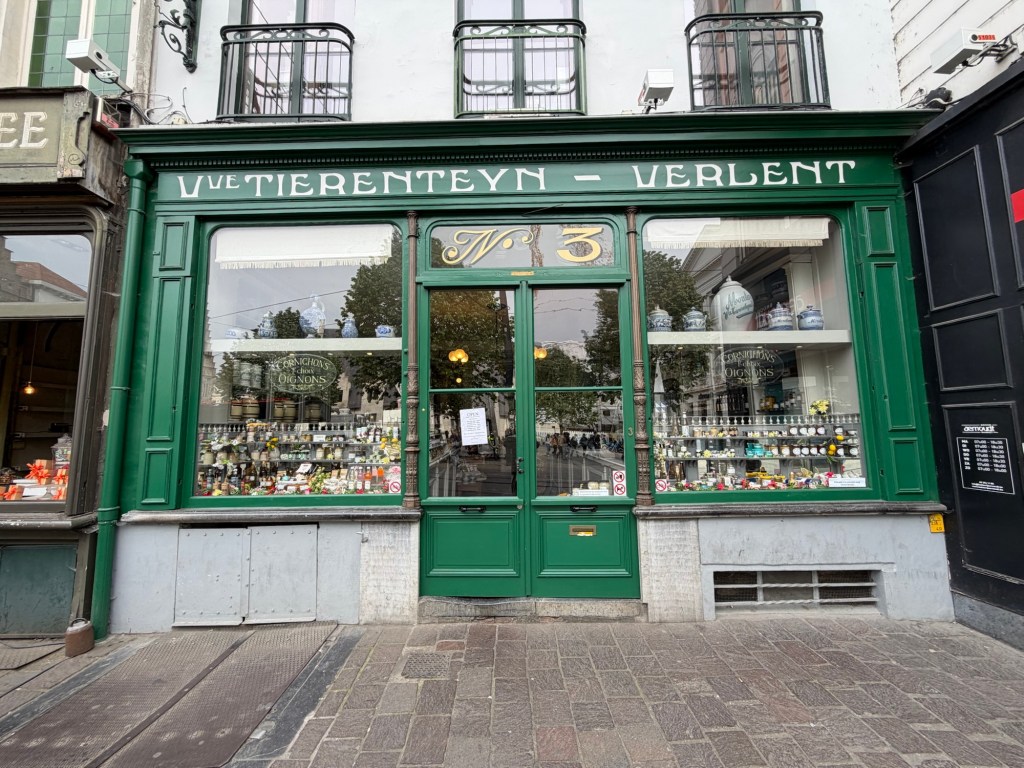
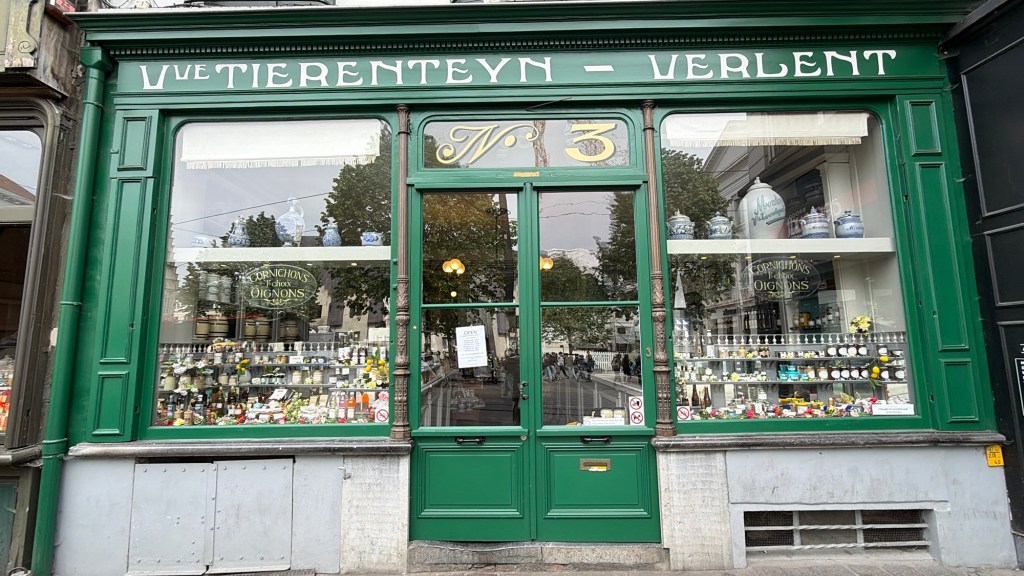
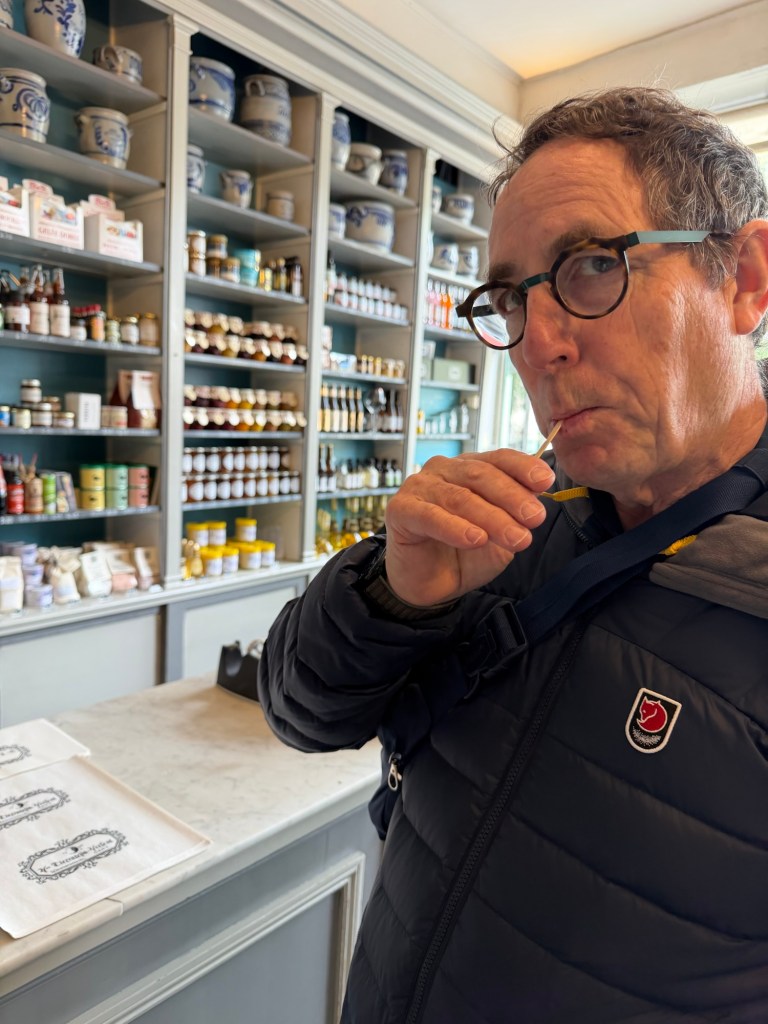
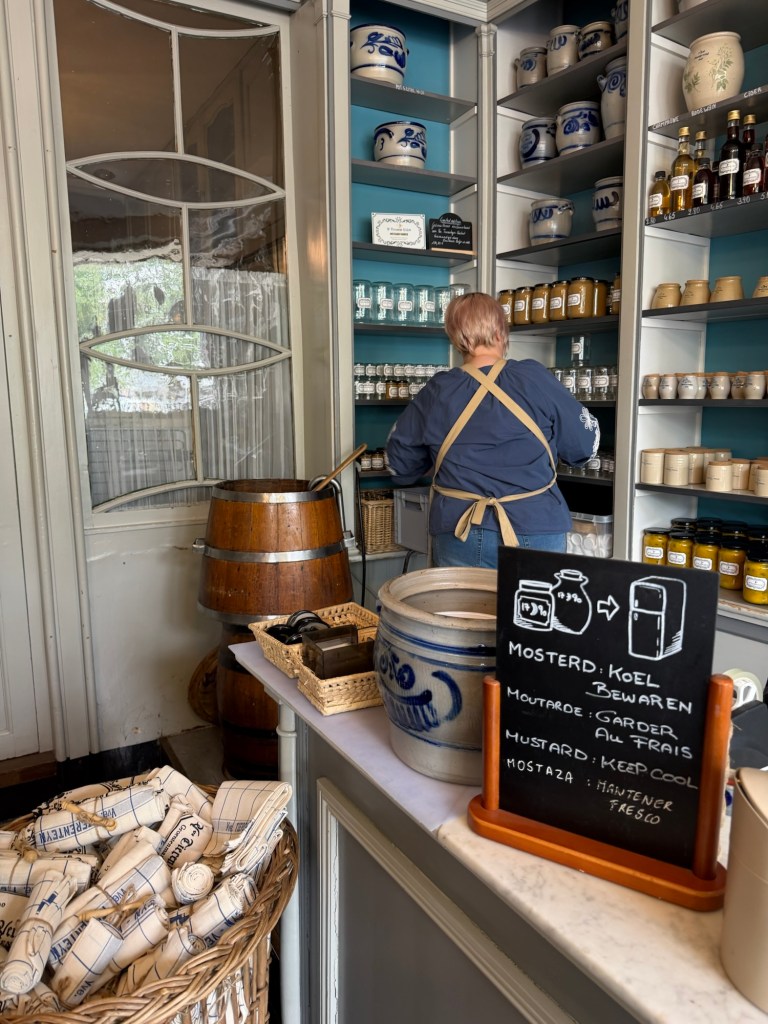
The sharp taste arrived a second after the sample touched the tongue — powerful, old-fashioned, and unmistakably alive. The shop itself felt suspended in another century.
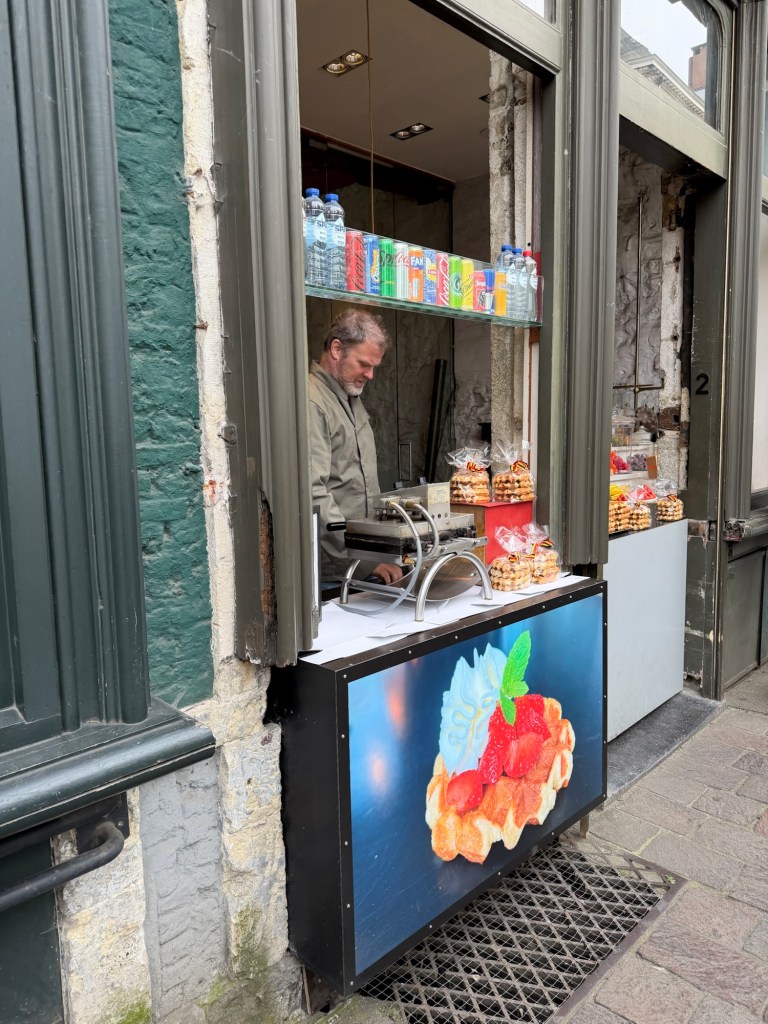
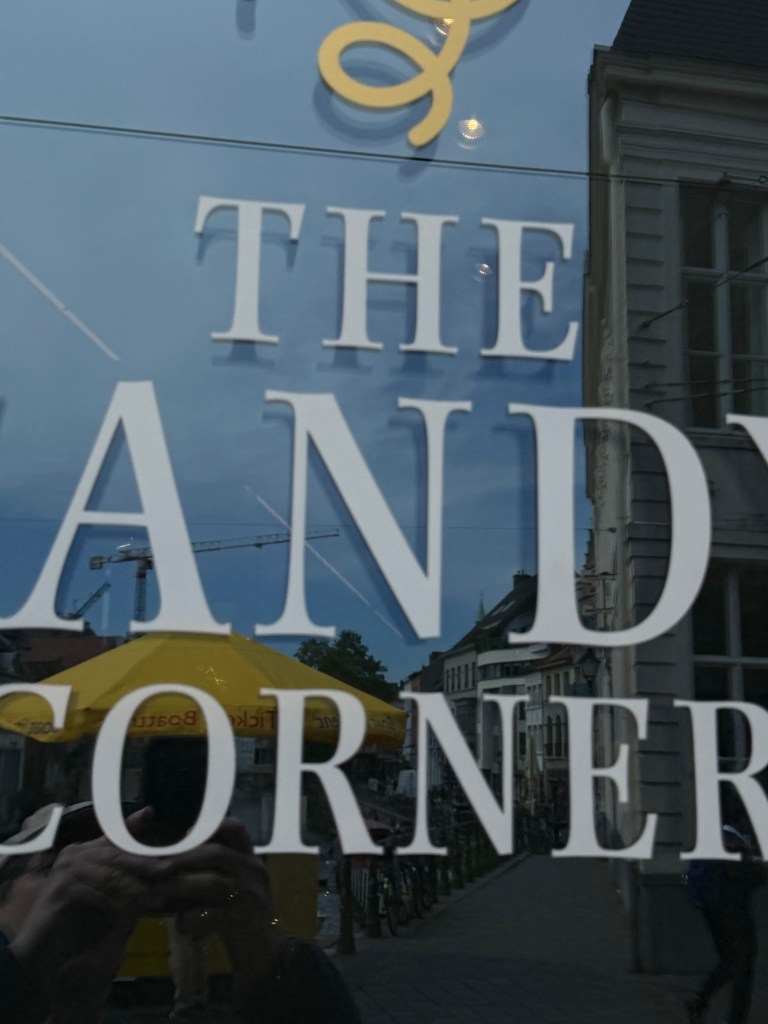
We then wandered into The Candy Corner (www.thecandycorner.be), where we bit into a cherry shell that gave way to a deep cherry filling, rich enough to stop conversation for a moment. The windows were filled with handmade sweets and old-fashioned candies, the sort of place where spring seems permanently suspended in sugar. And somewhere between chocolate and mustard, I found myself eating cuberdons — those peculiar cone-shaped Gentse neuzen, or “Ghent noses.” Their outer shell gives way to a thick raspberry syrup center that seems determined to escape the moment you bite into it. Sticky, theatrical, impossible to eat elegantly. Perfect, really.
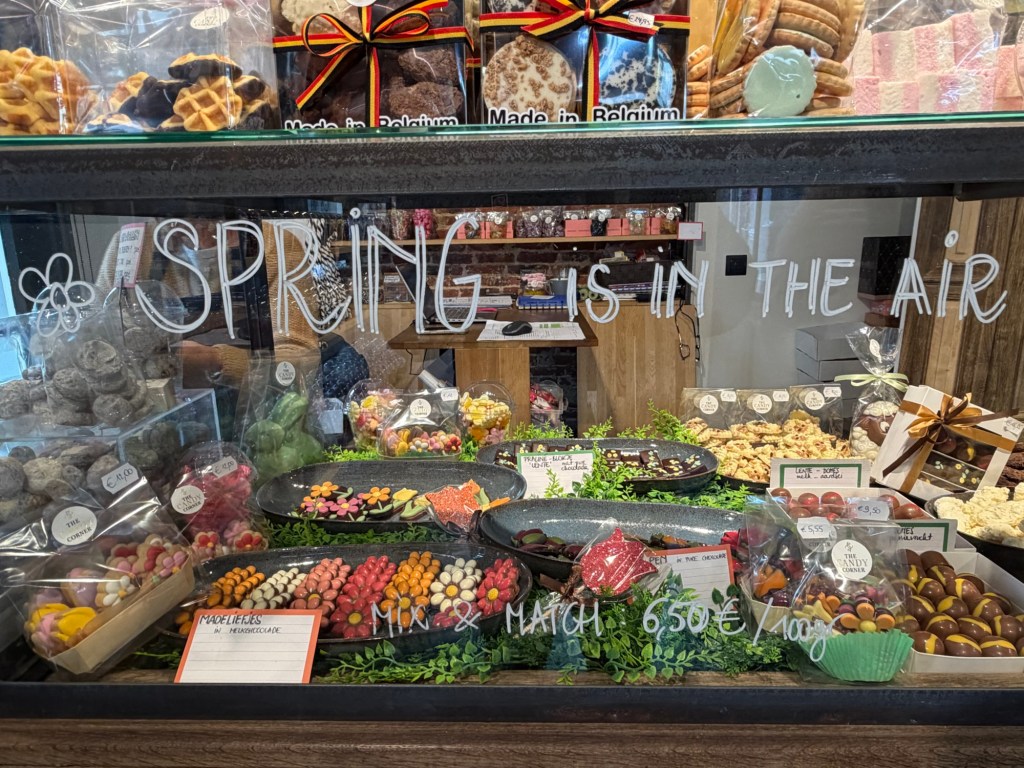
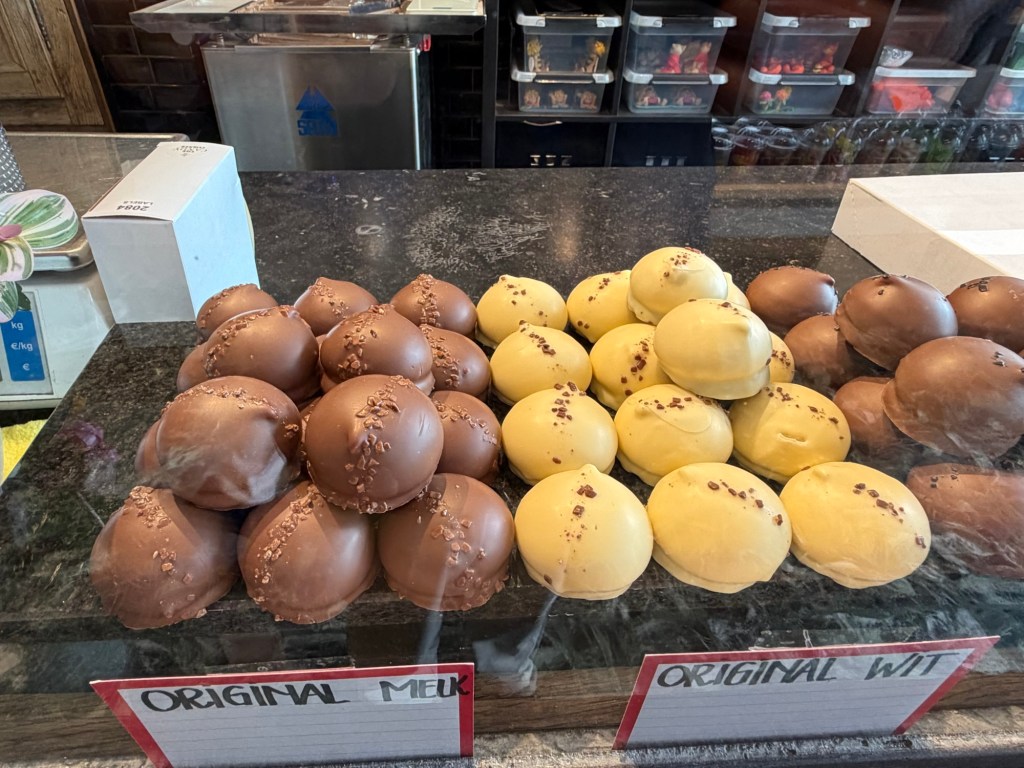
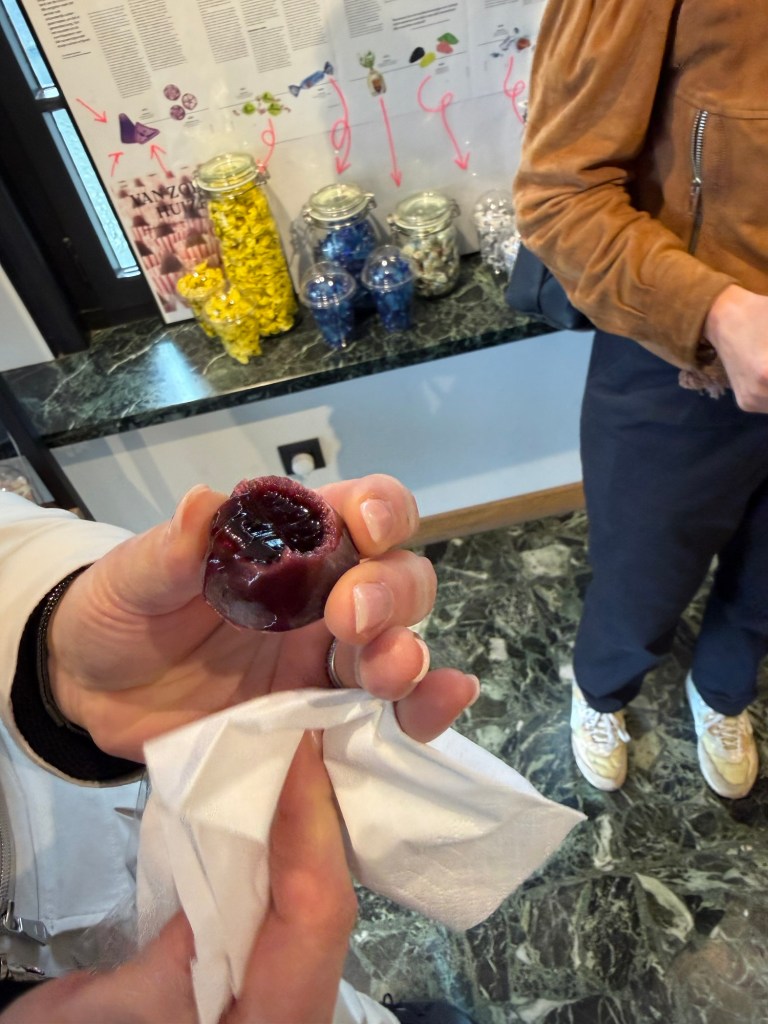
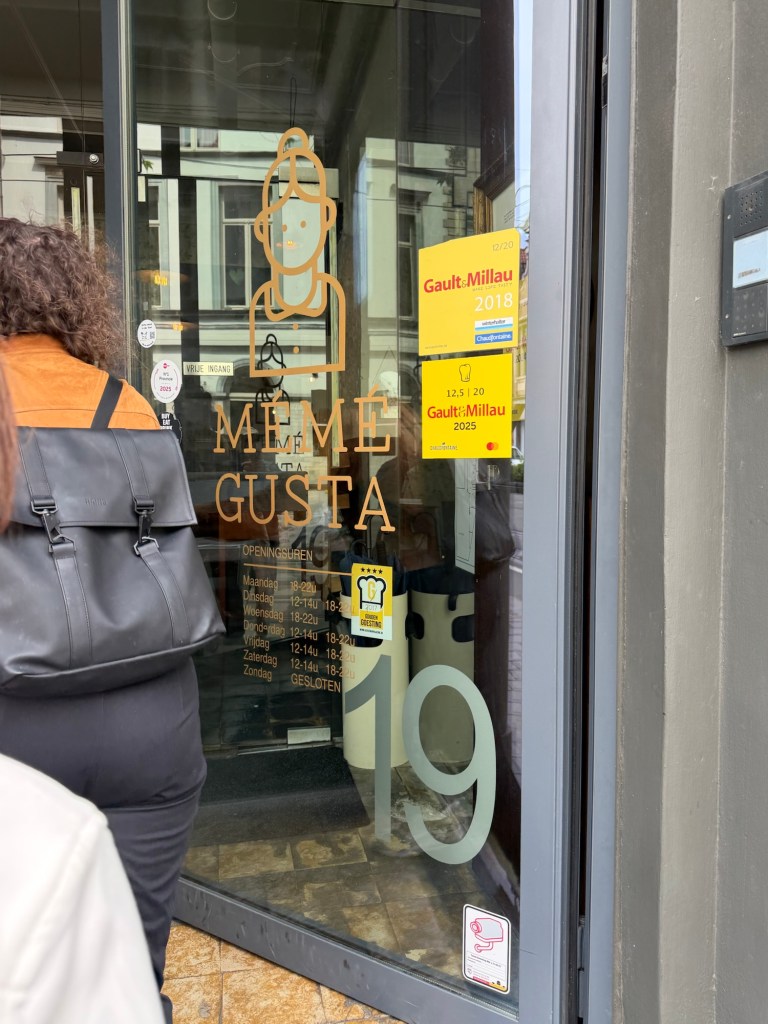
Eventually it was time for lunch at Meme Gusta (www.meme-gusta.be/nl), where even traditional Flemish comfort food seemed to carry its own regional identity.
I ordered a vegan version of Flemish stew, the classic slow-cooked dish usually made with beef and dark Belgian beer. Beth went with the traditional Flemish stew.
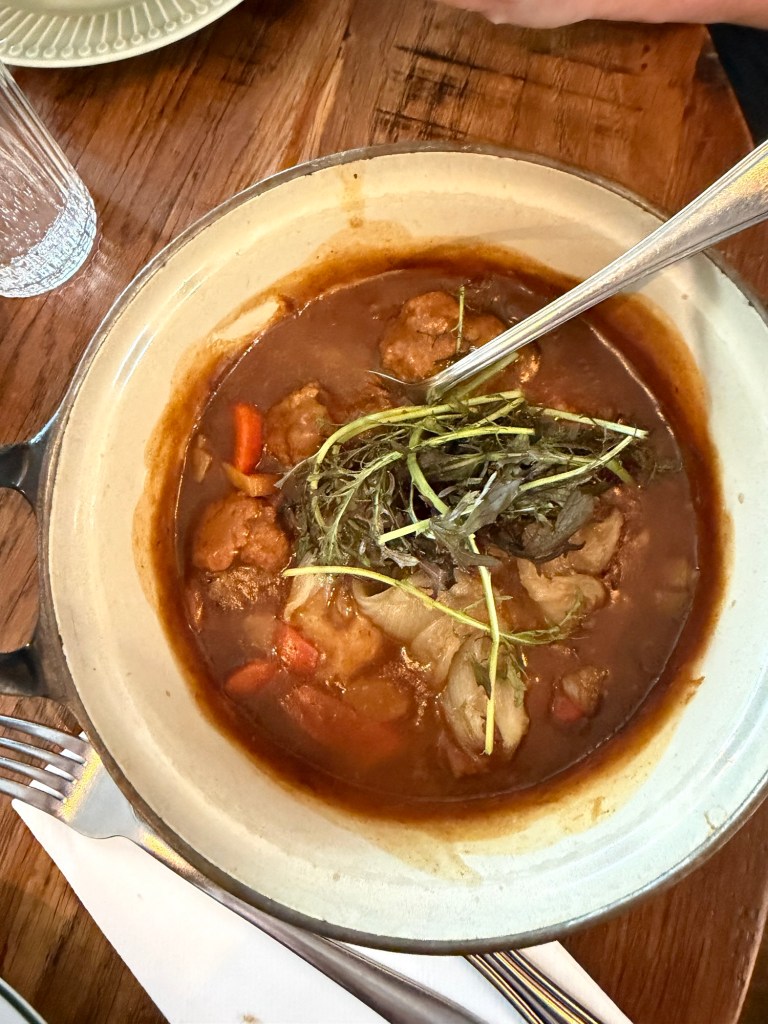
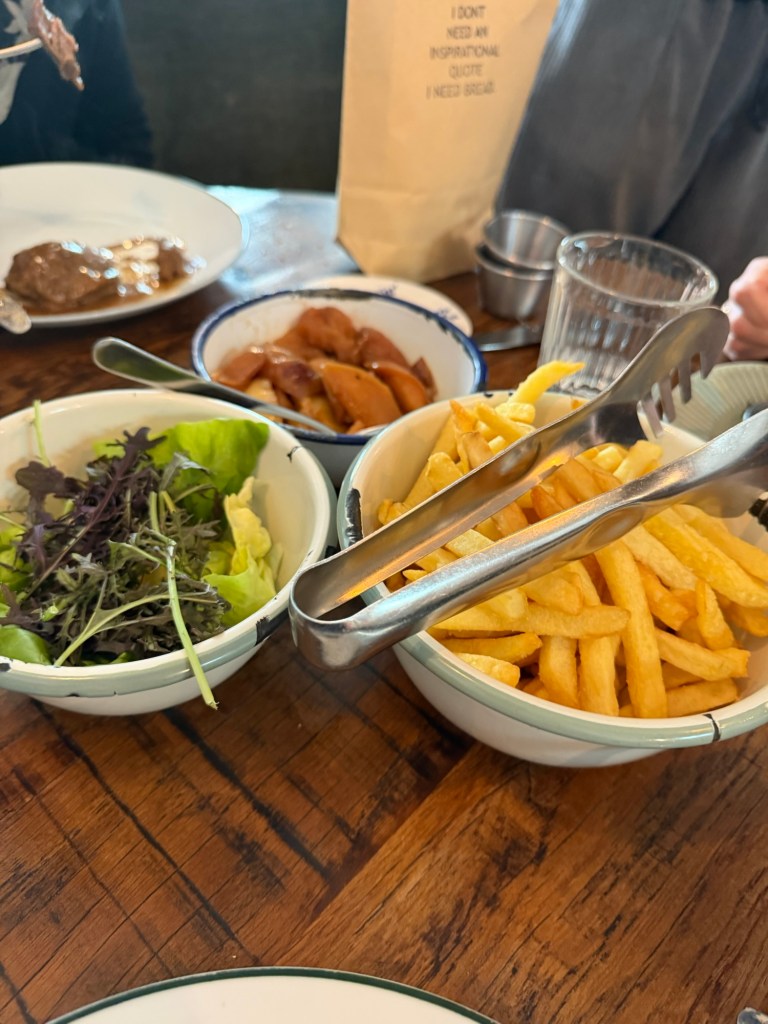
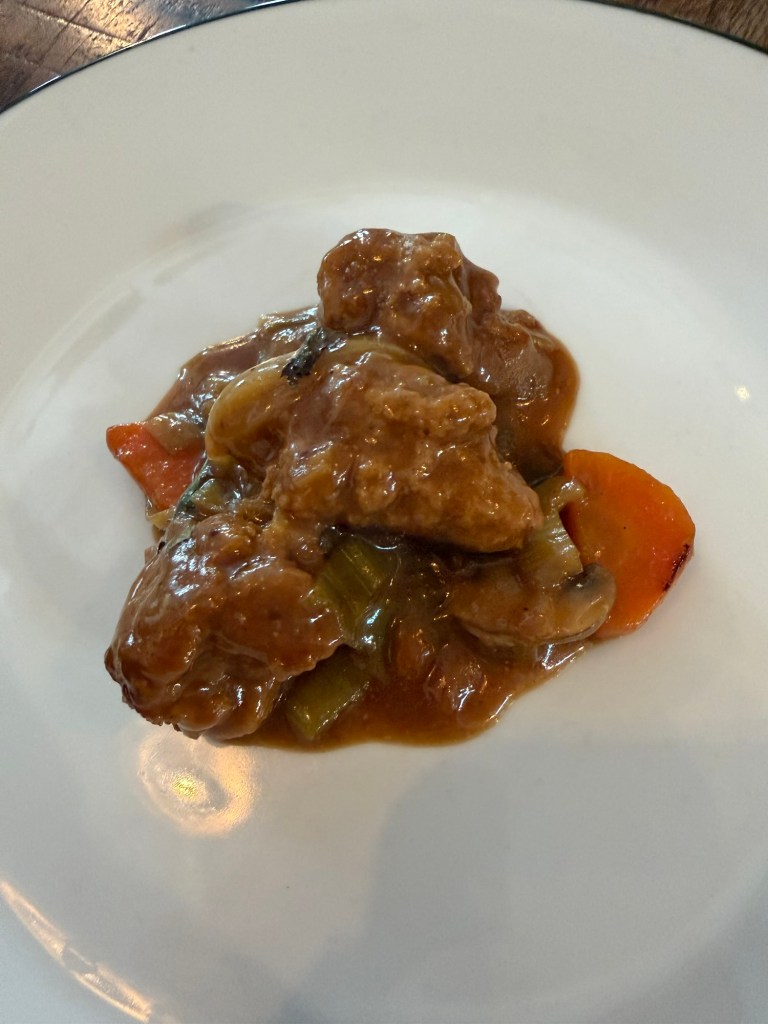
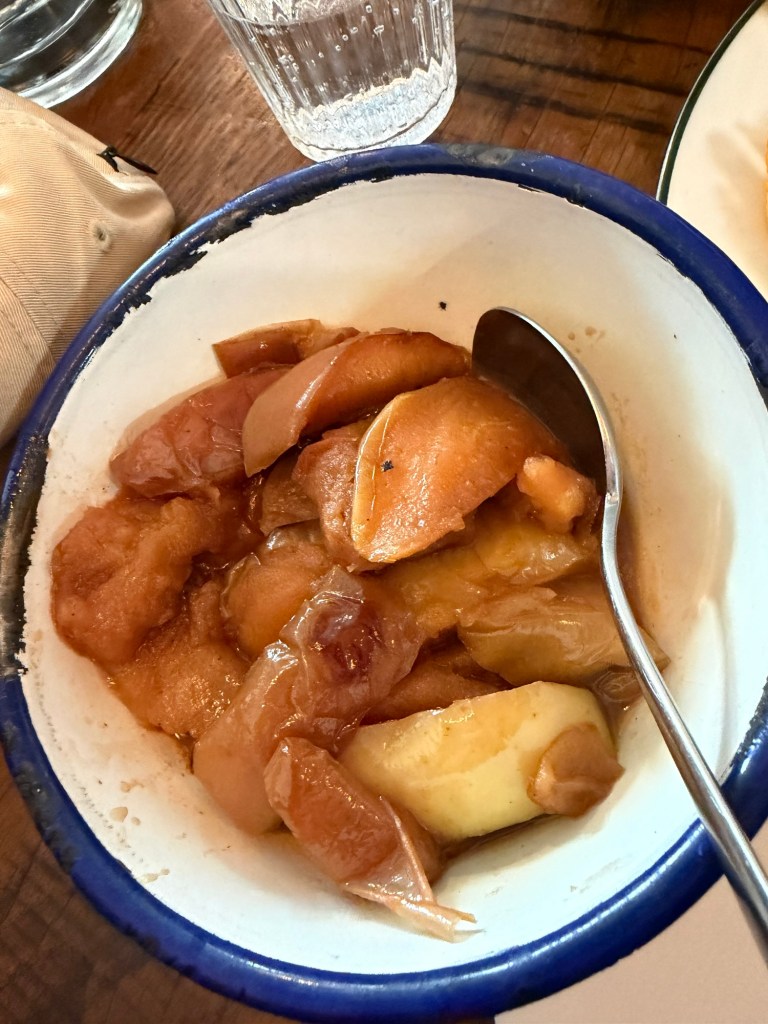
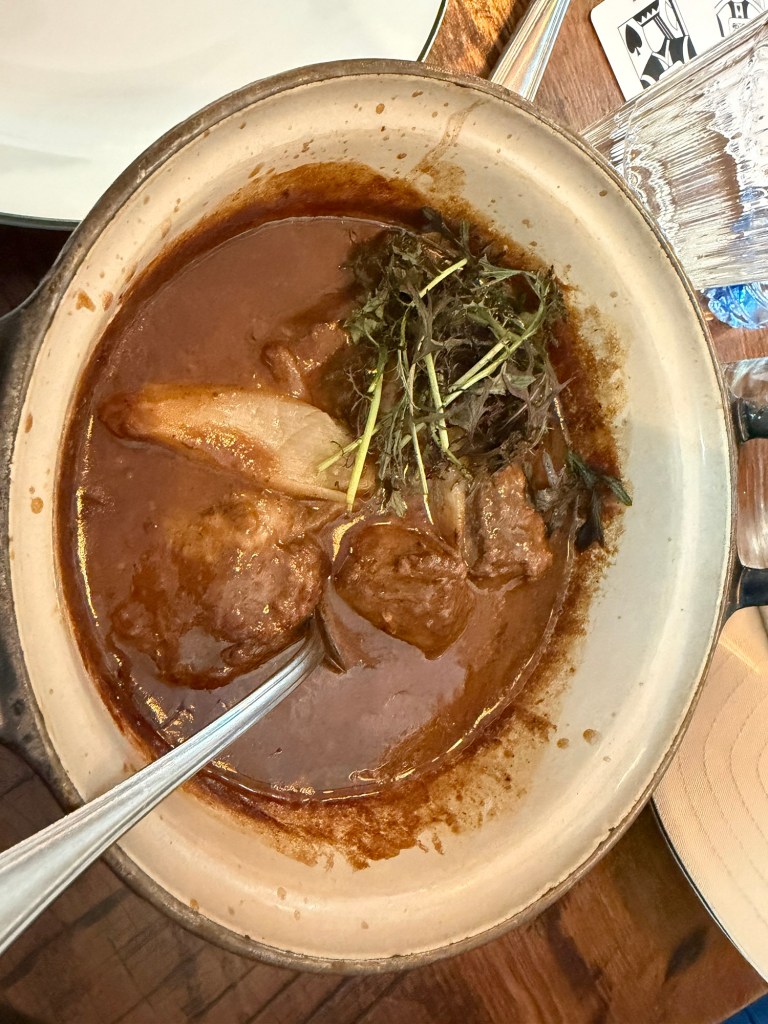
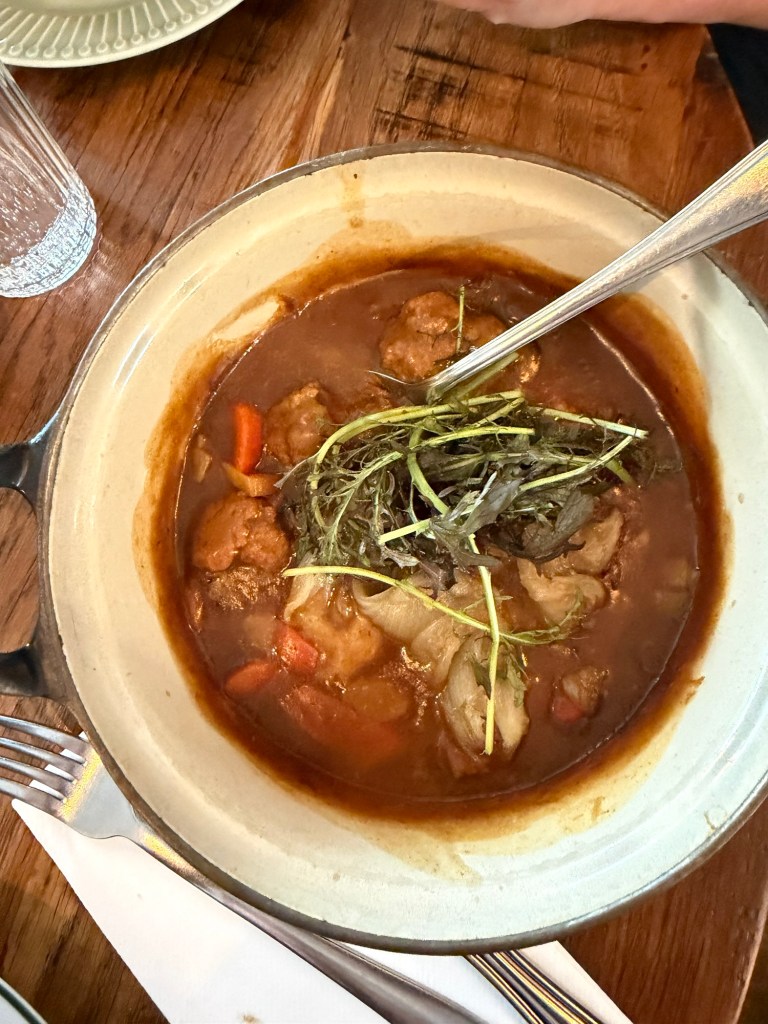
This version kept the deep richness and slightly sweet complexity the dish is known for, with soft onions melting into the sauce and apples alongside for contrast. Beside it came crisp Belgian fries, which here are treated not as a side dish but almost as a point of national pride.
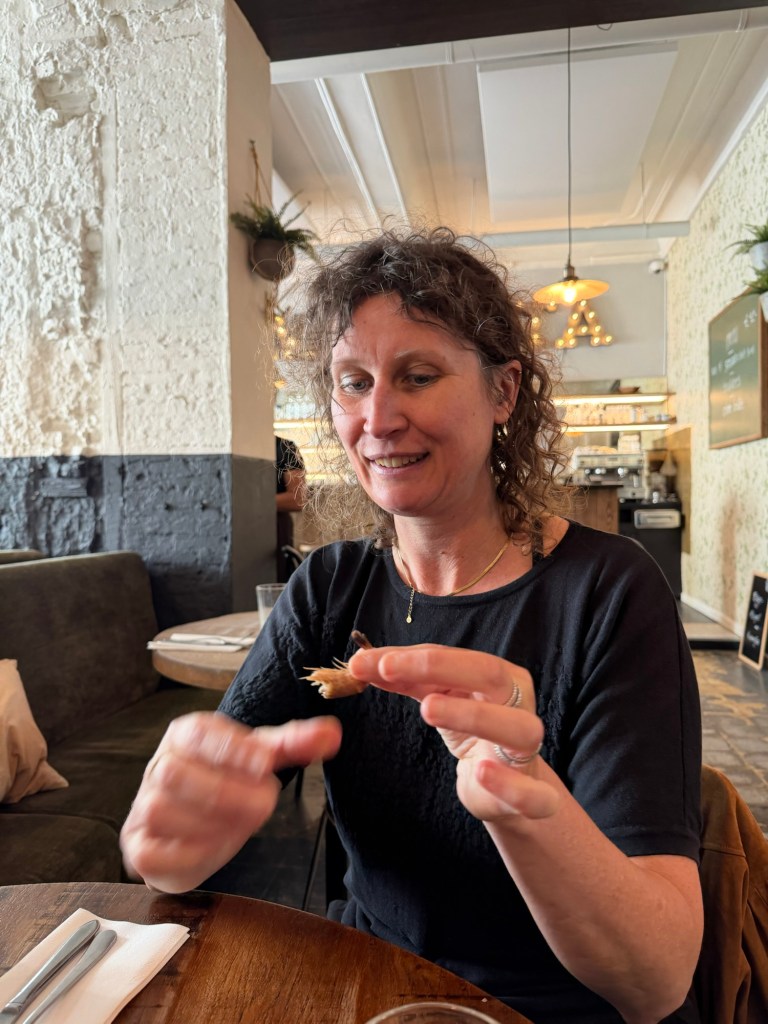
And Sophie, after patiently guiding us through her adopted city and answering an endless stream of questions, finally appeared in one of the photographs herself—caught mid-bite with an expression suggesting both amusement and perhaps mild concern over just how seriously I was taking all of this.
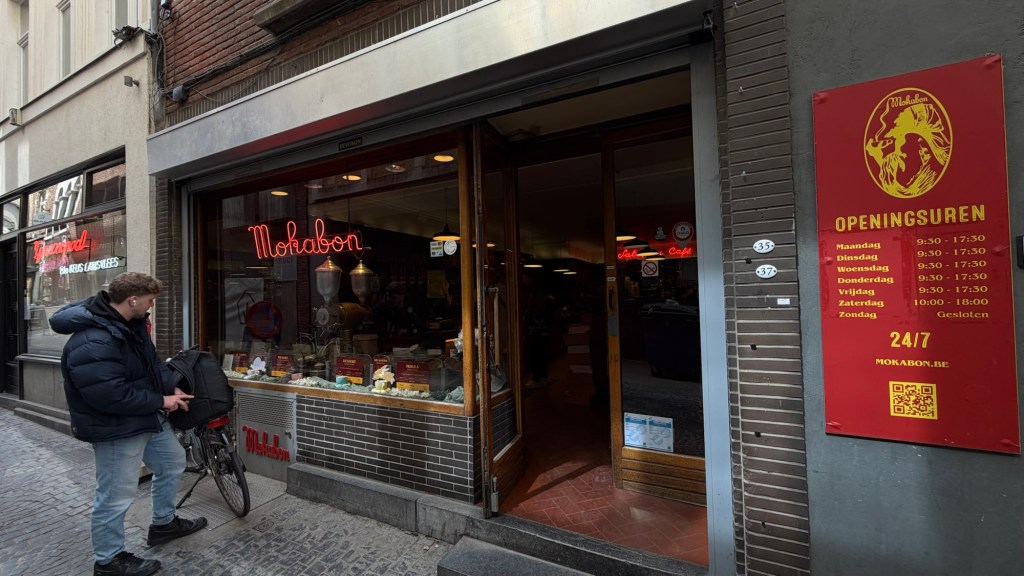
After lunch we stopped at the legendary Mokabon (www.mokabon.be), a dark red coffeehouse that feels suspended somewhere between another era and the present day. Mokabon has been part of Ghent life since the 1930s, and stepping inside feels like entering a coffeehouse largely untouched by fashion or reinvention. Founded in 1937, Mokabon became known not only for serving coffee but for roasting and importing beans from around the world at a time when coffee itself still carried an air of rarity and ritual.
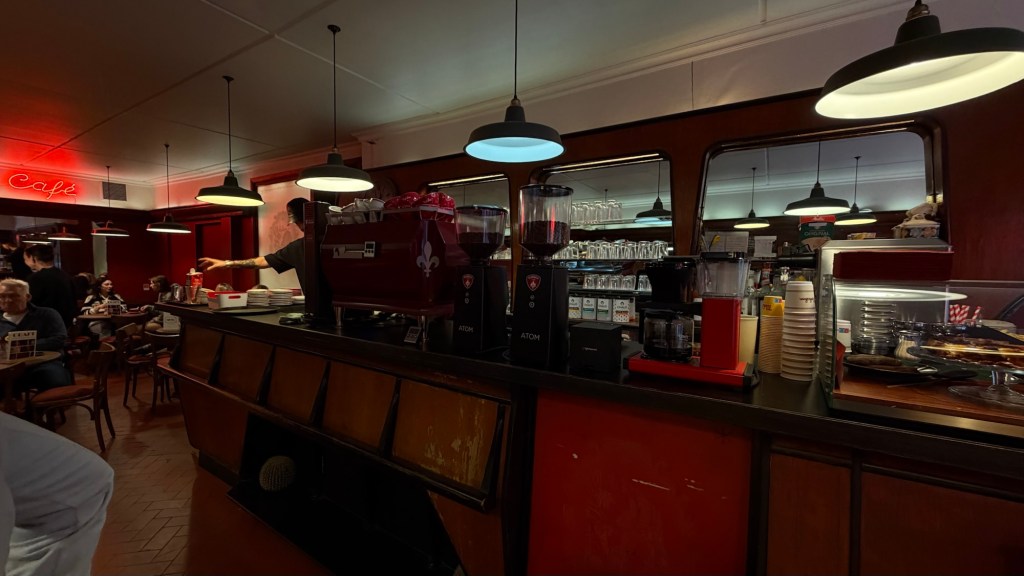
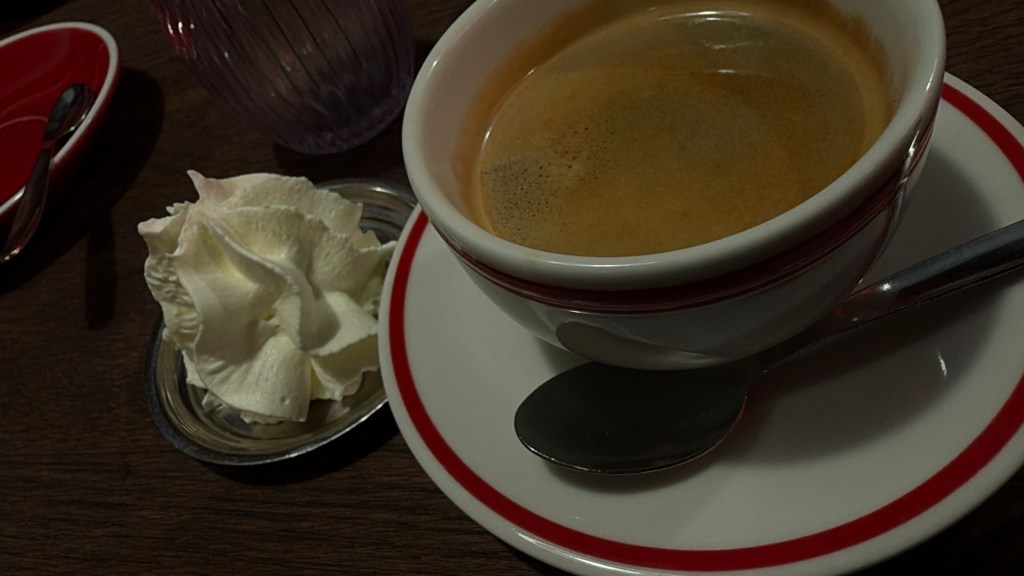
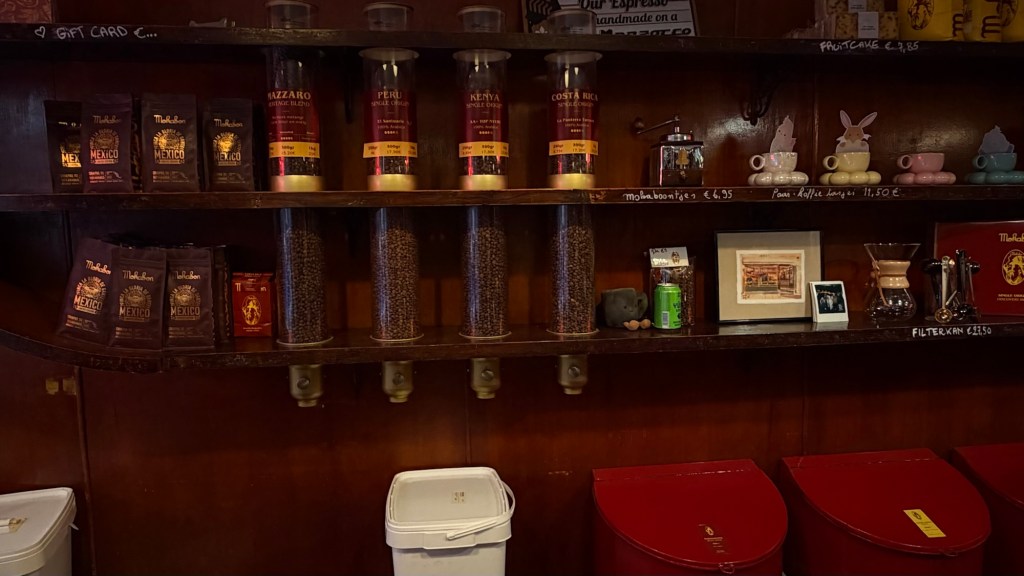
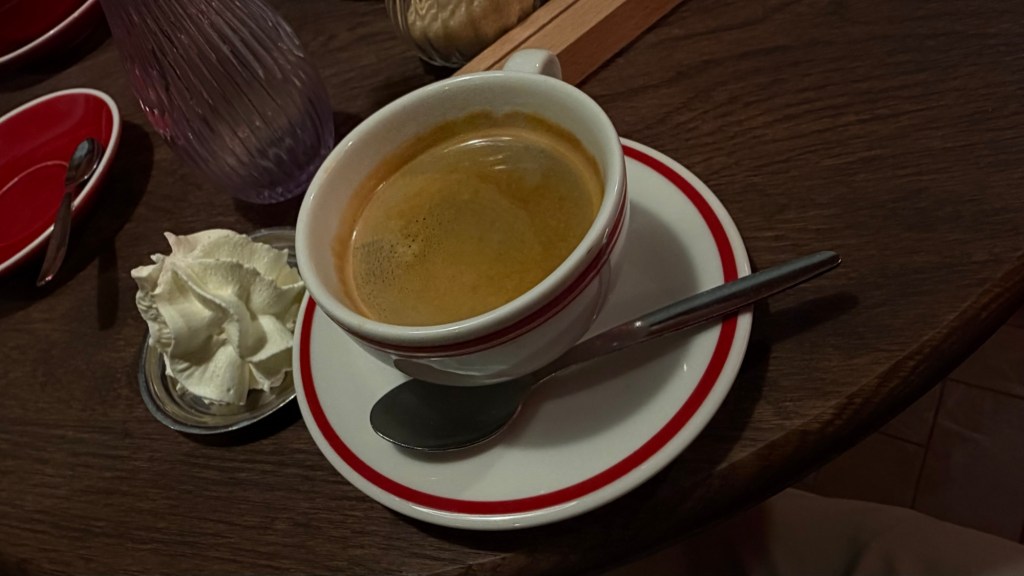
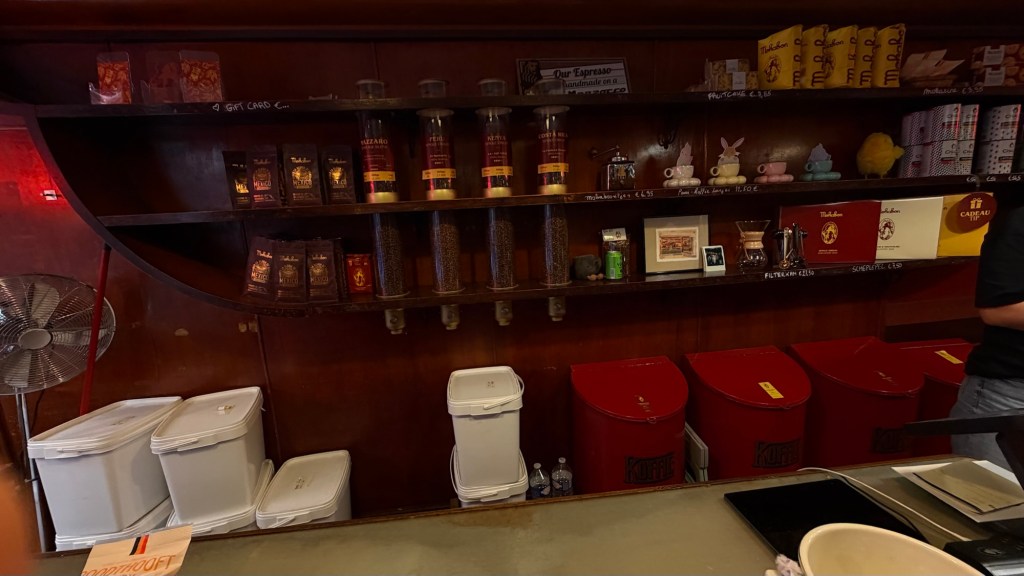
The room smelled of roasted beans and old wood, with shelves lined by coffees from Peru, Kenya, Costa Rica, and Mexico, stored in deep red tins beneath warm hanging lights. It was the kind of place where conversations naturally slow down.
The interior reflects that continuity. Dark wood, deep red walls, vintage tins, shelves of beans labeled by country of origin, worn counters, and narrow seating create the feeling of a place accumulated slowly over decades rather than designed all at once. It feels intimate without trying to be nostalgic.
What makes Mokabon especially Belgian is the way seriousness and comfort coexist there. Coffee is treated with expertise and precision, yet the atmosphere remains unpretentious. Students, professors, artists, locals, and travelers all seem to occupy the same small space naturally.
Sitting there, it became easy to imagine generations of conversations unfolding beneath those hanging lights — political debates, literary discussions, romances, arguments, ideas, ordinary afternoons — while outside the city kept changing around it.
Quite by accident, we ended up seated beside the famed industrial archaeologist Patrick Viaene.
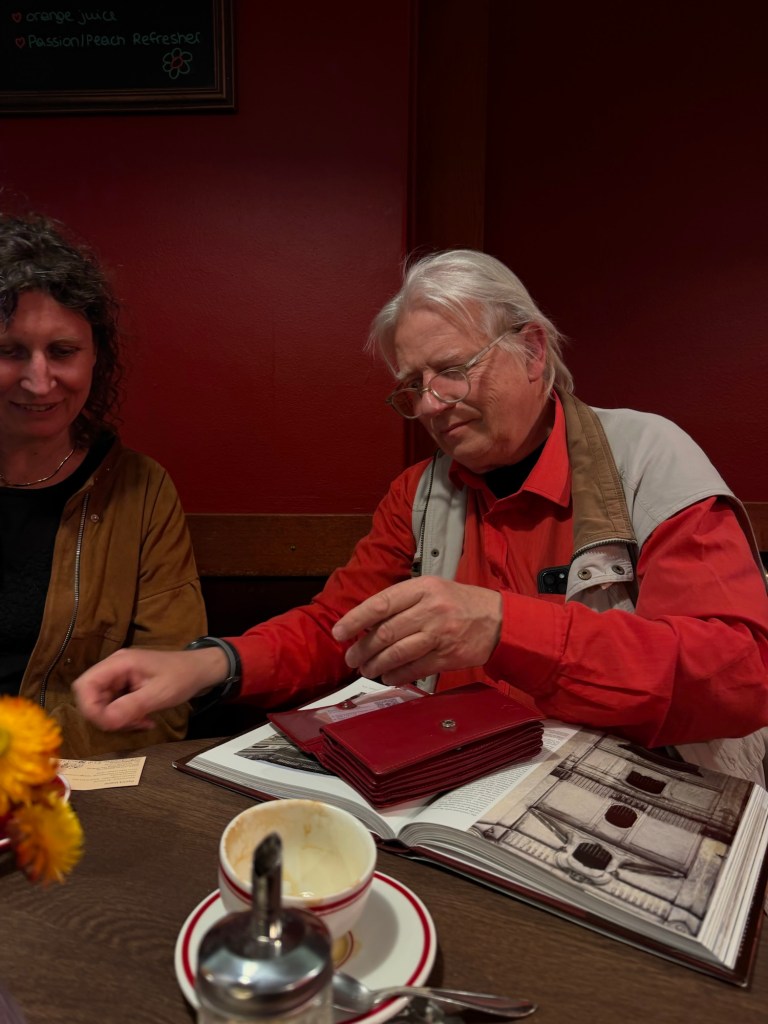
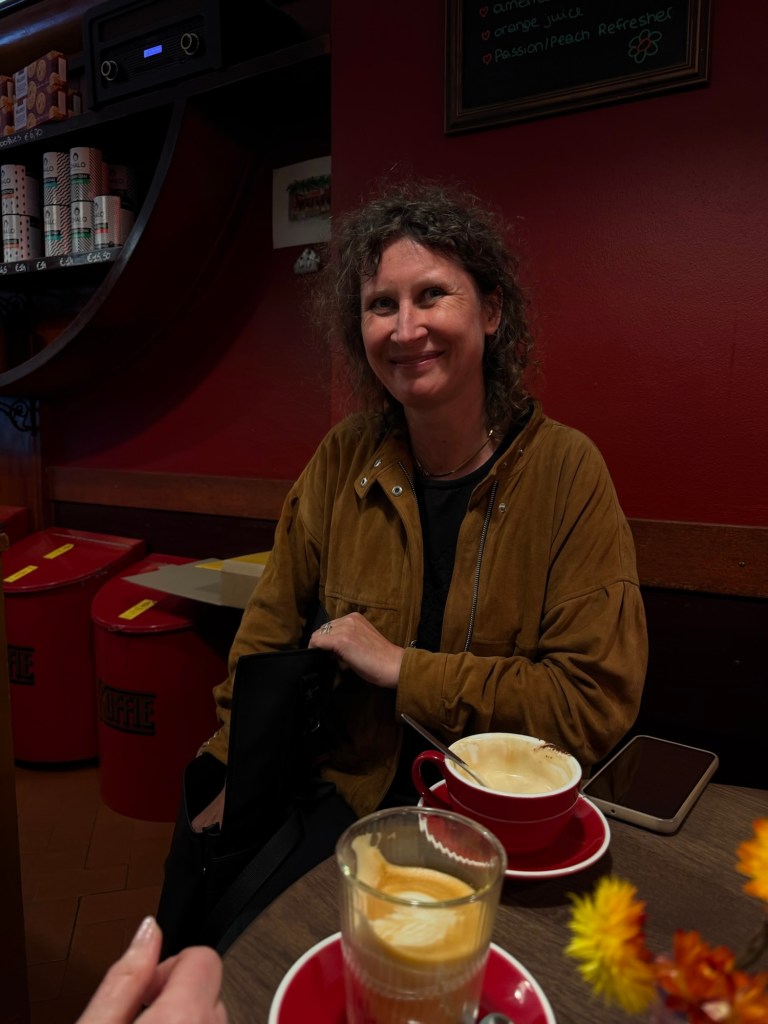
Within minutes we were talking about steel mills, preservation, vanished industries, and the strange emotional gravity of industrial ruins. Somehow the conversation crossed the Atlantic to Bethlehem Steel and the old steel works in Pennsylvania.
It struck me how universal these conversations are. In Europe, centuries of churches and guild halls are preserved with reverence, but so too are factories, rail yards, warehouses, and the machinery that built the modern world. Patrick spoke about industrial heritage not simply as engineering, but as human memory embedded in brick, steel, soot, and labor.
Over espresso served with a small cloud of whipped cream, we traded stories about preservation, decline, and the uneasy balance between remembering and erasing. Travel sometimes works this way: you think you are stopping for coffee, and instead you find yourself in a conversation that quietly links continents, industries, and histories together.
By the end, cards had been exchanged, books opened on the table, and for a short while, Mokabon became a meeting place between Flemish industrial history and the fading steel cities of Pennsylvania.
After coffee, chocolate, candy, lunch mustard, and our brief but permanent contribution to Ghent’s graffiti alley, we walked with Sophie to the boat dock and said goodbye. Like all good guides, she seemed to disappear back into the city she had spent the day translating for us.
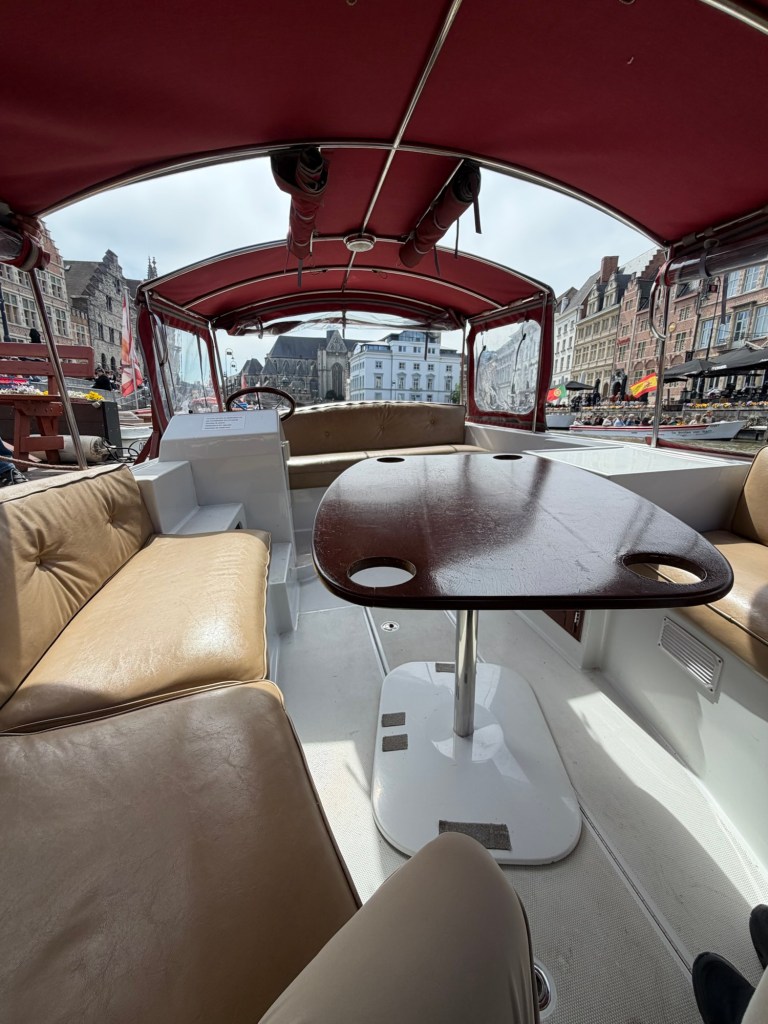
Then Ghent revealed itself from the water.
The canals changed everything. Streets that had felt intimate on foot suddenly opened into long medieval perspectives — stone bridges arching overhead, church towers rising unexpectedly behind rows of stepped guild houses, and entire façades visible only from the river. From the boat, the city felt less like a museum and more like a place still arranged around water the way it had been for centuries.
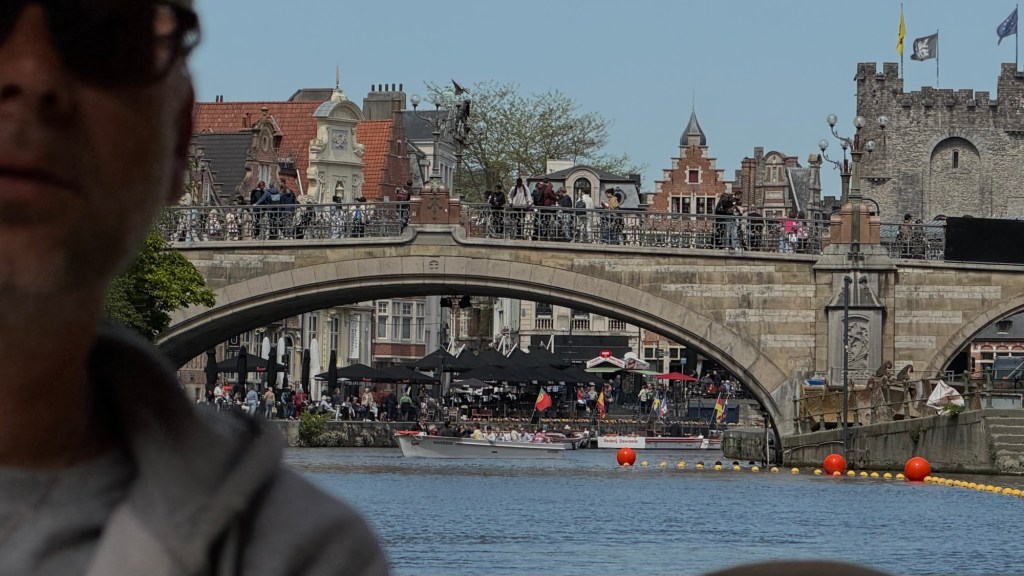
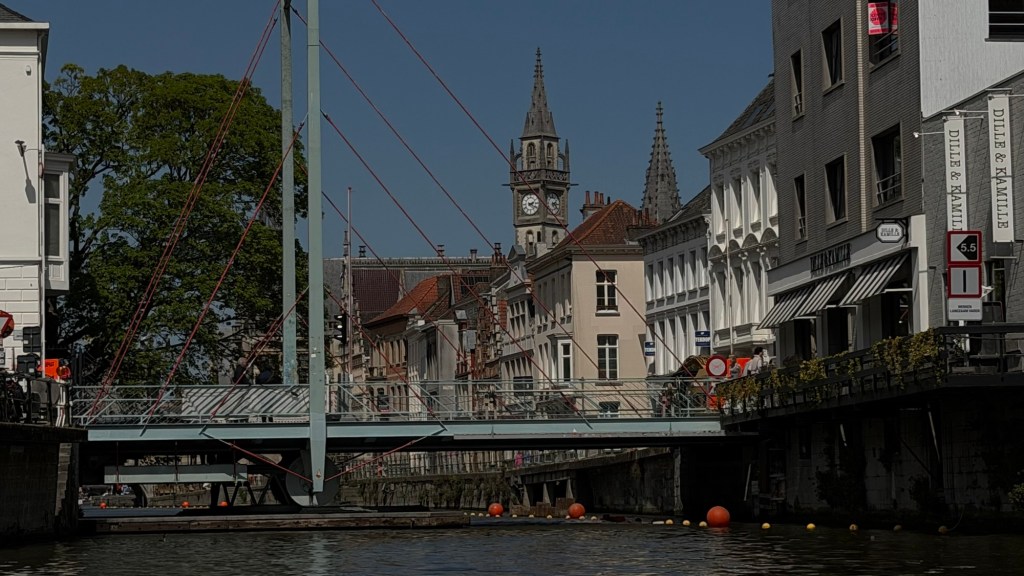
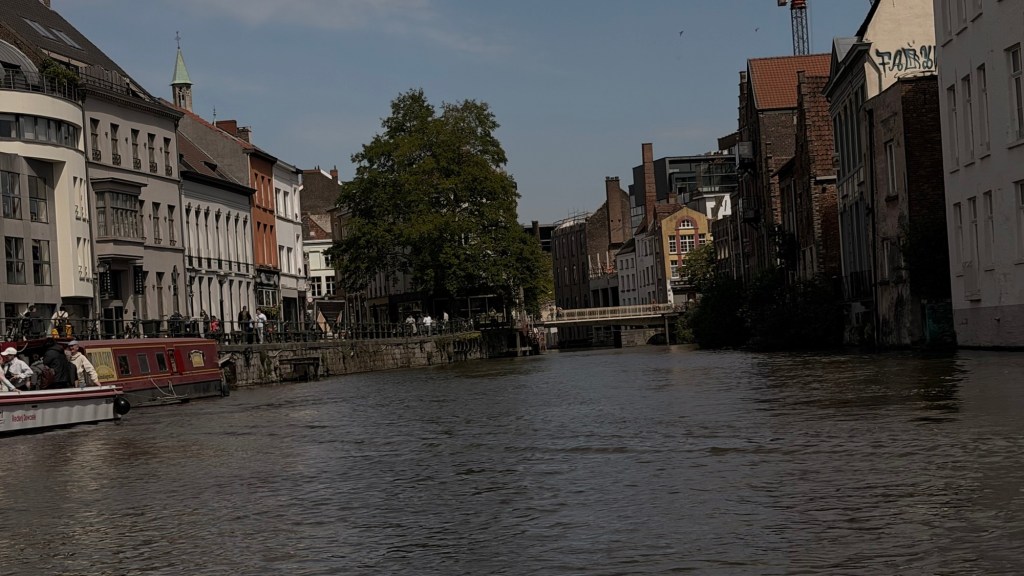
We slipped beneath bridges so low they framed the skyline like tunnels. At moments the city felt grand and theatrical; at others, strangely quiet. One turn revealed the immense walls of Gravensteen rising directly from the canal, its stone buttresses dropping into the water like the hull of a fortress ship.
Afterward, we met Mohammad for the drive east toward Spa, crossing quietly from Flemish Belgium into the French-speaking region of Wallonia. The transition was subtle at first — road signs changing language, architecture softening, conversations around us shifting from Dutch to French — but the atmosphere gradually changed as well.
Leaving behind the canals and medieval density of Ghent, the landscape opened into forests, rolling hills, and smaller villages tucked into the Ardennes. Belgium began to feel less urban and more rural, older in a different way.
We have much to look forward to in the coming days.