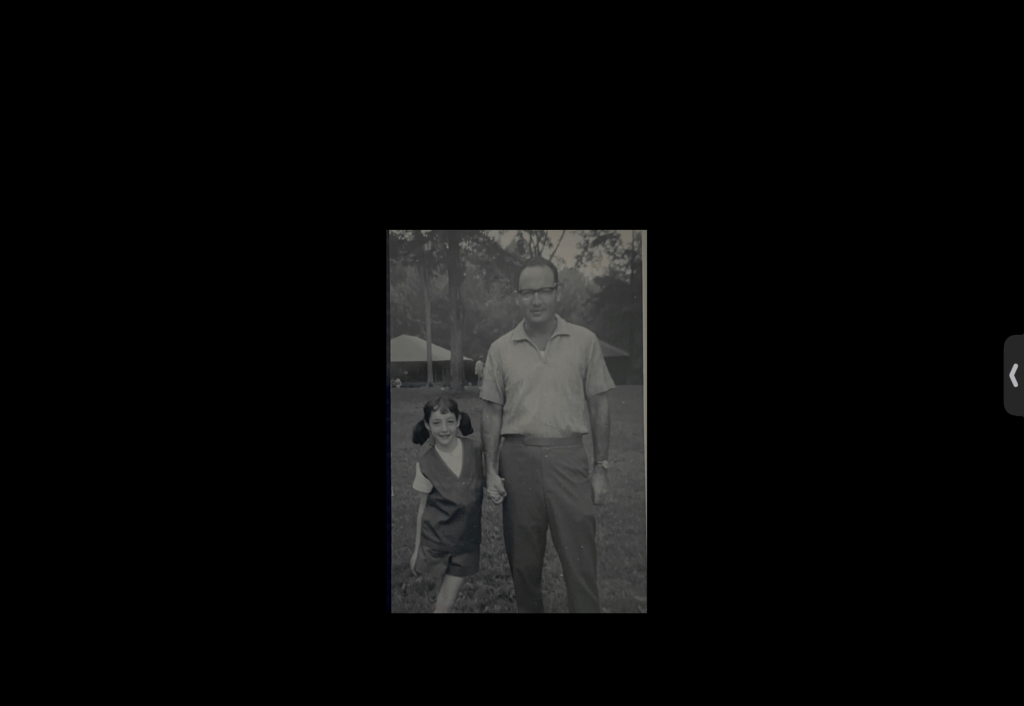
I’m a New World girl, born and raised in Delaware, now living just about an hour outside Philadelphia, home of the incomparable Philadelphia Orchestra.
Around here, there’s really no debate. To locals, it’s the best. That loyalty runs deep, shaped by years of listening to what’s known as the “Philadelphia sound”—a style built on a free-bowing string technique that gives the orchestra its unmistakably rich, lush tone. It’s the kind of sound that doesn’t just fill a hall; it wraps around you.
I could easily write an entire post on how that signature sound came to define an orchestra, and a city—but I’ll save that story for another day.
That said, I am an Old World girl at heart. When I travel, I’m drawn to the great concert halls of the world, especially the historic ones scattered across Europe, where the walls seem to hold as much memory as music. This trip is no exception.
We are in Amsterdam, and a visit to The Concertgebouw was simply non-negotiable.
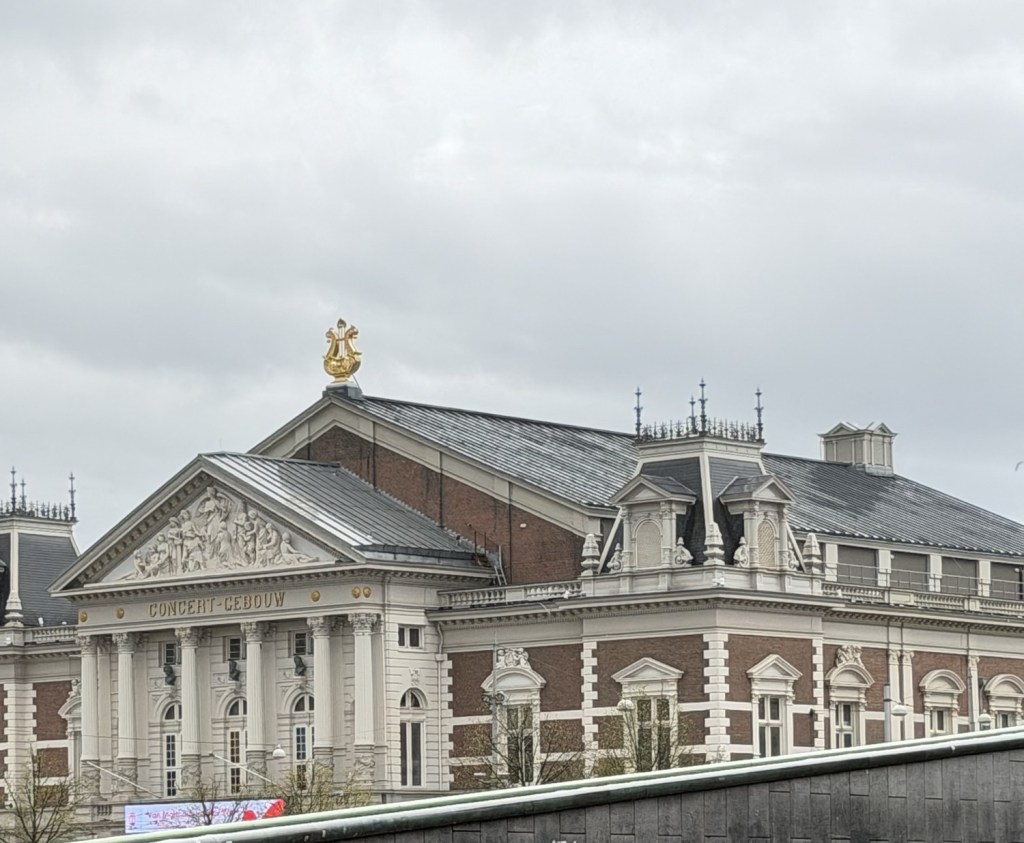
There’s something about approaching the Concertgebouw that already sets the tone: the roof mounted harp, the symmetry, the quiet grandeur, the sense that you’re stepping into a place where music has been taken seriously for well over a century. Opened in 1888, the Concertgebouw is renowned not just for its beauty, but for its acoustics, often ranked among the finest in the world.
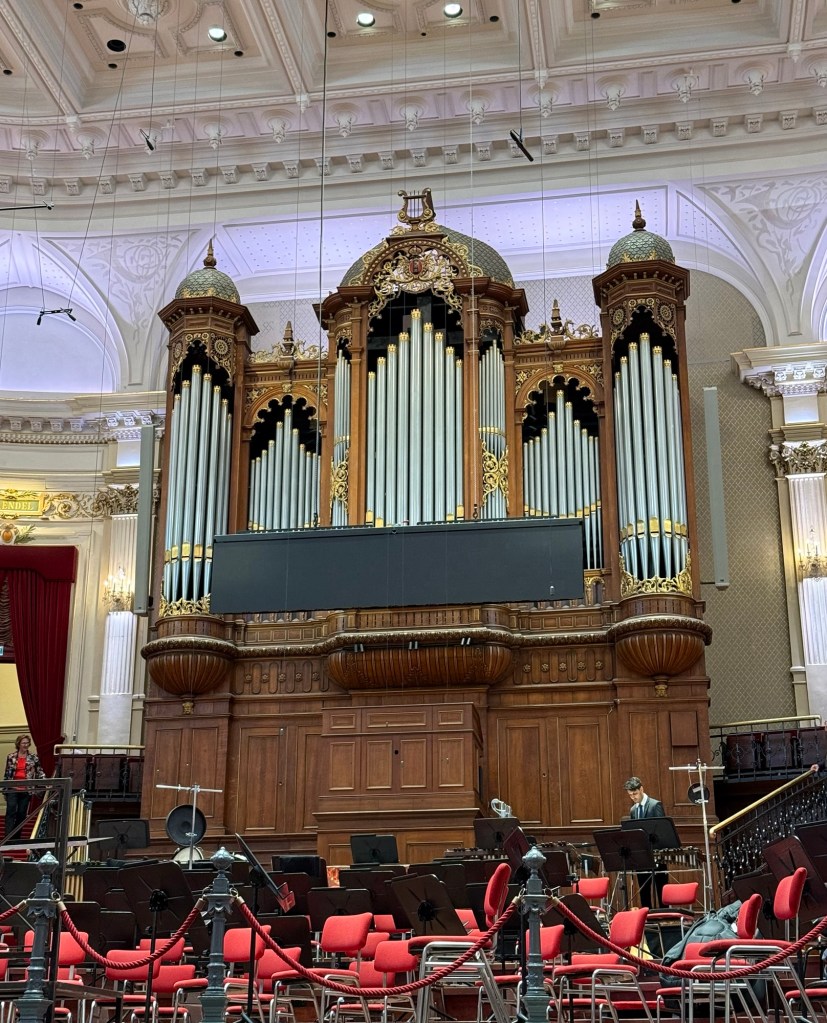
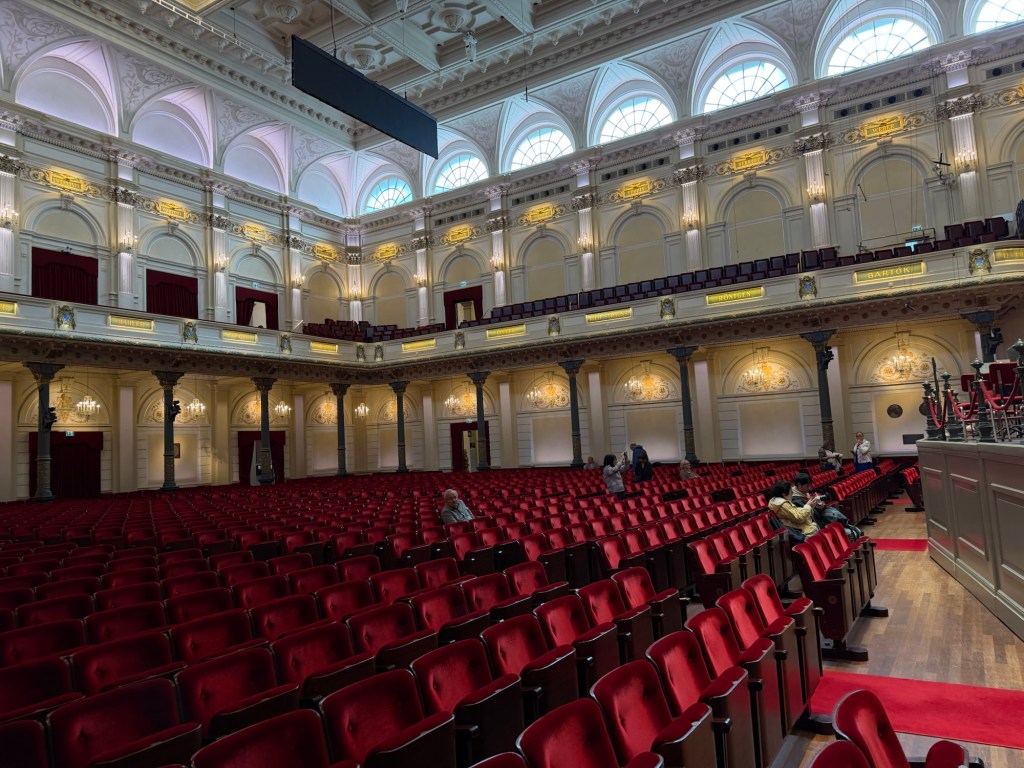
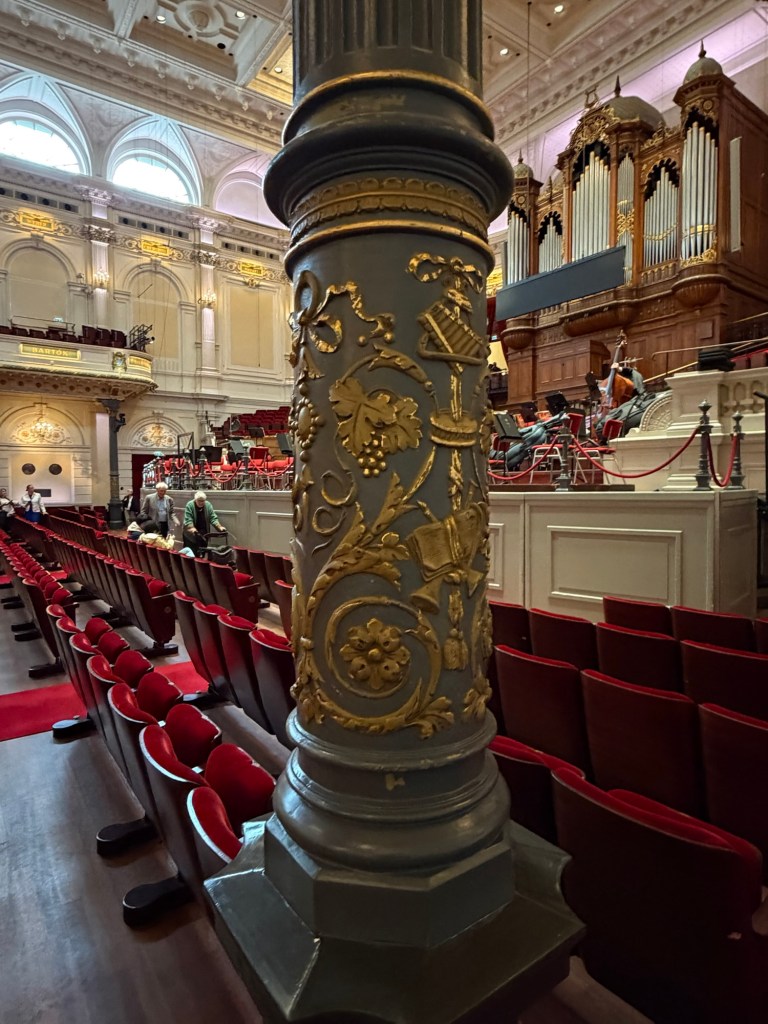
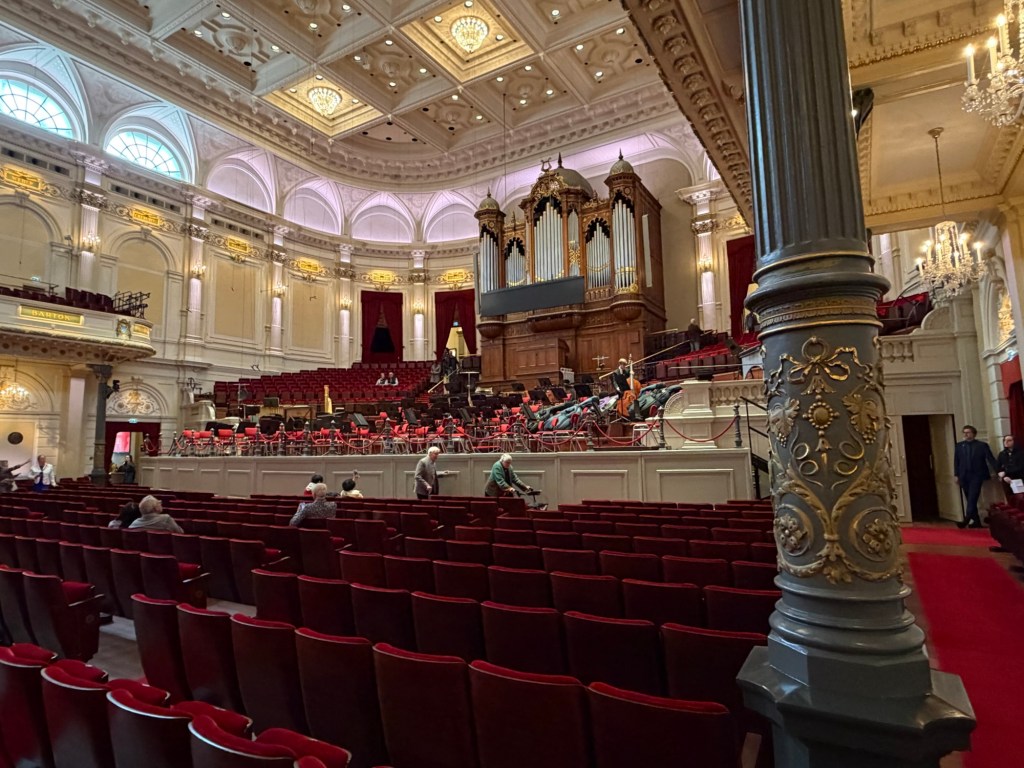
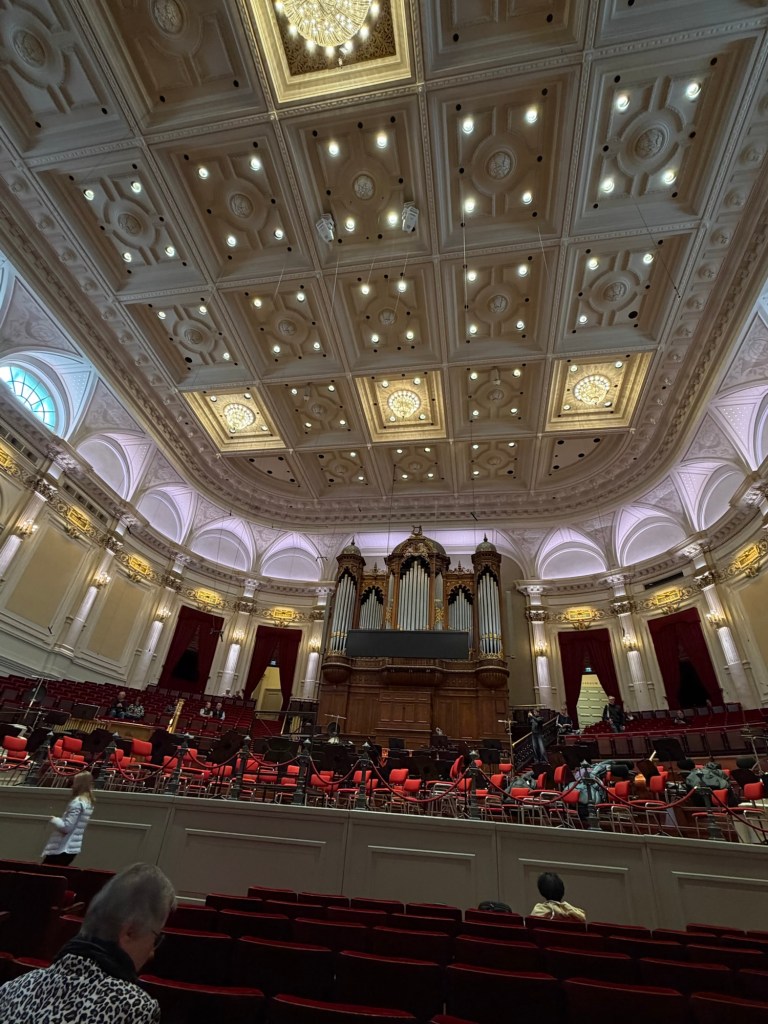
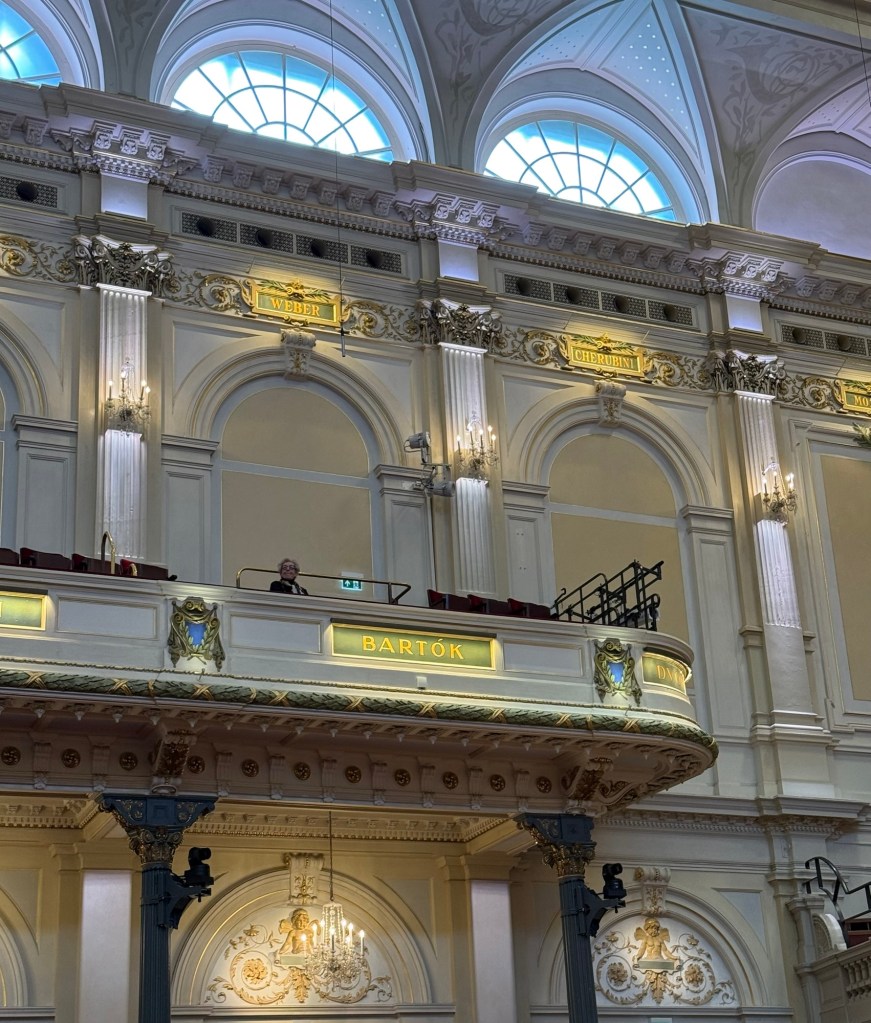
It is home to the Royal Concertgebouw Orchestra, an ensemble widely regarded as one of the greatest orchestras anywhere. The idea of hearing them there, in their own hall, adds a layer of anticipation that’s hard to describe.
Tickets were secured months in advance.
And now, the day is finally here and I am sitting in the hall at that exact moment just before the first note, when the hall is charged with the energy of expectation.
The orchestra was ready. From the rear staircase, the conductor descended—Andrés Orozco-Estrada, appearing here as a guest conductor—took the podium, and with the very first note, the hall proved its reputation for great acoustics.
I noticed a flash of red under his shoe and wondered—was it a pair of red-soled Christian Louboutin, or just the reflection of the hall’s deep red walls catching the light at the right angle? My interest was piqued because Yannick Nézet-Séguin, the conductor of the Philadelphia Orchestra, is known to wear those same red soled shoes. Either way, it lingered for a moment, a small, vivid detail in the half-light, before the room dimmed further and attention shifted to the stage.
But not every concert unfolds exactly as imagined. After an exciting overture, the rest of the first half of the program was a contemporary piece that was simply not to my liking. The cellos and walls seemed relieved when it ended, and my seatmates to the right agreed. Enough said.
After a complementary drink in a glass, I found my way back to my seat as the intermission ended, and I enjoyed a quick chat with the Dutch couple seated to my right. Travel makes conversation easy and novel.
Now I’m ready for the reason I chose this concert.
It’s Dvořák’s Ninth symphony in E minor, nicknamed the New World Symphony. Written during Dvořák‘s time in the United States in 1893, its a wonderful blend of his Czech heritage and his steep appreciation for American musical traditions. He didn’t copy American tunes note for note but instead he borrowed the flavor – the rhythms, the melodies, the feel. It’s a piece that is both deeply American, but all Dvořák.
After the lights are dimmed, I notice the gentlemen sitting next to me is no longer there, and that the seat is empty.
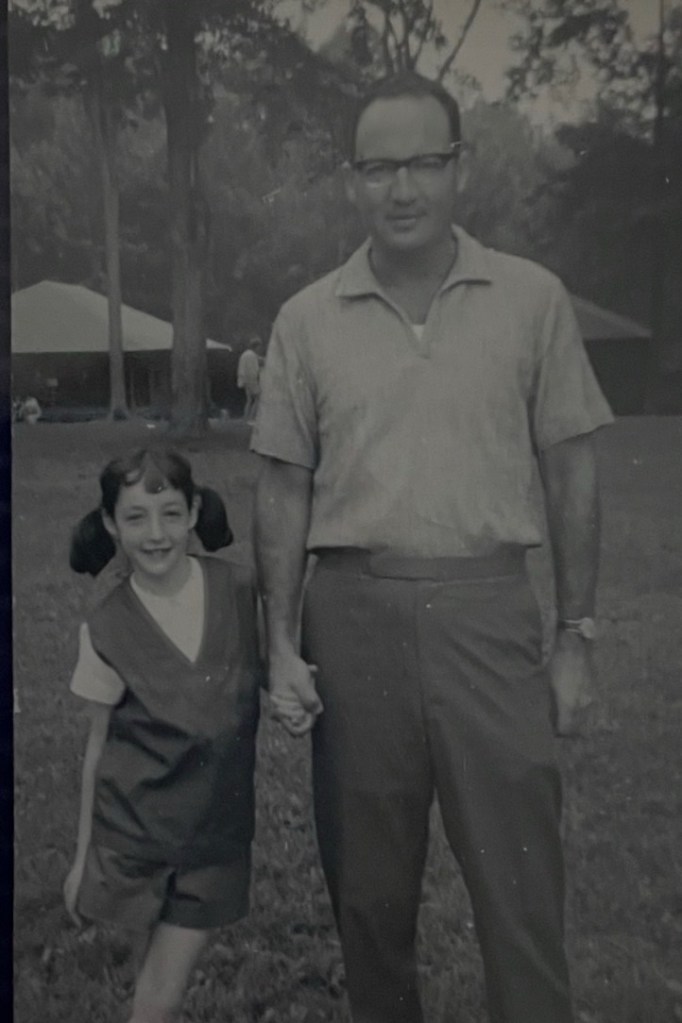
My mind drifts into the past because Dvořák’s Ninth symphony was one of my Dad’s favorite pieces of music. He was a lover of classical music starting in his college days.
My Dad was the doctor in town who took out almost every kid’s tonsils. Including mine.
Everyone knew him. And whenever we were out, at the store, on the street, anywhere really, someone would inevitably call out, “Hey, Doc… you took out my tonsils—how many years ago now?” It happened all the time. And without missing a beat, he’d smile and say, “I remember you.” Maybe he did. Maybe he didn’t. But it didn’t matter.
What mattered was the way he said it, with warmth, ease, and the quiet kindness that defined him.
And every one of those encounters ended the same way, with smiles all around. That was just the way Dad made people feel.
As a kid, I’d spend time with Dad in his office in the evening after he came home from work. I’d stand next to him as he’d pop a cassette into the player on his desk. That’s where it started. He’d walk me through the music, movement by movement, teaching me how to listen. Over time, it turned into a game—“name that tune”—but it was more than that. It was how I learned to hear.
And with that, the past settles into the present, and I’m ready to listen.
Dad died in 2018, but with the first note, it was as if he was sitting right next to me, enjoying the music, just like when I was a kid.
The Dvořák’s was a triumph—perhaps the best performance of this symphony I have ever heard.
The English horns especially, felt like they were telling a story in the Largo—something distant, maybe even a little nostalgic.
By the final movement, the French horns step forward with strength, but it never feels forced. The sound is just rich and powerful.
This great orchestra, this great hall, this conductor all came together to create something extraordinary, a moment I know I’ll never forget.
In fact, the conductor did something I don’t always like—he played with the tempo in places, stretching and shaping phrases—but here, it worked. It brought a deeper sense of feeling to the music, giving each melody room to breathe and speak.
By the end, the audience rose to its feet in a single motion. Applause filled the hall. And the cellos—those same cellos that had carried so much of the soul of the piece—were beaming with pride.
We all knew it.
We had shared something special.
Sadly, when the lights came on, Dad was not in the seat next to me. It was still empty.
But for those forty minutes, he had been there in the seat next to me.
Thank you, Dad, for sharing your love of music with me. It has enriched my life beyond anything I could have imagined, and brought me to this moment, where the New World girl meets the Old World.
Somehow it all feels like home in your office again, going through the music, movement by movement. I can hear the music. I can hear you.